
Your cart is empty Continue Shopping
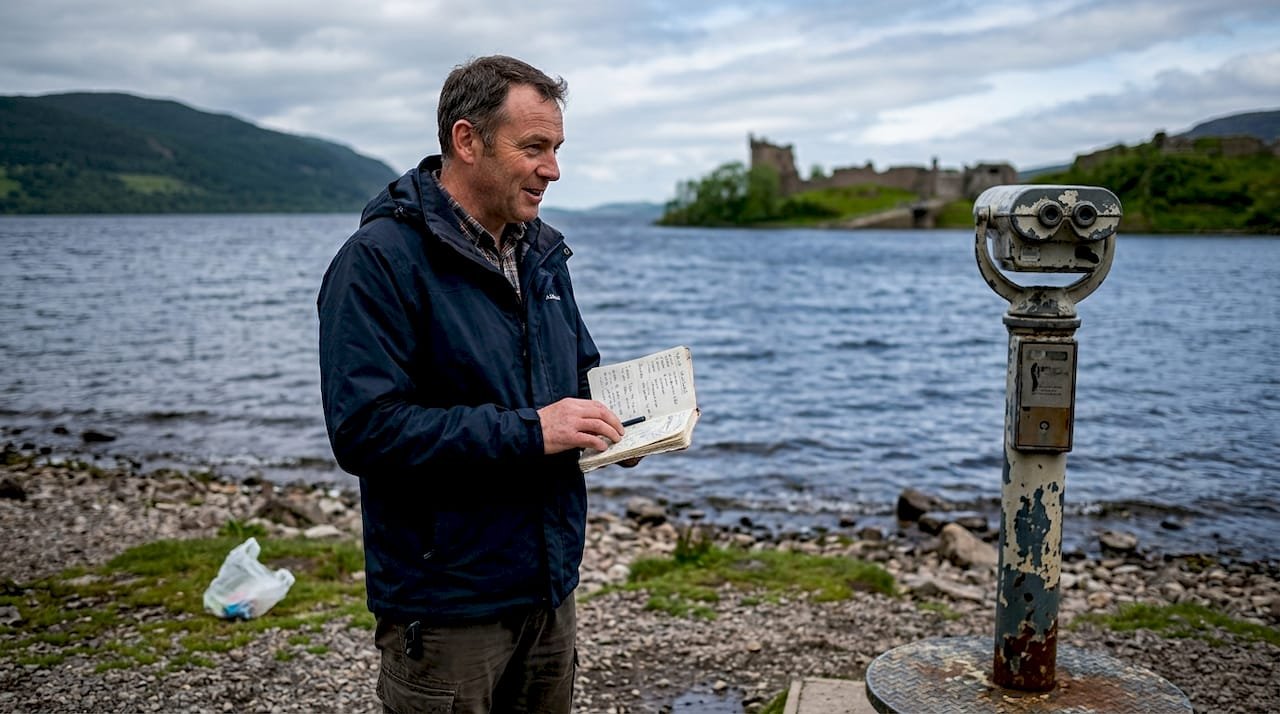
Discover Loch Ness: Myths, Heritage & Guided Tours
If you’ve searched for “Ness Lake” and landed here, you’re not alone. Thousands of travelers each year look up this name, only to discover that no such place officially exists in Scotland. The legendary waterway you’re thinking of is Loch Ness, one of the most iconic and visited destinations in the Scottish Highlands. From its jaw-dropping size to its monster myths and ancient castles, Loch Ness offers far more than a single famous story. This guide walks you through everything worth knowing, from the geography and folklore to the best experiences and how to customize your own Highland adventure.
Table of Contents
- Loch Ness: Size, depth, and setting the record straight
- Legend, monster, and mystery: The lore of Loch Ness
- Unmissable experiences around Loch Ness
- Customizing your Loch Ness and Highlands journey
- Our take: Why Loch Ness is more than a legend
- Plan your unforgettable Loch Ness adventure
- Frequently asked questions
Key Takeaways
| Point | Details |
|---|---|
| No ‘Ness Lake’ | The famous body of water is called Loch Ness, not Ness Lake, and is a must-see for visitors to Scotland. |
| Legends and science | Loch Ness offers a blend of myth and reality with a vibrant mix of folklore and scientific discovery. |
| Rich cultural sites | Travelers can enjoy castles, battlefields, museums, and cruises for a diverse Highland experience. |
| Custom tour options | Personalized tours help visitors tailor their journey to blend history, scenery, and special interests around Loch Ness. |
Loch Ness: Size, depth, and setting the record straight
Let’s clear something up right away. There is no “Ness Lake” in Scotland. The name comes from a translation confusion: “loch” is the Scottish Gaelic word for lake or sea inlet, so “Loch Ness” already means “the lake called Ness.” Calling it “Ness Lake” is a bit like saying “Lake Lake Ness.” The correct name is simply Loch Ness, and it sits in the Great Glen, a dramatic geological fault line that cuts diagonally across the Scottish Highlands from Inverness in the northeast to Fort William in the southwest.
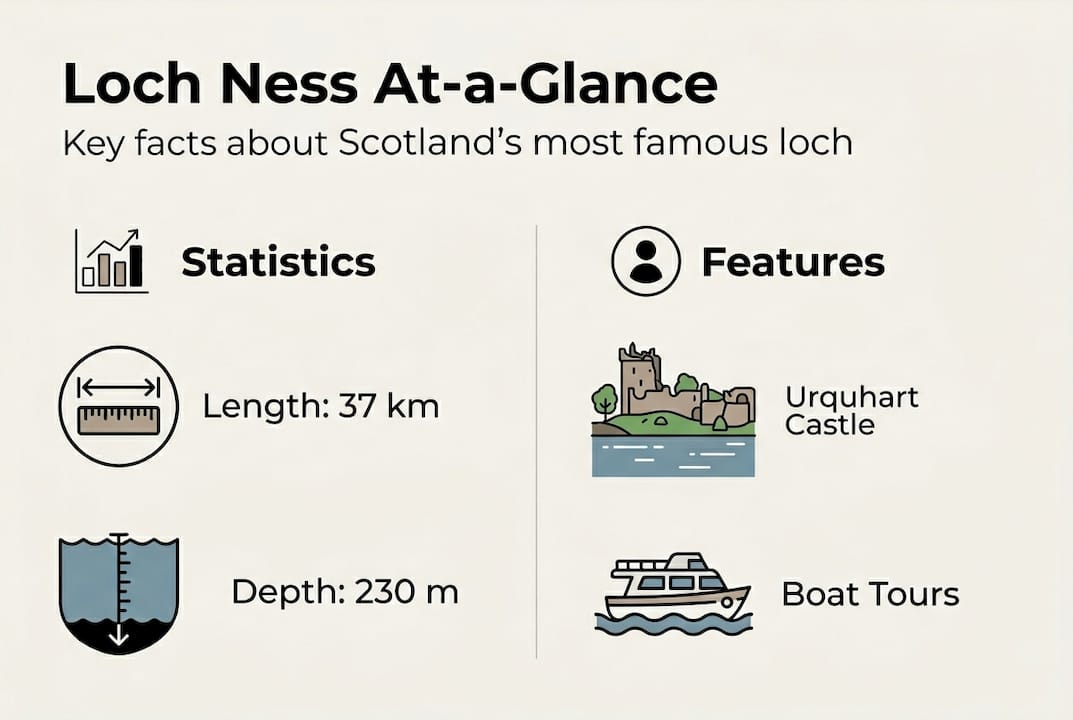
Now for the numbers that make this place truly remarkable. Loch Ness stretches 37 km long, plunges to a depth of 230 meters, covers a surface area of 56 km², and holds more freshwater by volume than all the lakes in England and Wales combined. It is the second largest Scottish loch by surface area but the largest by sheer volume in all of Great Britain. Those figures aren’t just trivia. They explain why the loch feels so vast and moody when you stand at its edge, and why centuries of sailors and explorers treated it with genuine respect.
| Statistic | Loch Ness |
|---|---|
| Length | 37 km |
| Maximum depth | 230 m |
| Surface area | 56 km² |
| Volume | Largest in Great Britain |
| Location | Great Glen, Scottish Highlands |
The loch is flanked by steep, forested hillsides that drop almost directly into the water. On overcast days, the surface turns a deep, almost black color due to high peat content in the water. This natural tannin effect means visibility underwater is extremely poor, which, as you’ll soon see, has played a significant role in keeping certain myths alive.
Here are a few key geographic facts worth knowing before you visit:
- Loch Ness runs roughly southwest to northeast along the Great Glen fault
- The city of Inverness sits at the northeastern end and is the main gateway
- The River Ness connects the loch to the Moray Firth and the North Sea
- The loch never freezes, even in the coldest Scottish winters, due to its enormous thermal mass
Pro Tip: Book your Loch Ness tours in advance during summer months. The stretch of road along the southern shore gets busy between June and August, and guided tours help you skip the parking headaches entirely.
Legend, monster, and mystery: The lore of Loch Ness
With the facts settled, it’s time to explore what truly sets Loch Ness apart, its legendary status in Scottish and global imagination.
The story of the Loch Ness Monster, affectionately known as “Nessie,” traces back to the sixth century, when Irish monk Saint Columba reportedly encountered a beast in the River Ness. But the modern myth exploded in 1933 when a local couple claimed to have seen a massive creature crossing the road near the loch. Newspapers ran the story, and within months, the world was captivated.
“The charm of Loch Ness lies not in whether the monster exists, but in the fact that millions of people still want it to.”
The most famous piece of supposed evidence, the 1934 “Surgeon’s Photo,” showed what appeared to be a long-necked creature rising from the water. It convinced many for decades. The image was eventually revealed as a hoax, constructed using a toy submarine fitted with a sculpted head. Yet the legend only seemed to grow stronger after the debunking.
Modern science has taken multiple serious runs at the mystery. Sonar sweeps, underwater cameras, and a major 2018 environmental DNA survey all came up empty. The DNA survey found no monster evidence, though researchers did note an unusually large presence of eel DNA, which some scientists believe could explain historical sightings of large, serpentine shapes in the water.
| Approach | Finding |
|---|---|
| 1934 Surgeon’s Photo | Confirmed hoax |
| Sonar investigations | No large unknown creature |
| 2018 DNA survey | No monster DNA; large eel presence |
| Eyewitness accounts | Unverified; likely misidentification |
Despite zero scientific proof, over 1 million visitors travel to Loch Ness every year, many specifically hoping to catch a glimpse of something unexplained. That’s the power of a well-told story.
Here’s a quick timeline of the legend’s biggest moments:
- 565 AD – Saint Columba’s reported encounter with a river beast
- 1933 – First modern newspaper sighting sparks global interest
- 1934 – The Surgeon’s Photo published and believed worldwide
- 1994 – Surgeon’s Photo revealed as a deliberate hoax
- 2018 – Environmental DNA study finds no evidence of large unknown species
For travelers who want to experience the legend in full, the Loch Ness Highland Tour covers the key sites connected to the monster myth alongside the region’s genuine natural beauty.
Unmissable experiences around Loch Ness
Legends aren’t the only draw. Loch Ness is surrounded by a rich tapestry of experiences. Here’s how to make the most of your visit.
The key attractions surrounding Loch Ness include Urquhart Castle, the Loch Ness Centre, boat cruises, Culloden Battlefield, and Clava Cairns, each offering a completely different lens on Highland history and culture.
Urquhart Castle is perhaps the most photographed spot on the loch. Perched on a rocky promontory with the water stretching behind it, this medieval ruin dates back to the thirteenth century and served as a key strategic stronghold during Scotland’s Wars of Independence. Walking through its towers gives you both a history lesson and one of the finest views in the Highlands.
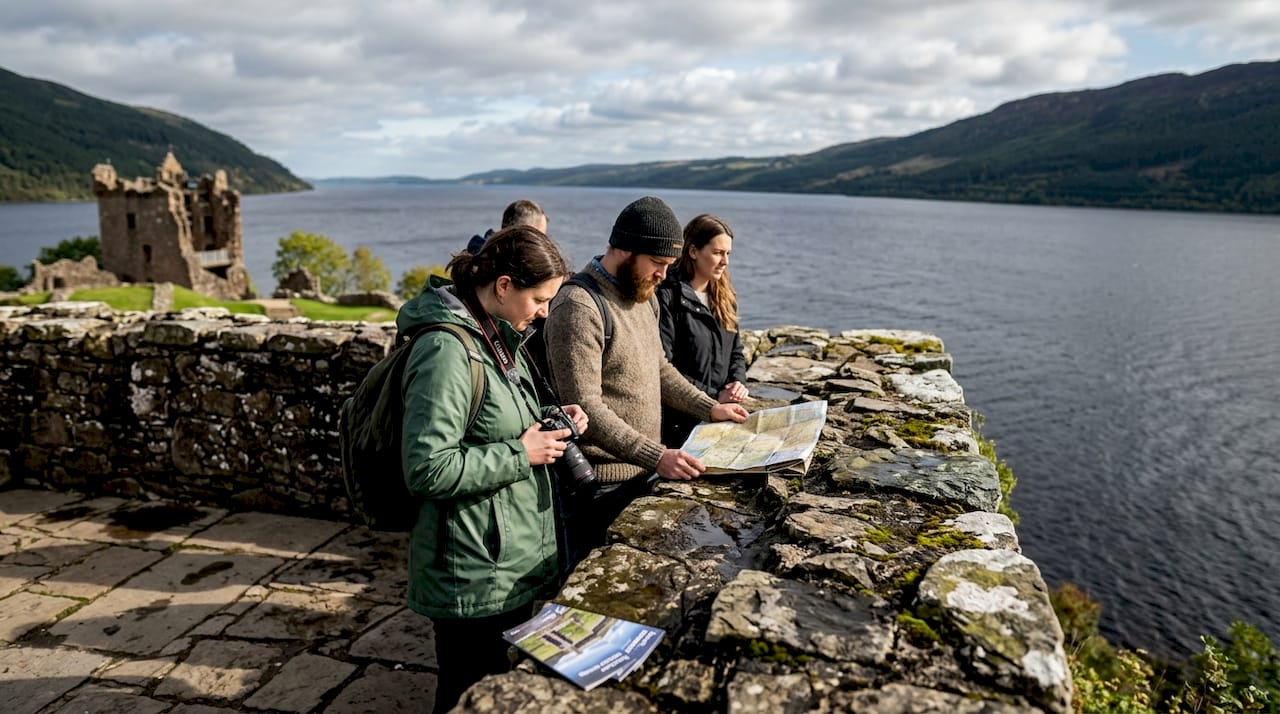
Boat cruises are another must. Getting out onto the water shifts your perspective entirely. You see the sheer scale of the loch from the middle, the forested hills rising on both sides, and the dark, glassy surface that makes Nessie stories feel almost plausible.
The Loch Ness Centre in Drumnadrochit is a great stop for those who want the full story, from geology and ecology to the monster myth and the science behind it. It’s interactive, well-designed, and genuinely educational for all ages.
Beyond the loch itself, the surrounding area holds some of Scotland’s most emotionally powerful heritage sites:
- Culloden Battlefield: The site of the 1746 battle that ended the Jacobite uprising and reshaped Scottish history
- Clava Cairns: A hauntingly beautiful Bronze Age burial site just outside Inverness, over 4,000 years old
- Inverness: The Highland capital, with its own castle, cathedral, and vibrant local food scene
Pro Tip: The Half Day Loch Ness Circular Tour is ideal if your time is limited. It covers the loch’s most scenic stretches efficiently, while the Culloden Moor and Clava Cairns tour pairs perfectly as an afternoon add-on for history lovers.
Customizing your Loch Ness and Highlands journey
To transform inspiration into reality, consider these options for crafting a personalized Loch Ness and Highlands adventure.
Loch Ness tours and Highland explorations come in many formats, and the right choice depends entirely on what you want to get out of your trip. Private guided tours offer the most flexibility. You set the pace, choose the stops, and your guide tailors the commentary to your interests, whether that’s geology, clan history, whisky, or wildlife.
Small group tours offer a social experience with the benefit of expert local knowledge at a more accessible price point. Theme-based tours, like whisky distillery routes or photography-focused excursions, let you go deep on a specific passion.
Here’s how to think through your options:
- Define your priorities: History, scenery, food, adventure, or a mix? Knowing this upfront helps you pick the right format.
- Consider your pace: Some travelers want to linger at every castle ruin. Others prefer covering more ground. Private tours accommodate both.
- Think about your group: Families with young children, couples, and solo travelers all have different needs. A good tour operator will ask about this before building your itinerary.
- Choose your season wisely: Summer brings long daylight hours and lush greenery. Autumn offers dramatic colors and fewer crowds. Winter is raw and atmospheric, perfect for those who want the Highlands without the tour buses.
- Respect local etiquette: Stay on marked paths near heritage sites, keep noise low around wildlife areas, and always ask before photographing local residents or private property.
Explore the full range of Scottish Highlands tours to find a format that fits your travel style, or browse custom Highland tour experiences if you want something built specifically around your group’s interests.
Our take: Why Loch Ness is more than a legend
Most travel content about Loch Ness leads with Nessie and ends there. We think that’s a missed opportunity, and honestly, a disservice to the place.
The monster story is entertaining. But what actually stays with people after they visit is something harder to put into words. It’s the quality of the silence on the water at dawn. It’s hearing a local guide explain how their grandmother’s family was cleared from the glens during the Highland Clearances. It’s standing at Culloden and realizing that the ground beneath your feet still carries weight.
Loch Ness earns its reputation not because of a creature that probably doesn’t exist, but because the landscape itself has a presence. The dark water, the ancient hills, the ruins that keep reappearing around every bend. These things are real, and they’re extraordinary.
We believe the travelers who get the most out of a visit are the ones who come curious about everything, not just the monster. Balancing skepticism with wonder, and pairing the famous myth with the genuine Loch Ness destination insights, is what turns a good trip into a story you’ll tell for years.
Plan your unforgettable Loch Ness adventure
Ready to see Loch Ness for yourself? Whether you’re drawn by the legend, the landscapes, or the rich Highland heritage, the experience is best when it’s built around you.
At Skye Highlands Tours, we specialize in private and small group tours that put your interests first. Browse our Loch Ness guided tours for ready-to-book itineraries, or explore the full range of Scottish Highlands experiences to plan a broader Highland adventure. If you want something fully tailored, our Highland tour packages let you mix and match destinations, themes, and pace to create exactly the trip you’ve been imagining.
Frequently asked questions
Is there a Ness Lake in Scotland?
No, “Ness Lake” is a common misnomer. The correct name is Loch Ness, a famous freshwater loch located in the Scottish Highlands near Inverness.
What are the top attractions near Loch Ness?
Popular sites include Urquhart Castle, Culloden Battlefield, the Loch Ness Centre, Clava Cairns, and scenic boat cruises on the loch itself.
Is it possible to tour Loch Ness and the Highlands in one day?
Yes, guided and custom tours can help you experience Loch Ness alongside several Highland highlights within a single well-planned day.
Has the Loch Ness Monster ever been proven real?
Despite decades of sightings and famous hoaxes, scientific surveys found no concrete evidence of the Loch Ness Monster, though the legend continues to draw over a million visitors annually.
4 Comments