
Your cart is empty Continue Shopping

Discover the Glenfinnan Viaduct: History, Views, and Tips
Most people first hear about the Glenfinnan Viaduct because of a certain boy wizard on a scarlet steam train. That’s fair. But reducing this iconic Scottish structure to a movie backdrop would be like calling the Golden Gate Bridge famous only because it appeared in a superhero film. The Glenfinnan Viaduct earned its place in Scottish history long before cameras rolled in the Highlands, and it continues to reward visitors who come looking for more than just a photo opportunity. This article walks you through everything you need to know, from its origins and engineering to the best viewpoints, practical travel tips, and the hidden layers of history waiting in the surrounding valley.
Table of Contents
- What is the Glenfinnan Viaduct?
- Why is the Glenfinnan Viaduct famous?
- Best ways to experience the Glenfinnan Viaduct
- Beyond the Viaduct: Glenfinnan’s rich history and surroundings
- The Glenfinnan Viaduct: What most visitors overlook
- Plan your perfect Glenfinnan and Highlands adventure
- Frequently asked questions
Key Takeaways
| Point | Details |
|---|---|
| Historic engineering marvel | The Glenfinnan Viaduct is a 21-arch railway bridge built in the West Highlands, renowned for its design and history. |
| Scenic and cultural hotspot | Beyond its Harry Potter fame, the Viaduct anchors a region rich in Highland history, wildlife, and visitor experiences. |
| Best visiting practices | Top viewpoints require a short walk, and timing a visit with the Jacobite steam train enhances the experience. |
| Expand your itinerary | Combine your visit with local monuments, museum stops, and outdoor activities for a fuller experience. |
What is the Glenfinnan Viaduct?
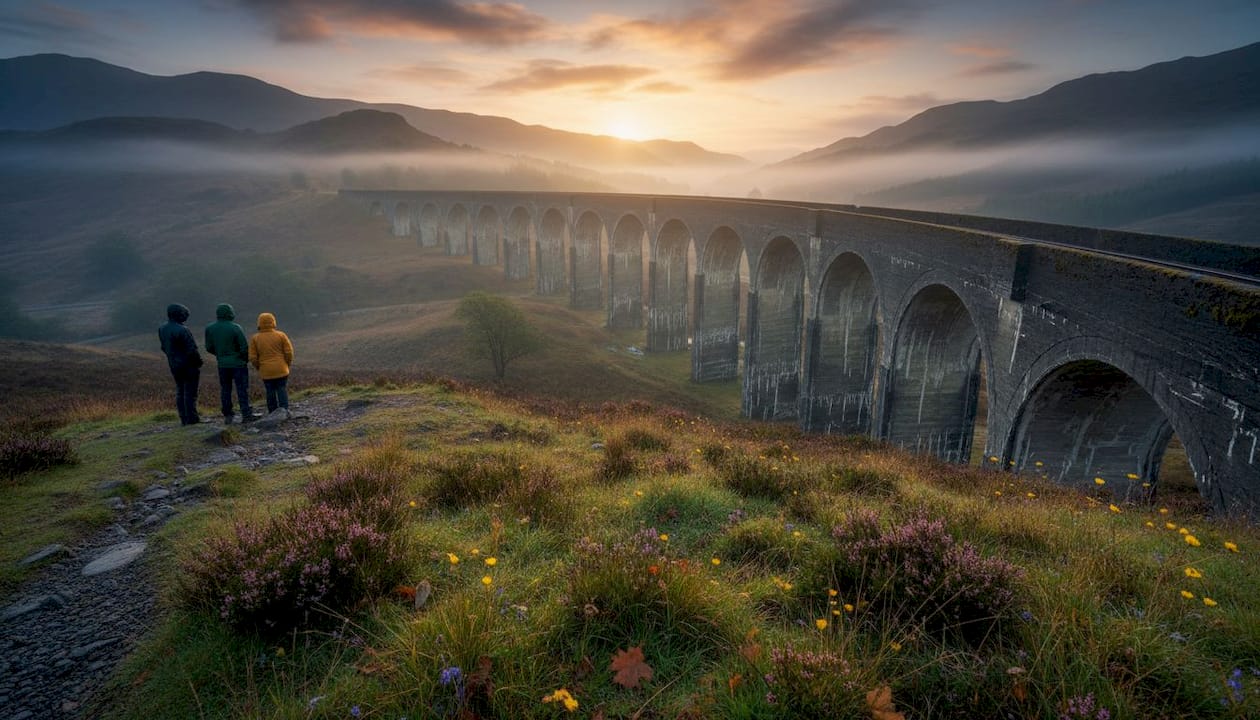
The Glenfinnan Viaduct is a curved, 21-arch railway bridge that spans a wooded valley at the head of Loch Shiel in the Scottish West Highlands. Built between 1897 and 1901 as part of the West Highland Line extension to Mallaig, it was one of the first major structures in Britain built using mass concrete rather than stone or brick. That decision alone set it apart from nearly every other bridge of its era.
The Viaduct’s engineering and historical significance are difficult to overstate. Designed by railway engineer Robert McAlpine, the structure is 416 meters (about 1,365 feet) long and rises up to 30 meters (approximately 100 feet) above the valley floor. The curved alignment gives it that sweeping, cinematic appearance that photographers and filmmakers have chased for over a century. At the time of construction, using mass concrete on this scale was considered a bold and risky experiment.
Here are a few key structural facts worth knowing before your visit:
- 21 spans, each arch carrying the railway tracks roughly 100 feet above the valley floor
- 100% mass concrete construction, groundbreaking for 1901 and still standing strong today
- 416 meters total length, making it one of Scotland’s longest railway viaducts
- Listed as a Category A structure in Scotland, the highest possible designation for historic buildings and structures
- Still an active railway line, meaning real trains cross it daily
| Feature | Detail |
|---|---|
| Year completed | 1901 |
| Construction material | Mass concrete |
| Number of arches | 21 |
| Total length | 416 meters (approx. 1,365 feet) |
| Maximum height | 30 meters (approx. 100 feet) |
| Listed status | Category A (Historic Scotland) |
| Active line | West Highland Line (Fort William to Mallaig) |

For a closer look at the site before you go, our guide to Glenfinnan Viaduct covers viewpoints, local history, and helpful planning notes. The Viaduct is far more than an old bridge. It represents a turning point in civil engineering and stands as a physical record of Scotland’s industrial ambition in the early 20th century.
Why is the Glenfinnan Viaduct famous?
Now that you know what the Glenfinnan Viaduct is, let’s explore why it draws so many visitors from around the world. Its fame operates on two distinct levels, and understanding both helps you appreciate the experience much more deeply.
The first level is pop culture. The Viaduct appeared in the Harry Potter film series, most memorably in Harry Potter and the Chamber of Secrets (2002), when the Hogwarts Express crosses it dramatically through the mist. That single scene introduced the structure to hundreds of millions of viewers worldwide. Today, many visitors arrive specifically hoping to recreate that image, timing their visit to catch the Jacobite Steam Train as it passes over the arches. The Harry Potter filming locations guide on our site maps out the other Scottish spots connected to the films, which can help you build a fuller itinerary around this theme.
But the second level of fame runs much deeper. The Viaduct’s reputation as a landmark of Scottish engineering and Highland travel existed long before any film studio arrived. Victorian and Edwardian photographers were already capturing its graceful curve in the early 1900s. Rail enthusiasts from across Europe traveled specifically to ride the West Highland Line and view the structure. Landscape painters featured it in their work. The Jacobite Steam Train, while now partly marketed toward Potter fans, was actually introduced as a scenic heritage railway experience celebrating the beauty of the Fort William to Mallaig route.
“The Glenfinnan Viaduct is one of those rare places where man-made engineering and natural Highland drama combine perfectly. Whatever brought you there, the valley has a way of slowing you down.”
Here’s a useful comparison to frame the two sides of the Viaduct’s fame:
| Dimension | Pop culture fame | Historical fame |
|---|---|---|
| Origin | Harry Potter films (2001 onward) | West Highland Line construction (1901) |
| Primary audience | Film tourists and Potter fans | Rail enthusiasts, historians, photographers |
| Key attraction | Jacobite train crossing | Engineering legacy, Category A listed status |
| Time-sensitive? | Yes, train schedule dependent | No, viewable any time of year |
| Depth of experience | Visual, shareable, immediate | Contextual, layered, longer-lasting |
Pro Tip: If you want the classic “Hogwarts Express” shot without battling a crowd 50 deep, position yourself at the hillside viewpoint at least 40 minutes before the scheduled train crossing. Locals know to arrive early. Most tourists don’t.
Both versions of the Viaduct’s fame are legitimate and worth celebrating. The Potter connection brought global attention to a part of Scotland that many international visitors would never have discovered otherwise. But once people arrive, the real landscape, the actual history, and the sheer scale of the structure tend to do the rest.
Best ways to experience the Glenfinnan Viaduct
Understanding the Viaduct’s fame, you might be wondering how best to see it in person. Here’s how to plan an unforgettable visit.
Timing your visit around the Jacobite Steam Train
The Jacobite runs seasonally, typically from May through October, and crosses the Viaduct twice daily on its round trip between Fort William and Mallaig. The westbound crossing typically occurs around 10:45 am, and the return eastbound crossing happens in the early afternoon. These are the moments most photographers aim for. Arriving outside peak summer months (June, July, August) gives you notably smaller crowds and often better light conditions.
Choosing the right viewpoint
The best viewpoints are located about 10 to 15 minutes’ walk from the main visitor center car park. There are two primary options:
- The hillside viewpoint above the car park. This elevated position offers the classic angled view of the curved viaduct with the valley stretching behind it. Most of the iconic photographs come from this spot. The path is steep and uneven in places, so wear appropriate footwear.
- The valley floor perspective. Walking down toward the railway line (without trespassing on the tracks, of course) gives you an entirely different sense of the structure’s scale and height. From below, those 30-meter arches become genuinely imposing.
- From the Jacobite Steam Train itself. If you want to experience the crossing rather than photograph it from outside, riding the train over the Viaduct is a thrilling option. Book well in advance for summer dates.
- From Loch Shiel. Taking a cruise on Loch Shiel provides a completely different angle on the broader Glenfinnan landscape, with the Viaduct visible in the distance framed against the surrounding hills.
Practical visit details
- Parking at the National Trust for Scotland visitor center car park. A small fee applies.
- Entry to the grounds is free. The visitor center has a small exhibition and cafe.
- The Glenfinnan area is accessible by ScotRail train directly to Glenfinnan station.
- Walking time from the station to main viewpoints is approximately 10 to 15 minutes.
- No specialist gear needed, but waterproofs and sturdy shoes are strongly recommended year-round.
Pro Tip: The Viaduct looks spectacular in low mist, which rolls in from the loch on cool mornings. Many visitors consider a slightly overcast Highland day to produce more atmospheric images than bright sunshine.
The Viaduct and Mallaig tour we offer pairs the Viaduct with the picturesque fishing village of Mallaig, giving you a full West Highland experience in a single day. If you’re building a broader Highland itinerary, our range of Scottish Highland tours can help you connect Glenfinnan with other iconic destinations across the region.
A telling statistic: the West Highland Line, which includes the Viaduct crossing, has been voted one of the greatest rail journeys in the world multiple times, by publications including Wanderlust and Conde Nast Traveler. That’s not simply because of the Harry Potter association. The entire 84-mile route from Glasgow to Mallaig passes through some of the most dramatic scenery in Europe.
Beyond the Viaduct: Glenfinnan’s rich history and surroundings
A visit to Glenfinnan offers more than just the Viaduct. The area’s history runs centuries deep, and its natural landscape holds its own against any Highland destination in Scotland.
The Glenfinnan Monument and the 1745 Jacobite Rising
Standing at the head of Loch Shiel is the Glenfinnan Monument, an 18-meter tower topped with a kilted Highlander. This is where Bonnie Prince Charlie raised his standard on August 19, 1745, marking the start of the Jacobite Rising that would end in defeat at the Battle of Culloden the following year. The monument commemorates the rising and the Highland clans who fought and died for the Jacobite cause. Standing there with the loch stretching out behind you, the weight of that history feels immediate and real. The National Trust for Scotland manages the site, and a small visitor center provides context on the campaign.
Wildlife and walking in the Glenfinnan valley
The surrounding hills and lochside offer some of the finest wildlife spotting in the Highlands. Visitors regularly encounter:
- Red deer grazing on hillsides, particularly in the early morning and evening
- Golden eagles and ospreys riding thermals above the valley
- Red squirrels in the woodland areas near the loch
- Otters along the loch shoreline, especially in quieter months
Several walking trails fan out from the village, ranging from short lochside strolls to more demanding hill routes. None require technical climbing skills, but some gain elevation quickly, rewarding those who push higher with panoramic views across multiple glens.
Loch Shiel cruises
Loch Shiel itself is one of Scotland’s most beautiful and least commercialized lochs. Boat cruises run seasonally and allow you to see the full sweep of the valley from the water. Some cruises travel as far as Acharacle at the southern end of the loch, passing through landscape that feels genuinely untouched.
“Loch Shiel doesn’t have the Loch Ness name recognition, but those who cruise it tend to agree it’s one of Scotland’s most beautiful bodies of water.”
If you’re bringing family along, our guide to planning a Highlands family trip addresses how to balance active sightseeing with accessible experiences for all ages, including younger children and grandparents.
The Glenfinnan Viaduct: What most visitors overlook
Having covered practical guidance and area highlights, here’s an insider’s take on what a Glenfinnan visit can actually become if you let it.
Most people who visit the Viaduct do the same thing. They park, walk up to the viewpoint, wait for the train, take the photo, and leave. The whole experience clocks in at under an hour. There’s nothing wrong with that. But it means they miss the better half of what Glenfinnan offers.
The Viaduct looks incredible in a photograph. But standing beneath it, listening to the valley’s silence, watching mist drift across the loch, and then reading even a brief account of what happened here in 1745 transforms the experience entirely. This is a place where two defining chapters of Scottish history intersect: the industrial ambition of the early 20th century and the desperate, romantic tragedy of the Jacobite cause. Very few spots in Scotland carry both of those layers simultaneously.
We’ve guided hundreds of visitors through Glenfinnan over the years, and the ones who leave most moved are almost never the ones who came purely for the Potter photo. They’re the visitors who asked a question about the Monument, wandered off the main path, or struck up a conversation with a local at the visitor center cafe. The place rewards curiosity in a way that a hurried visit simply can’t access.
The visitor insights on our Glenfinnan destination page go deeper into the less-visited corners of the valley, the trails most tourists skip, and the local knowledge that tends to make the difference between a good day out and a genuinely memorable one.
Our honest advice? Budget at least half a day for Glenfinnan. Bring a thermos. And before you leave, walk down to the Monument and spend five minutes actually reading the inscription. You’ll be glad you did.
Plan your perfect Glenfinnan and Highlands adventure
With new insight and inspiration, here’s how to take your Glenfinnan journey to the next level.
Experiencing the Viaduct with a knowledgeable local guide changes what you notice and what you take away. Instead of guessing which viewpoint works best or missing the train crossing by ten minutes, you arrive knowing exactly where to stand and when.

At Skye Highlands Tours, our private guided experiences are built around your interests, pace, and group size. Whether you want to focus on the Viaduct and Mallaig coast or combine Glenfinnan with Loch Ness, the Isle of Skye, or the Black Isle, we create itineraries that connect the dots in a way that self-guided visits rarely manage. Explore our full range of Highland Viaduct tours or browse all Scottish Highland tours to find the right fit for your trip. Every experience is private, flexible, and led by guides who genuinely love this landscape.
Frequently asked questions
What is the best time to see the Glenfinnan Viaduct and Jacobite steam train?
The best time to see both is mid-morning, especially around 10:45 am when the Jacobite train passes westbound, and visiting in spring or fall helps you avoid peak summer crowds while still catching the seasonal train service.
How do I reach the Glenfinnan Viaduct by public transport?
You can reach the Viaduct by ScotRail train to Glenfinnan station, then walk 10 to 15 minutes to the main viewpoints and the National Trust visitor center.
Is the Glenfinnan Viaduct accessible for people with mobility challenges?
The main visitor center is accessible, but the best viewpoints require moderate walking on uneven, uphill paths that can be genuinely difficult for those with limited mobility. The valley floor view is a flatter, easier alternative.
What else can I do near the Glenfinnan Viaduct?
Nearby activities include visiting the Glenfinnan Monument, walking scenic lochside trails, wildlife spotting for red deer and golden eagles, and taking a cruise along Loch Shiel to the southern end of the valley.
2 Comments