


Your cart is empty Continue Shopping
How to plan a personalized Scottish Highlands itinerary
Many travelers rush through the Highlands in just a few days, snapping photos at famous spots and moving on before the landscape even has a chance to sink in. The Scottish Highlands deserves better than that, and so do you. True Highland itinerary planning means designing a journey around your pace, your passions, and the stories that only a place like this can tell. Whether you are chasing ancient castles, misty lochs, or a warming dram of single malt whisky, the right plan turns a checklist trip into something you will still be talking about years from now.
Table of Contents
- What is Highland itinerary planning?
- Benefits of customized itinerary planning in the Scottish Highlands
- Guided tours vs. independent itinerary planning: A comparison
- Essential steps for crafting your personalized Highland itinerary
- Why most Highlands itineraries miss the real magic (and how you can avoid it)
- Plan your unforgettable Highland tour with local experts
- Frequently asked questions
Key Takeaways
| Point | Details |
|---|---|
| Quality beats quantity | Fewer stops with more time in each location create richer Highland experiences. |
| Custom planning pays off | Personalized itineraries offer cultural depth, flexibility, and unforgettable moments. |
| Best time to travel | May and June provide ideal weather and daylight for exploring the Highlands. |
| Choose your style | Guided tours bring expert insight; independent travel offers freedom but needs more prep. |
What is Highland itinerary planning?
Now that you know why a rushed tour can fall short, let’s break down exactly what Highland itinerary planning is and what makes it so special.
Highland itinerary planning is the deliberate process of designing a travel route through the Scottish Highlands that matches your personal interests, travel pace, and group needs. It goes well beyond picking a few famous stops on a map. It means thinking deeply about how long you stay in each location, which cultural experiences matter most to you, and how to balance big scenic landmarks with quieter, more intimate moments in places most tourists never find.
What separates a crafted Highland itinerary from a generic package tour is intentionality. A typical off-the-shelf tour might shuttle you from Loch Ness to the Isle of Skye and back in 48 hours. A well-planned itinerary gives you time to hike a sea cliff at golden hour, sit with a local guide over a cup of tea, and learn why a particular glen holds centuries of complicated history. The difference is profound.
Optimal itineraries last 5 to 7 days and focus on fewer bases to allow for genuine immersion rather than surface-level sightseeing. This is not just a travel preference. It is the difference between remembering your trip as a blur of car windows and remembering it as a collection of vivid, meaningful experiences.
Strong Highland itinerary planning rests on a few key ingredients:
- Custom routing: Choosing roads and regions that suit your interests, not just the most trafficked tourist paths
- Pacing: Allowing enough time in each location to actually feel present rather than perpetually transit-fatigued
- Cultural touchpoints: Building in visits to local communities, historic sites, and experiences like traditional Highland games or distillery tours
- Scenic variety: Mixing coastal views, inland glens, island landscapes, and mountain passes for a full picture of what the Highlands offers
- Flexibility: Leaving breathing room in your schedule for spontaneous detours, weather changes, or simply sitting still to absorb the view
If you are still figuring out the nuts and bolts of planning a Highlands trip, starting with these fundamentals gives you a solid foundation to build on.
Benefits of customized itinerary planning in the Scottish Highlands
With a solid definition in place, let’s explore why careful planning, as opposed to generic booking, can transform your Highland adventure.
The single biggest benefit of a customized itinerary is relevance. A trip built around what you love will always outperform a trip designed to satisfy the broadest possible audience. If you are fascinated by Jacobite history, your guide can take you to Culloden Battlefield and connect its story to the surrounding landscape in ways no audio guide ever could. If your family has young children, a custom plan accounts for shorter attention spans, accessible trails, and built-in stops that keep everyone energized.
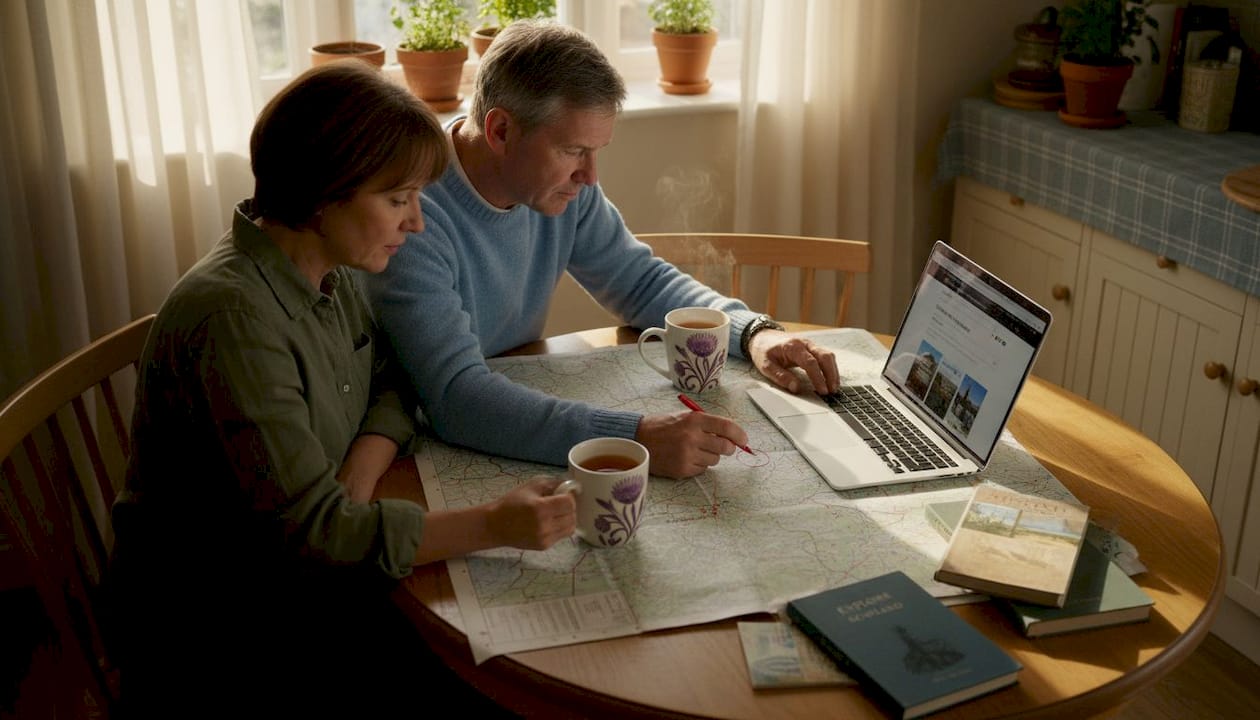
Private guides offer local stories and history that add a unique layer of value no map or travel blog can replicate. A local expert knows which viewpoint has the best light at 7 p.m., which distillery offers an experience worth the detour, and which back roads take you through the kind of landscape that makes your heart stop. That knowledge is not available on any app.
Customized planning also lets you focus on specific interests without compromise. Some travelers want a whisky-focused tour hitting three or four distilleries across Speyside and the Highlands. Others want a wildlife-centered trip built around red deer, golden eagles, and sea otters. Both are valid, and both are far better served by a tailored plan than by a standard tour bus schedule.
The benefits stack up quickly:
- Authentic local insight: Guides share stories that do not appear in guidebooks
- Interest-aligned experiences: Whether it is castles, whisky, geology, or Gaelic culture, you choose the focus
- Better pacing: Fewer places visited more deeply means less exhaustion and more genuine memory-making
- Special occasion support: Birthdays, anniversaries, and family reunions are all enhanced by personalized touches
Timing matters too. May and June sit at the sweet spot for Highland travel, offering long daylight hours, relatively mild weather, and landscapes draped in spring color before the peak summer crowds arrive. Planning your trip around these months adds another layer of quality to the experience.
Pro Tip: If you are booking private guided tours in the Highlands, ask your guide specifically what makes their home region unique. The answer will almost always lead you to a hidden experience you would never have found on your own.
Guided tours vs. independent itinerary planning: A comparison
After highlighting these advantages, it is important to understand your options. Should you plan your own journey, or trust a professional guide?
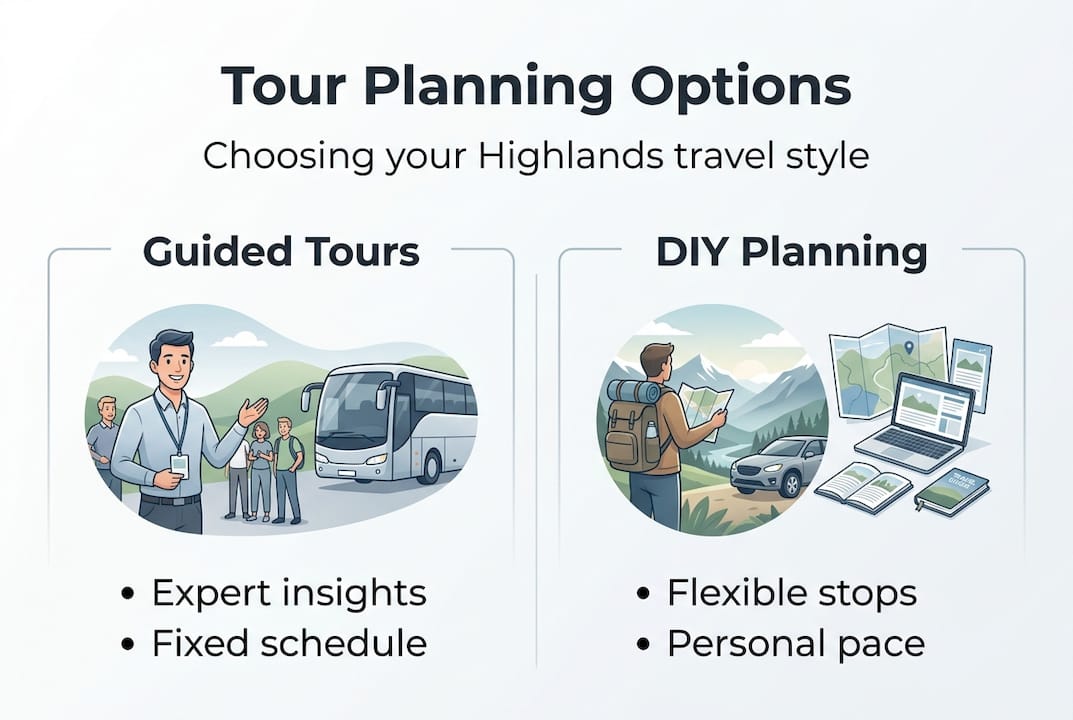
Both approaches have genuine merit, and the right choice depends entirely on your personality, travel experience, and what you value most. Self-drive tours require offline maps and car rental, while guided options simplify logistics considerably, letting you focus on the scenery rather than the navigation.
Here is a straightforward comparison to help you decide:
| Factor | Guided tours | Independent planning |
|---|---|---|
| Local knowledge | Deep and immediate | Requires extensive research |
| Logistics | Handled for you | Your full responsibility |
| Flexibility | Structured, but often customizable | Fully flexible |
| Cost | Higher upfront, lower stress | Lower base cost, more variables |
| Best for | First-timers, special occasions, groups | Experienced independent travelers |
| Hidden gem access | Guides know the spots | Hit or miss |
Independent planning works beautifully for experienced travelers who enjoy the research process, do not mind navigating single-track Highland roads, and are comfortable adapting when a road is closed or a ferry is delayed. It is a legitimate and rewarding way to travel.
That said, most first-time Highlands visitors underestimate how logistically complex the region can be. Mobile signal drops out in remote glens. Weather can change a planned route in under an hour. Ferry schedules to the islands run on their own timetable.
Common mistakes independent travelers make include:
- Overloading the itinerary: Trying to reach too many destinations in too few days
- Underestimating driving times: Highland roads are scenic but slow, and single-track stretches with passing places require patience
- Skipping offline preparation: Relying on live GPS in areas with no cell coverage is a recipe for getting lost
- Missing local context: Arriving at a historic site without background knowledge is a missed opportunity
Pro Tip: If you opt for independent travel, guided Highland tours do not have to be all-or-nothing. Booking a guide for one or two key days gives you expert insight on the most complex or significant parts of your trip while keeping the rest of your schedule flexible. You can also explore custom tour experiences that blend structured guidance with personal freedom.
Essential steps for crafting your personalized Highland itinerary
Whichever approach you choose, here is how to put it all together for a seamless and rewarding Highlands experience.
Building a strong Highland itinerary is not complicated once you break it into clear stages. Follow these steps and you will avoid the most common planning pitfalls:
- Set your goals: Before you open a map, write down what you most want from this trip. Scenery, culture, food, history, wildlife? Your goals shape every decision that follows.
- Choose your bases: Rather than moving accommodations every night, select two or three strategic bases from which to explore surrounding areas. This reduces packing stress and gives you a genuine sense of place.
- Map your route logically: Connect your bases in a way that minimizes unnecessary backtracking. A clockwise loop through the Highlands is a classic structure that works well for most trip lengths.
- Book guides and drivers early: Quality local guides fill their calendars quickly, especially in peak season. Securing your guide before your accommodation gives you the best selection.
- Weave in cultural highlights: Plan at least one distillery visit, one historic site, and one experience that connects you to living Highland culture, whether that is a traditional music session or a visit to a working croft.
- Download offline maps: Before you leave your hotel each morning, ensure your navigation works without a signal. Apps like maps.me or downloaded Google Maps regions are essential on remote routes.
Most immersive trips prioritize fewer bases and allow time to explore each region properly, and May and June consistently offer the best combination of weather and natural light for photography and outdoor activities.
Use this quick reference table to match your available time to a realistic Highland experience:
| Trip length | Suggested focus | Recommended bases |
|---|---|---|
| 3 days | Isle of Skye highlights | Portree |
| 5 days | Skye + Loch Ness region | Portree, Inverness |
| 7 days | Full Highland loop | Portree, Fort William, Inverness |
| 10+ days | Extended Highlands and islands | Multiple regional bases |
The step-by-step Scottish Highlands planning process becomes much more intuitive once you commit to this framework. You will find that each decision flows naturally from the one before it.
Pro Tip: Always build one fully unscheduled afternoon into your itinerary. The Highlands has a way of presenting unexpected gifts, a sudden rainbow over a sea loch, a red deer appearing at a roadside, a friendly pub conversation that turns into a private history lesson. Leave room for it.
Why most Highlands itineraries miss the real magic (and how you can avoid it)
Let’s get honest about what most travel plans get wrong. The Highlands is not a checklist. Yet most itineraries, whether booked through a large tour operator or assembled from a listicle, treat it exactly that way. Fourteen must-see stops in six days. Photo at Eilean Donan Castle, quick loop around the Fairy Pools, dinner in Inverness, done.
The result is a trip that looked great on paper and felt vaguely disappointing in reality. Not because the Highlands failed you, but because you never slowed down enough to let it in.
Focusing on immersive, personalized experiences consistently outperforms racing between famous stops, and experienced Highland travelers know this truth intimately. The ones who come back, the ones who tell you the trip changed something in them, are almost always the ones who stayed longer in fewer places and asked more questions of the people they met along the way.
The best single decision you can make is to prioritize depth over distance. Choose your scenic Scottish Highlands destinations carefully, then commit to really being there rather than rushing toward the next pin on your map. Leave space in your schedule for the stories no guidebook has written yet, because those are the ones you will carry home.
Plan your unforgettable Highland tour with local experts
If you want your Highland travel plans to be truly unforgettable, work with those who know the land best.
At Skye Highlands Tours, we have spent years refining the art of personalized Highland travel. Our local guides bring more than directions. They bring the kind of deep, lived knowledge that turns a drive through a glen into a story you will be telling for the rest of your life. Explore our full range of Highland destinations with Skye Highlands Tours and find the landscapes that speak to you.
Ready to build something truly your own? Browse our custom Highlands itinerary options to see how we tailor every detail to your group’s interests and pace. If you are traveling with family, our family Highlands trip tips are a great place to start. Reach out and let’s plan something remarkable together.
Frequently asked questions
How many days do you really need to explore the Scottish Highlands?
Five to seven days is the ideal length for a meaningful Highland journey, giving you enough time to explore without the fatigue that comes from trying to cover too much ground too quickly.
When is the best time of year to visit the Highlands?
May and June offer the best weather and longest daylight hours, making them ideal for outdoor activities, photography, and comfortable touring before peak season crowds arrive.
Do I need a private guide for my Highland trip?
Private guides provide deeper local insights and historical context that significantly enhance your experience, though a well-prepared self-drive trip is absolutely possible with the right offline tools and research.
Is it better to visit many places or focus on a few bases?
Staying in fewer bases and exploring each area thoroughly delivers a more authentic and rewarding experience, reducing travel fatigue and giving you time to genuinely connect with the landscapes and communities around you.
24 Comments