
Your cart is empty Continue Shopping
Why group size matters on tours: your 2026 guide
Group size is the single most influential factor shaping your guided tour experience, determining everything from which sites you can enter to how much time your guide spends with you personally. The role of group size in tours is well understood by experienced operators, yet most travellers book without ever asking how many people will share their day. Industry benchmarks place genuine small group tours at 8–16 participants, with private tours covering 1–6 guests and large groups running to 20 or more. Each category delivers a fundamentally different product, not just a different headcount.
Why group size matters on tours: access and exclusivity
The most underappreciated benefit of a small group is physical access. Boutique restaurants, private conservancies, historic house interiors, and narrow medieval streets all impose hard limits on visitor numbers. Beyond a certain threshold, group size changes the product entirely, blocking entry to venues designed for smaller tables and eliminating the quieter, less touristy moments that make a trip memorable.
A group of six can slip into a distillery’s private tasting room that a group of thirty cannot enter at all. On the Isle of Skye, certain coastal paths and viewpoints become genuinely dangerous when crowded, and local land managers restrict access accordingly. Skyehighlandstours structures its private Highland tours precisely to reach these locations before the coach parties arrive.
Itinerary flexibility also depends on group size. A small group can linger at Glenfinnan Viaduct for an extra twenty minutes without disrupting a downstream schedule. A group of forty cannot make that call without cascading delays affecting meals, transport, and the next site.
- Exclusive venue access: Small groups qualify for private tastings, restricted heritage rooms, and off-season site entries closed to large tours.
- Flexible pacing: Guides can adjust stops in real time based on weather, interest, or spontaneous discoveries.
- Quieter moments: Fewer people means less ambient noise, which matters enormously at atmospheric sites like Loch Ness or the Black Isle.
- Reduced environmental impact: Smaller footprints protect fragile landscapes and satisfy responsible travel standards increasingly demanded by Scottish land managers.
Pro Tip: Ask operators for the exact maximum headcount in writing before booking. Marketing terms like “small group” are not standardised and can legally describe anything from 12 to 50 people.
How does group size affect social dynamics and guide interaction?
Guide attention is a finite resource. On a tour of 30 guests, your guide divides their time, energy, and storytelling across every person present. On a tour of eight, you receive a fundamentally different level of engagement, including real answers to specific questions, adjusted commentary based on your interests, and genuine conversation rather than broadcast narration.
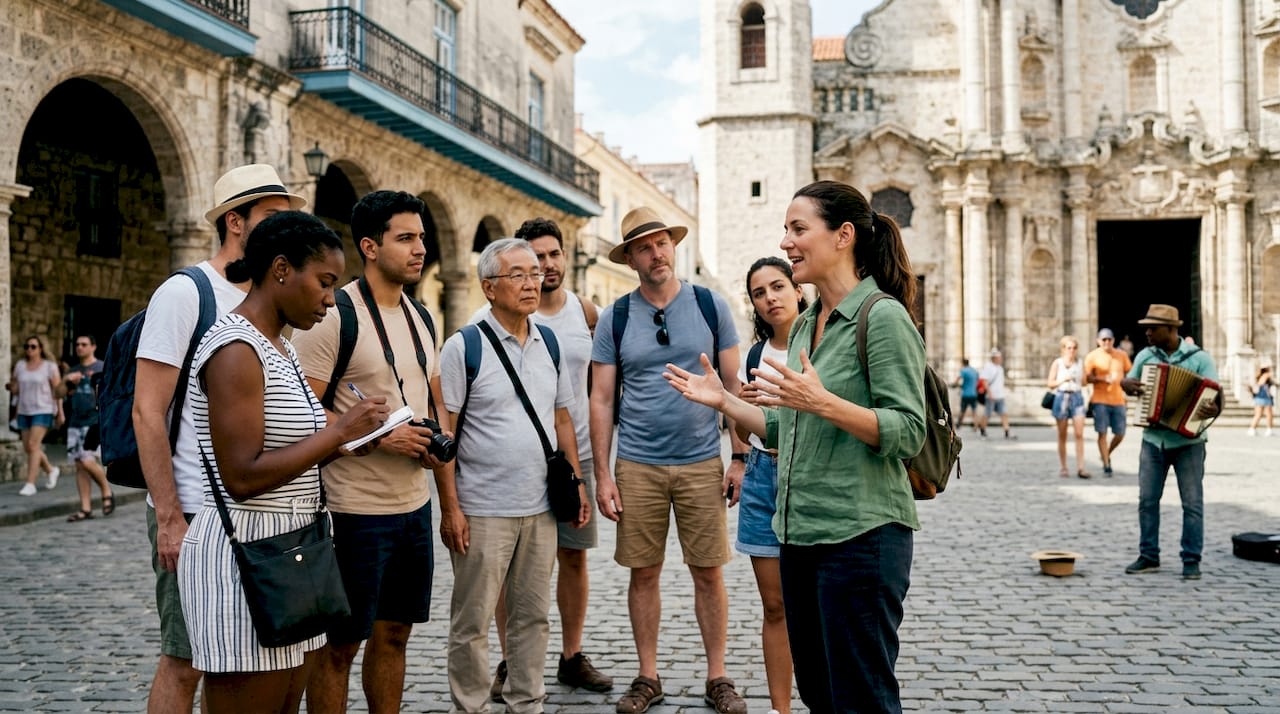
Small groups foster a built-in community that solo travellers and retirees particularly value. The social bonds that form naturally in a group of eight feel organic rather than forced. Many solo travellers choose small group tours repeatedly for exactly this reason, finding the social environment they want without any awkward icebreaker exercises.
The guide interaction differences across group sizes follow a clear pattern:
- Private tours (1–6 guests): The guide functions almost as a personal expert, tailoring every explanation to your specific background, pace, and curiosity. Questions are answered immediately and in depth.
- Small group tours (8–16 guests): A strong community atmosphere develops naturally. The guide can still learn names, adjust commentary, and respond to individual interests across the group.
- Mid-size tours (12–20 guests): Interaction becomes more broadcast-style. The guide manages the group rather than engaging with it. Personal attention drops noticeably.
- Large group tours (20+ guests): Guests at the back frequently miss commentary entirely. The experience resembles a lecture rather than a guided conversation, and reviews reflect this.
Pro Tip: If you travel solo and want social connection without losing depth, a capped small group tour of 8–12 people gives you both. Confirm the cap before paying.
What is the logistical impact of group size on pacing and comfort?
Logistics are where group size causes the most invisible damage to a tour. Every extra guest amplifies minor delays, turning simple transitions into high-friction events. A group of six crosses a road in seconds. A group of forty crosses in waves, losing minutes at every junction, meal stop, and toilet break.
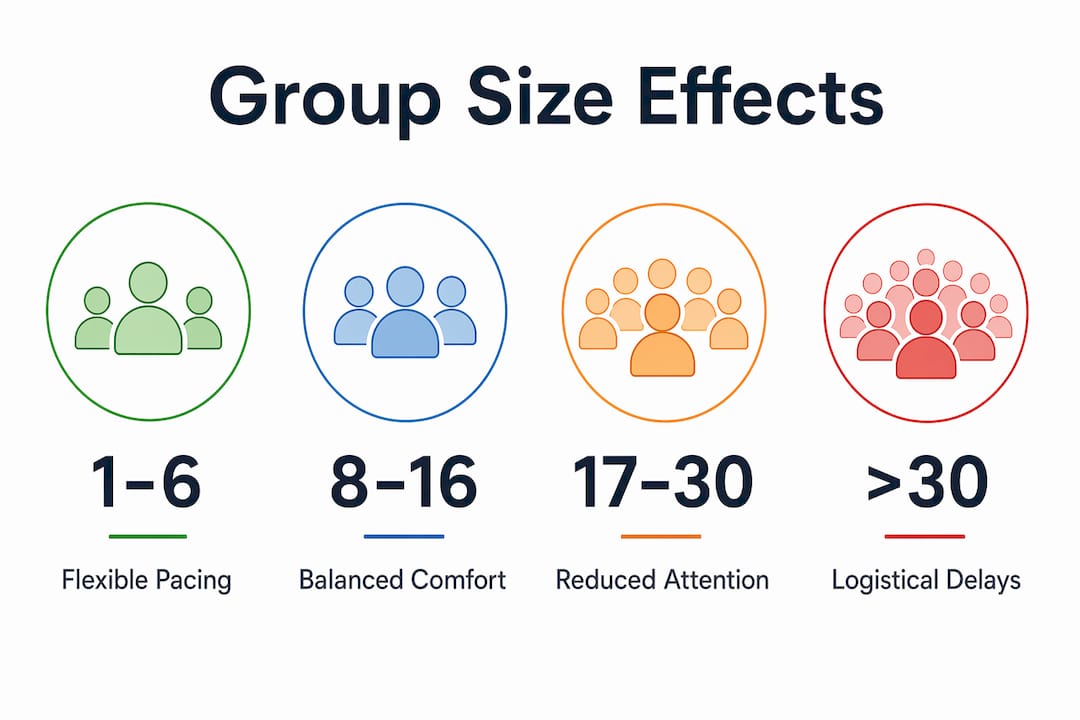
The cumulative effect over a full day is significant. By mid-afternoon, a large group tour has typically lost 45–90 minutes to regrouping, slow meal service, and staggered boarding. That time comes directly out of site visits and guide commentary. Smaller groups, by contrast, move with the efficiency of a well-organised family, adapting to conditions rather than fighting them.
Activity-based tours feel this most acutely. In cycling or walking tours, smaller groups increase safety and guide effectiveness by keeping all participants visible and attention focused. A guide leading twelve cyclists through the Scottish Highlands can monitor every rider. A guide leading thirty cannot.
| Group size | Typical pacing | Guide attention | Logistical friction |
|---|---|---|---|
| Private (1–6) | Fully flexible | Personalised throughout | Minimal |
| Small (8–16) | Mostly flexible | High, names known | Low |
| Mid-size (12–20) | Structured | Moderate | Moderate |
| Large (20+) | Fixed schedule | Broadcast only | High |
The table above reflects the industry standard categories used by tour operators when designing products. Travellers who prioritise comfort and absorption of information consistently report better experiences in groups of 16 or fewer.
Are small group tours worth the higher price?
Small group departures capped at 8–10 guests command price premiums of 40–80% over standard large group pricing. That figure sounds steep until you account for what you actually receive. The guide cost is spread across fewer people, which means the operator must charge more per head, but the experience delivered per pound spent is measurably higher.
The economics work in both directions. Well-run small group tours can match or exceed the revenue of larger groups while generating better reviews and stronger repeat booking rates. Operators who understand this cap their tours at 12–16 guests to balance revenue with quality, rather than filling every seat available.
The value case for small groups rests on three concrete points:
- Personalised engagement: Your guide knows your name, your interests, and your pace. That is not possible in a group of forty.
- Higher-quality experiences: Access to exclusive venues, flexible itineraries, and quieter moments at iconic sites all require a small headcount.
- Better value over time: Travellers who book small group or private excursions report higher satisfaction and are significantly more likely to rebook or recommend the operator.
Large group tours do serve a genuine purpose. For budget travellers whose primary goal is ticking off headline sites, a large coach tour delivers those highlights at a lower per-person cost. The trade-off is depth, flexibility, and personal attention. Knowing which you want before you book is the most useful decision you can make.
Key takeaways
Small group tours, capped at 8–16 guests, deliver superior access, guide interaction, and logistical comfort compared to large group tours, making them the stronger choice for travellers who prioritise depth over price.
| Point | Details |
|---|---|
| Group size defines the product | Private, small, mid-size, and large tours deliver fundamentally different experiences, not just different headcounts. |
| Small groups unlock exclusive access | Groups of 8–16 can enter venues, tastings, and sites that are physically closed to larger tours. |
| Guide attention is finite | Personal interaction drops sharply above 16 guests, reducing commentary quality and Q&A depth. |
| Logistics compound with scale | Every additional guest adds friction to transitions, meals, and movement, cutting into site time. |
| Premium pricing reflects real value | Small group tours cost 40–80% more but produce better reviews, higher satisfaction, and stronger repeat bookings. |
What I have learned from years of watching groups of all sizes
By Alin
The most common mistake I see travellers make is assuming that a smaller group automatically means a better trip for everyone. It does not. A family of four who wants to cover six Highland sites in one day may actually benefit from a structured mid-size tour with a fixed schedule, because the discipline of a larger group keeps them moving. The mistake is booking without asking the question at all.
Solo travellers almost always underestimate how much group size affects their comfort. I have watched solo guests on large coach tours spend entire days at the edges of conversations they could not join, physically present but socially invisible. The same travellers on a capped small group tour of ten people become the most engaged guests on the coach by lunchtime. The social environment of a small group does something that no itinerary can manufacture.
The other thing I have noticed is that travellers consistently undervalue the access argument. They focus on price and miss the fact that the boutique whisky distillery, the private castle room, or the off-path viewpoint simply does not exist on the large group itinerary. You cannot buy your way into those moments after the fact. They are only available to groups small enough to fit through the door.
My practical advice: always confirm the maximum group size in writing before booking. The term “small group” is not standardised across the industry and can describe anything from 12 to 50 people depending on the operator. Ask for the contractual cap. If an operator cannot give you a number, that tells you everything you need to know.
— Alin
Skyehighlandstours: tours built around your group, not the other way round
Skyehighlandstours designs every departure around the traveller, not the maximum headcount. Whether you are a couple seeking a private day on the Isle of Skye, a family wanting a flexible Highland itinerary, or a small group of friends after a specialist whisky experience, the options are built to fit your size and pace.
Every tour offered through Skyehighlandstours comes with an expert local guide, a confirmed group size cap, and the flexibility to adjust the day as it unfolds. From the Glenfinnan Viaduct to the Black Isle, the focus is on depth of experience rather than volume of passengers. Travellers who want to understand what a genuinely personalised Scottish Highlands experience looks like will find the full range of private and small group options clearly laid out, with pricing and itinerary details available before you commit.
FAQ
What is the standard size for a small group tour?
The industry benchmark for a genuine small group tour is 8–16 participants. Private tours typically cover 1–6 guests, while anything above 20 is classified as a large group tour.
Why do small group tours cost more?
Small group departures capped at 8–10 guests command premiums of 40–80% over standard pricing because guide costs are spread across fewer people and the experience delivered is measurably more personalised.
How does group size affect guide quality?
Guide attention is finite. Above 16 guests, commentary reaches fewer people and personal interaction drops significantly, with guests at the back frequently missing key information entirely.
Are large group tours ever the right choice?
Large group tours suit budget travellers whose primary goal is visiting headline sites at lower cost. They work less well for travellers who want flexible pacing, exclusive access, or meaningful guide interaction.
How do I confirm the real group size before booking?
Ask the operator for the contractual maximum headcount in writing before paying. Marketing terms like “small group” carry no legal definition and can describe groups of up to 50 people depending on the operator.
1 Comment