
Your cart is empty Continue Shopping
What is small group travel? Your 2026 guide
Small group travel is defined as a guided tour format capped at 8–16 participants, designed to deliver intimate access, genuine cultural immersion, and logistical ease that large coach tours cannot replicate. The industry term is “small group touring,” and it sits between private travel and mass group tours in both price and experience. Skyehighlandstours specialises in exactly this kind of guided experience across the Scottish Highlands, from the Isle of Skye to Loch Ness. Understanding what is small group travel helps you decide whether this format fits your travel style before you commit to a booking.
What is small group travel, and what defines it?
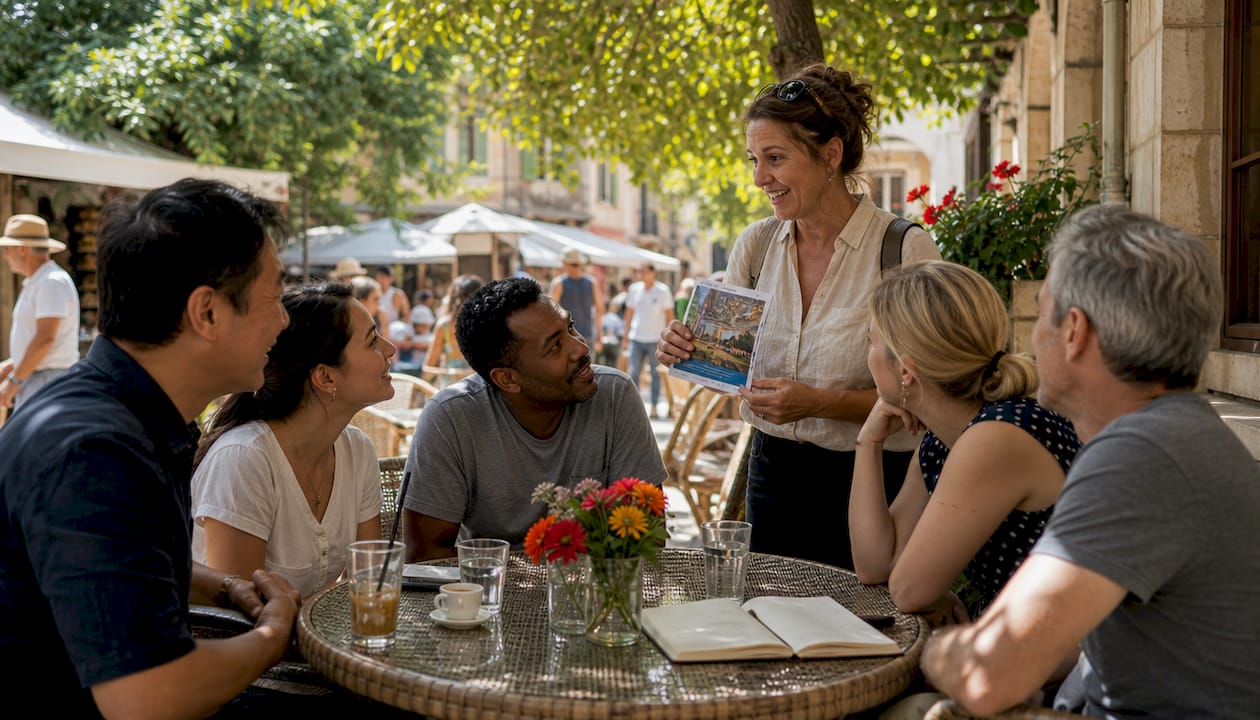
Small group travel is a guided tour format where the number of participants is deliberately capped to preserve intimacy and agility. The industry optimal range is 8–16 people. That ceiling is not arbitrary. It reflects real infrastructure limits at destinations, including restaurant table sizes, accommodation capacity, and site access rules.
Once a group exceeds 16 participants, the experience changes in measurable ways. Boutique venues cannot seat everyone together. Guides struggle to maintain personal contact with each traveller. Sites that permit small parties turn groups away. The loss of intimacy beyond 16 is not a matter of preference. It is a functional constraint built into how destinations operate.
The format differs clearly from private tours, where you hire a guide exclusively for your party, and from large coach tours, where 40 or more travellers follow a fixed script. Small group touring sits between these two. You share costs with fellow travellers, gain the benefit of a vetted local expert, and retain the flexibility that only a compact group can enjoy.
Pro Tip: Ask any operator for their exact maximum group size before booking. Some providers label tours “small group” with 40 or more participants, which fundamentally changes the experience you receive.
| Format | Group size | Cost level | Flexibility | Social dynamic |
|---|---|---|---|---|
| Private tour | 1–6 | Highest | Very high | Intimate, personal |
| Small group tour | 8–16 | Mid-range | Moderate | Social, connected |
| Large coach tour | 30+ | Lowest | Low | Minimal personal contact |
What are the benefits of small group travel tours?
The benefits of small group travel go well beyond convenience. The format delivers advantages across four distinct areas: social connection, cultural depth, logistical ease, and cost.
Built-in companionship. Travelling with 8–16 people creates a natural social setting without the pressure of managing relationships yourself. Around half of travellers on many small group trips travel solo. That statistic matters because it shows the format actively attracts people who want connection without sacrificing independence.
Deeper cultural access. Expert guides unlock experiences that larger groups simply cannot reach. Private conservancies, early site entries, and family-run venues all require small party sizes to grant access. A guide who knows the owner of a remote Highland distillery, for example, can arrange a private tasting that no coach tour could offer.
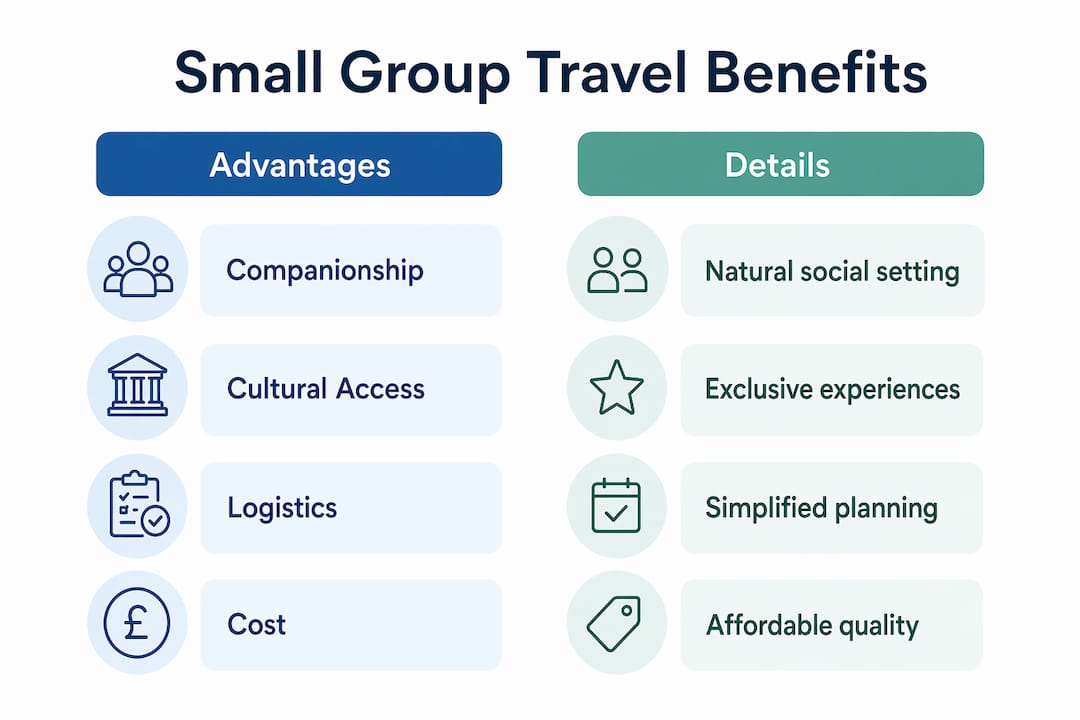
Logistical ease. Operators handle transport, route planning, and activity scheduling. Many also arrange stays of at least two nights per destination to reduce the fatigue of constant packing and unpacking. You arrive, you experience, you sleep. The planning burden sits with the operator, not with you.
Cost balance. Small group tours cost roughly 50% less than equivalent private tours while delivering comparable quality in guidance and access. They do carry a premium over budget independent travel, reflecting the expert knowledge and exclusive access built into the price. That trade-off suits travellers who want depth without the full cost of a private arrangement.
Pro Tip: If you are a solo traveller, look specifically for operators who offer single-supplement waivers. These remove the extra charge for occupying a room alone, making small group travel significantly more affordable.
How does small group travel compare to private and independent travel?
Choosing between small group touring, private travel, and independent travel comes down to three factors: budget, social preference, and how much planning you want to do yourself.
Private tours offer the highest level of personalisation. Your guide works exclusively for your party, the itinerary bends entirely to your preferences, and you never share a dining table with strangers. The cost reflects that exclusivity. A private excursion is the right choice when your group has very specific interests or when privacy is non-negotiable.
Independent travel gives you maximum freedom at the lowest cost. You set every detail yourself, from transport to accommodation to daily pace. The trade-off is logistical effort and the absence of expert guidance. You may visit the same sites as a guided group but miss the context, the backstory, and the access that a knowledgeable guide provides.
Small group touring sits between these two. It costs significantly less than private travel while delivering expert guidance and exclusive access. It asks you to share the experience with a small number of fellow travellers, which most people find enriching rather than limiting.
| Factor | Small group tour | Private tour | Independent travel |
|---|---|---|---|
| Cost | Mid-range | High | Low |
| Guide expertise | Vetted local expert | Vetted local expert | None included |
| Flexibility | Moderate | Very high | Total |
| Social connection | Built-in | Within your party only | Self-managed |
| Logistical effort | Minimal | Minimal | High |
| Exclusive access | Yes | Yes | Rarely |
Small group travel is the best fit when you want expert guidance and social connection without the full cost of a private arrangement. It suits solo travellers, couples, and small groups of friends who share broad interests but do not need a fully bespoke itinerary.
What should you look for when choosing a small group tour?
Choosing the right small group tour requires more than reading a brochure. Several practical checks separate a genuinely intimate experience from a rebranded coach tour.
Confirm the maximum group size. Ask the operator directly. Some providers label tours “small group” with 40 or more participants, which removes the core benefits of the format. Any operator unwilling to state a firm cap is a warning sign.
Assess guide credentials. A vetted local expert brings more than route knowledge. They bring relationships with venue owners, historical context, and the ability to adapt the day when conditions change. Ask whether guides are employed directly or sourced through third-party agencies.
Check itinerary pacing. A well-designed small group itinerary builds in breathing room. Rushed schedules that cram six sites into one day undermine the depth that makes small group travel worthwhile. Look for itineraries that allow genuine time at each location.
Understand guaranteed departures. Many reputable operators offer guaranteed departures once a minimum booking count is reached, often as few as two to four travellers. This protects you from last-minute cancellations that can derail travel plans.
Clarify inclusions and extras. Know exactly what the tour price covers. Transport, accommodation, and guide fees are usually included. Meals, entrance fees, and optional activities often are not. A clear breakdown prevents unwelcome surprises on the day.
Pro Tip: Read recent reviews specifically for comments on group size and guide quality. These two factors predict experience quality more reliably than any other metric.
Key takeaways
Small group travel delivers the best balance of expert guidance, cultural access, and social connection when the group size stays within the 8–16 participant range.
| Point | Details |
|---|---|
| Group size ceiling matters | Tours capped at 8–16 people preserve access to boutique venues and maintain guide-to-guest quality. |
| Cost sits between private and budget | Small group tours cost roughly 50% less than private tours while delivering comparable access and expertise. |
| Solo travellers benefit most | Around half of small group travellers travel solo, gaining companionship without sacrificing independence. |
| Verify the operator’s claims | Always confirm the exact maximum group size, as some operators misuse the “small group” label. |
| Guaranteed departures reduce risk | Operators offering guaranteed departures protect your booking from last-minute cancellations. |
Why small group travel is worth taking seriously
By Alin
The most common misconception I encounter is that small group travel is a compromise. Travellers assume they are giving up privacy and flexibility to save money. That framing misses the point entirely.
The real value of small group touring is access. A group of twelve people can sit around a single table in a family-run Highland inn. A guide who has worked the same region for a decade knows which distillery will open its private cask room for a small party, and which glen is empty at dawn. Those experiences do not scale. They exist precisely because the group is small.
I have seen travellers return from Scottish Highlands tours and describe moments that no amount of independent planning could have produced. A private conversation with a gamekeeper on a remote estate. A whisky tasting in a room that does not appear on any public booking page. These are not accidents. They are the direct result of a trusted guide with a small, manageable group.
My advice for anyone considering their first small group trip: stop comparing it to a holiday you have already taken. Compare it to the version of that holiday where someone who genuinely knows the place is standing next to you, opening doors you did not know existed.
— Alin
Skyehighlandstours and small group travel in the Scottish Highlands
Skyehighlandstours brings the principles of genuine small group travel to the Scottish Highlands, covering destinations including the Isle of Skye, Loch Ness, Glenfinnan Viaduct, and the Black Isle.
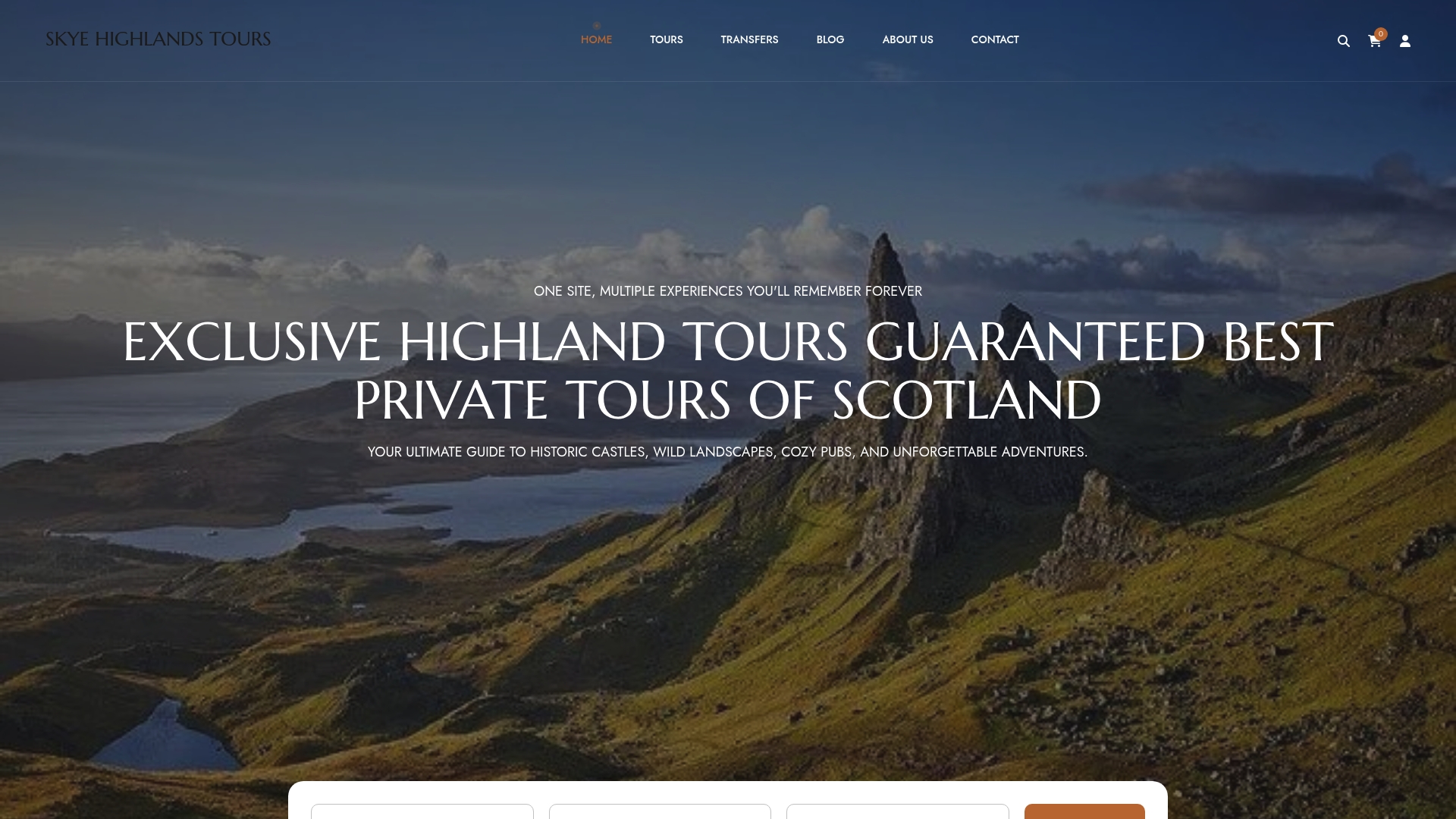
Every tour is led by an expert local guide who knows the Highlands well enough to adapt the day to your group’s pace and interests. Itineraries are tailored to suit different physical abilities, group sizes, and occasions, from family adventures to specialist whisky tours. If you want to understand how customised Highland itineraries work in practice, Skyehighlandstours offers detailed options and transparent pricing to help you plan with confidence. Explore the full range of Scottish Highlands experiences and find the tour that fits your group.
FAQ
What is the ideal group size for small group travel?
The industry standard for small group travel is 8–16 participants. Groups exceeding 16 lose access to boutique venues and the personal attention that defines the format.
Is small group travel suitable for solo travellers?
Small group travel suits solo travellers well. Around half of participants on many small group trips travel alone, and the format provides built-in companionship alongside personal independence.
How much does small group travel cost compared to private tours?
Small group tours cost roughly 50% less than equivalent private tours. They carry a premium over budget independent travel, reflecting expert guidance and exclusive access.
What does “guaranteed departure” mean on a small group tour?
A guaranteed departure means the tour runs once a minimum number of bookings is reached, often just two to four travellers. This protects you from last-minute cancellations.
How do I know if a tour is genuinely small group?
Ask the operator for their exact maximum group size before booking. Some providers label tours “small group” with 40 or more participants, which removes the core benefits of the format.
1 Comment