
Your cart is empty Continue Shopping
Seasonal variations in tours: the 2026 guide for UK operators
Seasonality is the single most predictable disruptor in the tour business. It causes recurring, measurable fluctuations in demand driven by climate, school calendars, public holidays, and events, and it shapes almost every operational and financial decision a tour operator makes. UNWTO confirms that seasonality is consistent and anticipatable, which means operators who treat it as a crisis are leaving money on the table. Those who plan around it build genuinely resilient businesses.
The role of seasonal variations in tours goes well beyond filling beds in summer and surviving winter. It determines how you price, staff, market, and develop your product throughout the year. Get it wrong and you face overcrowding in peak months, empty schedules in low season, and cash flow gaps that compound into structural problems. Get it right and the same predictable cycle becomes your planning framework.
Key consequences of seasonality that every operator needs to account for:
- Demand spikes in peak months create overcrowding, price inflation, and service strain
- Off-peak periods produce revenue gaps, underutilised assets, and staff retention problems
- Shoulder seasons offer the best opportunity for product innovation and niche marketing
- Institutional drivers (school holidays, events) are harder to predict than climate patterns
- Customer expectations shift across seasons, changing what your product needs to deliver
What drives seasonality in UK tours?
Two distinct forces shape seasonal patterns in UK tourism: nature-related causes and institutional causes. Scholars consistently identify temperature as the primary natural driver of seasonal variation, with rainfall, daylight hours, and humidity playing supporting roles. Institutional causes, covering school terms, bank holidays, festivals, and sporting calendars, are actually more prevalent in the UK context, though they are also less predictable than the weather.
Nature-related drivers in the UK:
- Extended daylight and warmer temperatures from may through august pull visitors to outdoor and scenic destinations
- Rainfall peaks in autumn and winter across western Scotland and Wales, suppressing demand for walking and wildlife tours
- The Scottish Highlands experience dramatic daylight variation, from roughly 17 hours in june to under 7 in december, directly affecting tour scheduling windows
- Coastal destinations in Cornwall and the Lake District see sharp demand drops once sea temperatures fall below comfortable levels in october
Institutional drivers in the UK:
- The summer school holiday window (mid-july to early september) generates the largest single demand surge for family-oriented tours
- Scottish school holidays differ from English ones by two to three weeks, creating a distinct secondary peak for Highland operators
- Bank holidays in may and august produce short-break demand spikes, particularly for day excursions and guided tours within driving distance of cities
- Events such as the Edinburgh Festival Fringe (august), the Royal Highland Show (june), and the Highland Games season (july to september) create localised demand peaks that operators can plan around
The table below illustrates how demand and weather conditions vary across UK regions by season, giving operators a practical reference for planning.
| Season | Scottish Highlands | Lake District | Cornwall | Key institutional driver |
|---|---|---|---|---|
| Spring (Mar–May) | Moderate demand, unpredictable weather | Rising demand, walking season begins | Growing coastal interest | Easter holidays, bank holidays |
| Summer (Jun–Aug) | Peak demand, long daylight hours | Peak demand, crowding at honeypots | Peak demand, beach tourism | School summer holidays, festivals |
| Autumn (Sep–Nov) | Shoulder season, foliage appeal | Declining demand, wet weather | Declining demand | None dominant |
| Winter (Dec–Feb) | Low demand, festive exceptions | Very low demand | Very low demand | Christmas, Hogmanay |

How does excursion demand actually fluctuate through the year?
Statistical analysis of excursion demand confirms what most operators already sense: summer peaks dominate natural and cultural activities, while winter demand concentrates on festive events and warm-climate destinations. The correlation between demand and climate variables is strong enough to be operationally useful, not just academically interesting.
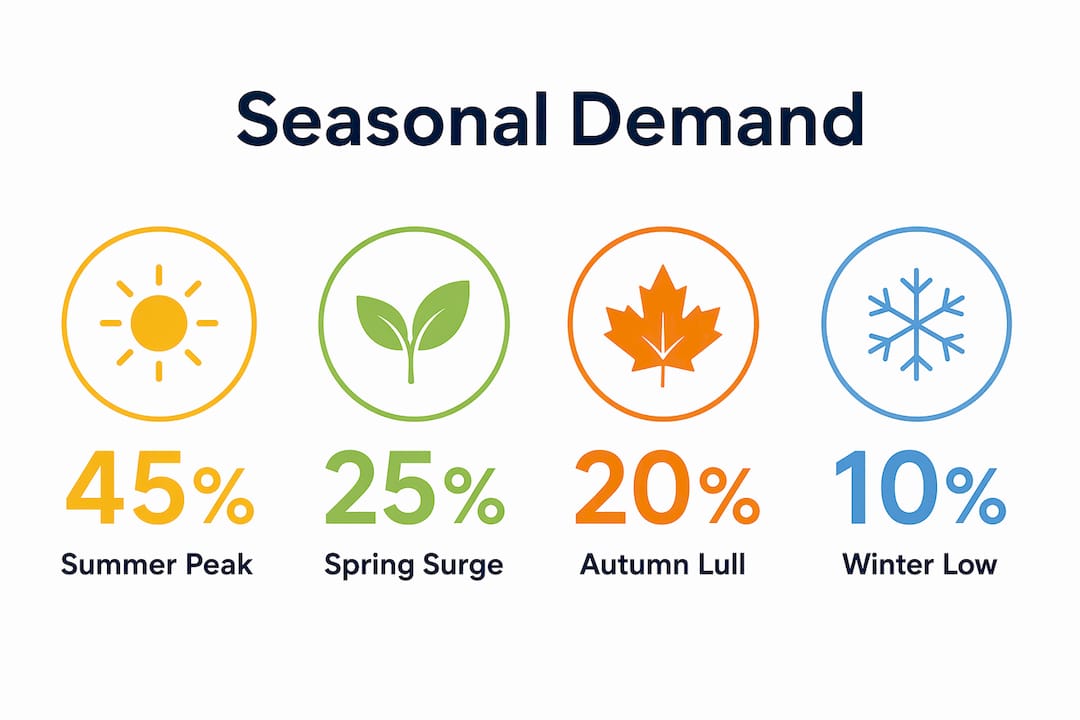
Research demonstrates that temperature and precipitation are the two climate variables most tightly linked to excursion uptake. Higher temperatures increase demand for outdoor and scenic tours; rain suppresses it, particularly for walking, cycling, and wildlife experiences. Daylight availability matters too, especially in northern destinations like the Scottish Highlands where a winter tour day is genuinely short.
| Season | Demand level | Primary excursion types | Customer profile |
|---|---|---|---|
| Spring | Moderate and rising | Walking, wildlife, cultural heritage | Couples, retirees, domestic travellers |
| Summer | Peak | Scenic drives, boat trips, outdoor adventures | Families, international visitors, groups |
| Autumn | Shoulder | Foliage tours, whisky experiences, history | Couples, enthusiasts, cruise passengers |
| Winter | Low with festive spikes | Festive events, whisky tours, Hogmanay | Domestic short-breakers, niche enthusiasts |
The demand gap between peak and off-peak periods is one of the most significant resource management challenges in UK tourism. UNWTO identifies seasonality as a primary cause of resource over-utilisation, with destinations reporting sharp disparities between high and low season that directly affect staffing, infrastructure, and pricing decisions.
The practical implication for tour operators is that product design cannot be season-neutral. A tour built around long summer evenings on the Isle of Skye needs a fundamentally different winter equivalent, not just a price cut. Seasonal change alters the pull features of a destination, shifting what customers expect and what they will actually enjoy when they arrive.
Operational and marketing strategies to manage seasonal fluctuations
The operators who handle seasonality best treat it as a planning input, not a problem to solve after the fact. UNWTO experts emphasise that because seasonality is consistent and predictable, proactive strategies outperform reactive ones every time. That means building your operational calendar, pricing model, and marketing schedule around known seasonal patterns rather than responding to them in real time.
Best practices for managing seasonal demand:
- Use dynamic pricing to capture peak-season revenue and stimulate off-peak bookings through targeted discounts
- Schedule seasonal marketing campaigns 3–6 months ahead of each demand period, not weeks before
- Develop shoulder-season products specifically, rather than discounting peak products into the shoulder
- Build partnerships with local event organisers, distilleries, and heritage sites to create exclusive off-peak experiences
- Cross-train staff during low season so the business can flex capacity without emergency hiring in peak months
- Use booking data from previous years as your primary forecasting tool, supplemented by event calendars and school term dates
Pro Tip: Festivals and events are among the most reliable institutional drivers you can plan around. Identify micro-peaks in your region, a local Highland Games, a food festival, a whisky event, and build a specific product and pricing strategy around each one. Operators who align pricing with micro-peak demand capture revenue from periods that would otherwise sit empty.
Flexible scheduling is particularly valuable for Scottish Highland operators. Flexible tour options that can be adjusted for group size, duration, and itinerary give you the ability to serve both the summer family market and the autumn whisky enthusiast without running two entirely separate operations. The infrastructure is the same; the product framing changes.
Marketing strategy also needs to shift by season. Summer campaigns should focus on availability and booking urgency, given that demand already exists. Shoulder and off-peak campaigns need to create demand by communicating what is genuinely distinctive about that period: the quieter roads, the dramatic autumn light, the access to distilleries that are too busy to accommodate groups in july and august.

How advanced operators use seasonality data beyond occupancy rates
Tourism scholars recommend moving beyond hotel occupancy metrics to embrace multi-factor seasonality analysis for effective demand management. For tour operators, that means tracking booking lead times, group size distributions, cancellation rates by season, and customer origin alongside the headline visitor numbers. Each of those variables tells you something different about how to respond.
Scottish Highland operators provide some of the clearest examples of adaptive seasonality management in the UK. The pattern that works consistently involves using the off-peak window not just to survive, but to build. Scheduling specialist offerings 6–9 months in advance yields better resource allocation and higher programme success rates than filling gaps reactively. Whisky and history workshops run in october and november, for instance, attract a different and often higher-spending customer than the summer scenic tour market, with lower overhead and stronger local partnership opportunities.
Balancing ‘actual’ and ‘perceived’ product identity across seasons is one of the subtler challenges. Seasons alter the pull features of a destination, which means the same glen looks and feels like a different product in february than in july. Operators who communicate this honestly, rather than trying to sell the summer experience year-round, build stronger customer trust and more appropriate expectations.
Advanced strategies for year-round viability:
- Track booking lead times by season to identify when each customer segment makes decisions
- Use shoulder seasons to pilot new tour products with lower financial risk before scaling them
- Build local partnerships (distilleries, heritage sites, activity providers) that give you exclusive access in low season
- Invest in staff training and product refinement during off-peak months to maintain service quality at peak
- Develop a seasonal content calendar that positions each period’s genuine strengths rather than discounting the peak product
- Monitor event calendars 12 months ahead and reserve capacity for confirmed micro-peaks
The comparison below shows how a reactive approach to seasonality differs from a proactive one across key operational dimensions.
| Operational dimension | Reactive approach | Proactive approach |
|---|---|---|
| Pricing | Discounts applied when bookings are low | Dynamic pricing set months in advance by season |
| Staffing | Emergency hires in peak, redundancies in off-peak | Cross-trained core team with seasonal flex capacity |
| Product development | Same product year-round, discounted off-peak | Season-specific products developed in shoulder periods |
| Marketing | Campaigns launched close to the travel date | Campaigns scheduled 3–6 months ahead per season |
| Partnerships | Ad hoc arrangements when needed | Long-term agreements with local suppliers by season |
| Forecasting | Gut feel and last year’s revenue | Booking data, event calendars, and climate indicators |
Skyehighlandstours applies this kind of thinking across its Scottish Highlands destinations, where the seasonal contrast between a summer Isle of Skye excursion and an autumn whisky tour is sharp enough to require genuinely different products, not just different prices.
Financial implications of seasonality and cash flow management
Cash flow is where seasonality becomes existential for small and medium tour operators. Revenue concentrated in a 12–16 week summer window has to sustain a business that runs costs year-round: staff wages, vehicle maintenance, insurance, marketing, and platform fees do not pause in january. Operators who do not plan for this explicitly tend to find themselves borrowing in february to cover costs that were entirely predictable.
The most effective structural response is to build a cash reserve policy based on your actual seasonal revenue curve. That means calculating your average monthly revenue across the full year, identifying the months where income falls below operating costs, and holding enough reserve from peak earnings to bridge those gaps. It sounds obvious, but many operators manage cash reactively, spending peak revenue as it arrives rather than allocating it forward.
Advance bookings and deposits are the other lever. A non-refundable deposit policy, applied consistently, converts future demand into present cash and gives you a forward revenue picture that makes planning far more reliable. Operators running private group tours can often secure deposits 3–6 months ahead, which materially smooths the cash flow curve.
Pricing strategy also has a direct cash flow dimension. Dynamic pricing that captures higher revenue in peak periods does more than maximise yield; it builds the reserve that funds off-peak operations. Shoulder-season pricing set too low erodes that reserve without generating enough volume to compensate. The right shoulder price is the one that attracts the niche segment willing to pay for a quieter, more personalised experience, not the one that fills every slot at a discount.
Customer segmentation and targeting based on seasonal behaviour
Different customer segments make travel decisions at different times and for different reasons, and seasonality is one of the clearest lenses for segmenting your market. Properly segmenting customers by seasonal behaviour allows tour operators to tailor offers and optimise marketing campaigns for each period. The practical challenge is that most operators collect the data to do this but do not analyse it systematically.
The broadest segmentation by season looks like this: summer attracts families and international visitors who plan months ahead and prioritise iconic experiences; shoulder seasons attract couples, retirees, and enthusiasts who are more flexible, more interested in depth over spectacle, and often higher-spending per head; winter attracts domestic short-breakers and niche travellers drawn by specific events or experiences. Each group responds to different messages, books through different channels, and has different price sensitivity.
Customer preferences also shift within seasons, not just between them. A family booking a Scottish Highlands tour in july wants flexibility around children’s interests and physical ability. An autumn whisky enthusiast wants depth, access, and expert guidance. Treating these as the same customer with a seasonal price adjustment misses the point entirely.
The most useful segmentation tool most operators already have is their own booking history. Analysing who books when, how far in advance, at what price point, and through which channel gives you a segmentation map that is specific to your business rather than generic to the industry. That data, combined with event calendars and school term dates, lets you build targeted campaigns for each segment at the moment they are most likely to be making decisions. Custom tour planning that reflects these segment differences converts better than one-size-fits-all seasonal promotions.
Activity type also segments by season in ways that are worth tracking explicitly. Cycling and outdoor activity tourism peaks in spring and summer when conditions favour it, while cultural and heritage experiences draw more evenly across the year. Knowing which of your products attracts which segment in which season lets you allocate marketing spend where it will actually generate bookings rather than spreading it evenly across the calendar.
Putting your seasonal strategy into practice with Skyehighlandstours
Understanding seasonal patterns is one thing; building a tour business that performs across all twelve months is another. Skyehighlandstours has developed its private Scottish Highlands tours specifically to serve different customer segments across every season, from summer scenic excursions on the Isle of Skye to autumn whisky experiences in Speyside. The private format means itineraries can be adjusted for season, group size, and interest without the constraints of a fixed group departure.
If you are planning a tour that works with the season rather than against it, the 2026 booking guide covers everything from lead times to deposit structures and seasonal availability.
Key takeaways
Seasonal variations in tours are predictable and manageable when operators treat them as a planning framework rather than an annual disruption.
| Point | Details |
|---|---|
| Seasonality is predictable | UNWTO confirms it is consistent and measurable, enabling proactive planning rather than reactive responses. |
| Two distinct cause types | Nature-related drivers (temperature, daylight) and institutional drivers (holidays, events) require different management responses. |
| Cash flow needs explicit planning | Peak revenue must be allocated forward to cover off-peak operating costs; advance deposits materially smooth the curve. |
| Shoulder seasons are underused | Product innovation, staff training, and niche marketing in shoulder periods build year-round viability. |
| Segmentation sharpens campaigns | Analysing who books when and through which channel lets operators target each seasonal segment with the right message at the right time. |
FAQ
Why is seasonal variation important in tour operations?
Seasonal variation determines demand levels, pricing, staffing, and cash flow across the year. Because it is consistent and predictable, operators who plan around it can build proactive strategies rather than responding to revenue gaps after they appear.
What role does seasonality play in UK tourism?
Seasonality drives the concentration of visitor demand into a relatively short peak window, typically summer, creating overcrowding and price inflation at peak and underutilisation of resources at off-peak. Institutional factors like school holidays and events amplify these patterns in the UK context.
What are the practical uses of seasonal variation data?
Operators use seasonal data to set dynamic pricing, schedule marketing campaigns, develop shoulder-season products, manage staffing levels, and forecast cash flow. Booking history analysed by season and customer segment is the most directly useful data source for most tour businesses.
What do seasonal variations mean for excursion demand?
Statistical analysis confirms that summer peaks dominate natural and cultural excursions, while winter demand focuses on festive events and specialist experiences. The gap between peak and off-peak demand is sharp enough to require genuinely different products, not just adjusted prices.
How can tour operators reduce the financial impact of off-peak periods?
Building a cash reserve from peak earnings, using non-refundable deposits to convert future bookings into present cash, and developing niche products for shoulder and off-peak segments are the three most effective approaches. Dynamic pricing that captures full peak-season value funds the off-peak periods that follow.
1 Comment