
Your cart is empty Continue Shopping
250g and 120m: Scotland Drone Rules 2026, Land, Wildlife and Tours
Scotland runs on the same UK drone law as the rest of Great Britain, but flying here means stacking two extra legal layers on top of it: land access and wildlife protection. You must obey the CAA’s Drone and Model Aircraft Code (the 120m ceiling, minimum distances, Flyer and Operator ID), and you also need landowner permission for take-off and landing under Scottish access law, plus awareness of NatureScot’s wildlife rules and the country’s dense scatter of small regional airports.
TL;DR:
- Pilots must obtain landowner permission for take-off and landing, as the right to roam does not automatically cover drone operations in Scotland.
- Operating a drone near protected wildlife sites or colonies requires extra caution and adherence to seasonal guidelines from NatureScot to avoid criminal offences.
- Check airspace maps and NOTAMs carefully, since many airports have extended flight restriction zones that can include seemingly remote locations.
- Most recreational flights fall under the Open Category but require Flyer ID, Operator ID, and a basic understanding of drone class marks and Remote ID setup.
- Weather, especially wind and fog, can significantly impair drone safety and visual line of sight, demanding thorough pre-flight condition checks.
Table of Contents
- Drone rules Scotland pilots must follow under UK law
- Land access in Scotland: take-off, landing and the Land Reform Act
- Wildlife and conservation offences that apply in Scotland
- Airspace and FRZs in Scotland: check maps, not assumptions
- Registration, Flyer and Operator ID, and Remote ID explained step by step
- Authorisations, commercial operations and what enforcement actually looks like
- Practical pre-flight checklist tailored to Scotland
- Flying drones near Scotland’s landmarks and tourist hotspots
- Local council rules on drones in Scottish parks and towns
- Weather considerations that make Scottish drone flights harder
- How local guides handle drone requests on Scottish tours
- Let a local guide handle the access, not just the itinerary
- Sources
- FAQ
Drone rules Scotland pilots must follow under UK law
Scotland has no parallel drone statute. The Drone and Model Aircraft Code that governs Manchester or Cardiff governs Fort William too, and that single fact catches a surprising number of visiting pilots off guard.
The baseline rules are non-negotiable, and one detail carries a serious sting.
The legal height limit for drone flights in the UK is generally set by regulation, and you must keep your drone in unaided visual line of sight at all times. Operators are legally responsible for each flight, and endangering an aircraft is a serious criminal offence with substantial penalties, according to Gov. That is not a fine you negotiate away; it is a criminal offence with a custodial ceiling.
Beyond the height limit, four other rules shape almost every Scottish flight:
- Minimum distances to people and property. The Drone Code sets separation distances that scale with your drone’s weight class and the sub-category you’re flying in (A1, A2 or A3). Flying over crowds or uninvolved people is restricted regardless of the altitude in drone regulations.
- Flyer ID and Operator ID. If your drone weighs 250g or more, or carries a camera, you generally need a Flyer ID (a basic competency test) and the drone’s owner needs an Operator ID, according to CAA guidance.
- Registration for certified aircraft. Some unmanned aircraft categories require formal registration under the Unmanned Aircraft (Offences and Consequential Amendments) Regulations 2025.
- Class marks and Remote ID from 2026. Newer drones sold in the UK carry class marks (C0 to C4) that determine which sub-category they can fly in. Drones with a UK1 to UK3 class mark increasingly need Remote ID broadcasting enabled, so check your model’s documentation before you fly.
A drone bought secondhand or imported before class marking existed may still fall under legacy weight-based rules. When in doubt, the Drone Code itself is the document to check, not a forum thread.
Land access in Scotland: take-off, landing and the Land Reform Act
Scotland’s right to roam confuses a lot of drone pilots, and understandably so. The Land Reform (Scotland) Act 2003 gives the public a statutory right of access to most land and inland water for recreational purposes, but that right does not automatically cover flying a drone from that land.
A legal opinion prepared by Harper Macleod LLP for NatureScot concludes that operating a drone is likely “excluded conduct” under section 9(f) of the Land Reform (Scotland) Act 2003. In plain terms: you can walk onto most open land freely, but taking off or landing a drone from that same spot is a separate act that access rights don’t cover. You still need the landowner’s permission.
This matters just as much for a hobbyist launching from a hillside near Glencoe as it does for a commercial operator shooting promotional footage. Neither is automatically covered by the right to roam.
Pro Tip: Before heading into a remote glen, check who manages it. Large tracts of the Highlands sit under Forestry and Land Scotland, the National Trust for Scotland, or private sporting estates, and most publish a contact address or online enquiry form.
Practical steps for securing permission:
- Identify the landowner using estate maps, Forestry and Land Scotland’s public land records, or National Trust for Scotland property pages.
- Email or write ahead of your visit, stating dates, drone model, and intended flight area.
- Get permission in writing, even a short email reply, and carry a copy on the day.
- Ask about seasonal restrictions, since estates managing deer stalking or grouse shooting often have closed periods.
Wildlife and conservation offences that apply in Scotland
Disturbing certain protected species with a drone is a criminal offence in its own right, separate from anything in the Drone Code. The Wildlife and Countryside Act 1981 and the Nature Conservation (Scotland) Act 2004, held on legislation.gov.uk, protect nesting birds, seal colonies, and other species from intentional or reckless disturbance.
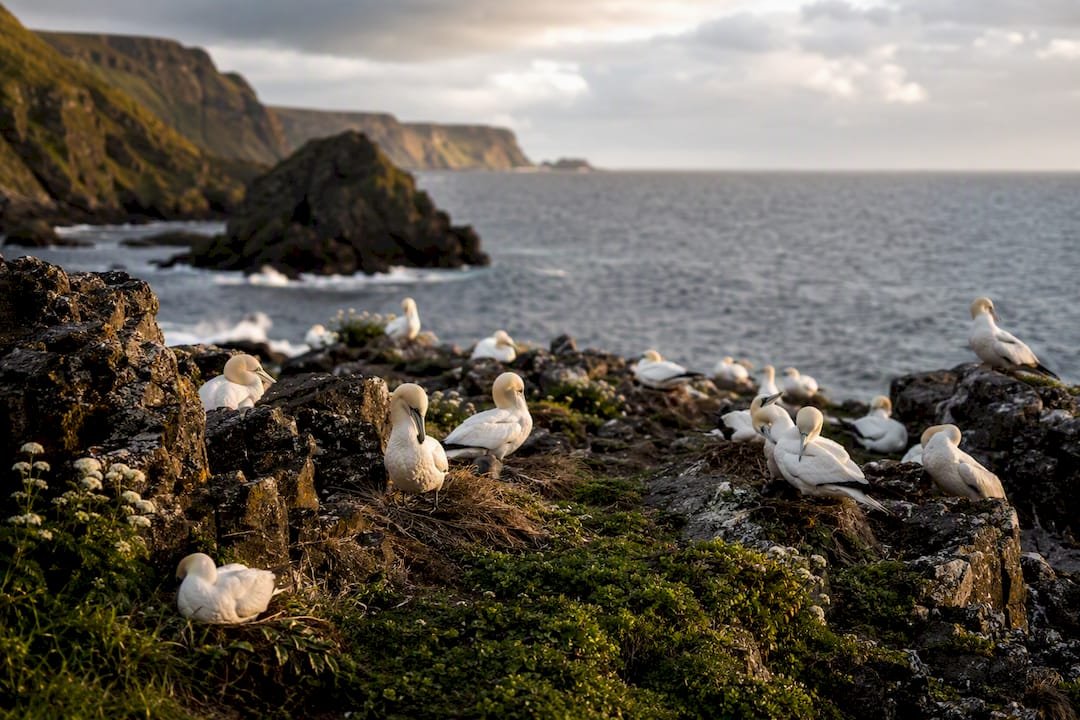
The Drone Code polices where and how high you fly. Wildlife law polices what your flight does to a living creature, and the two can be breached independently of each other.
Species and places that carry particular risk include:
- Golden eagle and osprey nest sites, many of which are actively monitored during breeding season (roughly March to August).
- Seal colonies on beaches and skerries around the coastline, easily spooked into a stampede by a low-flying drone.
- Basking seabird cliffs on islands such as St Kilda or the Shiant Isles, where colony disturbance can cause mass abandonment.
NatureScot treats disturbance enforcement as an active priority, not a paperwork exercise, and it works alongside Police Scotland on reported incidents. If you’re flying anywhere near a known colony or nest, check NatureScot’s seasonal guidance first and give the site far more clearance than the minimum legal distance suggests. A telephoto lens from further back beats a drone that scatters a hundred nesting gulls into the air.
Airspace and FRZs in Scotland: check maps, not assumptions
It feels counterintuitive, but a remote glen can still sit inside a legally binding no-fly zone. Most airports, including the regional airports run by Highlands and Islands Airports Limited (HIAL) at places like Inverness, Kirkwall, Sumburgh and Stornoway, have Flight Restriction Zones (FRZs) extending several kilometres beyond the runway itself.
Flying inside an FRZ without permission is an offence, full stop, whether you knew you were in one or not.
Before any flight near a coastal or island location, check:
- Drone Assist or the equivalent CAA-endorsed airspace map for live FRZ boundaries.
- NOTAMs (Notices to Airmen) for temporary restrictions covering events, military exercises, or VIP movements.
- The relevant airport’s operations desk directly, if your planned flight sits anywhere near the FRZ boundary. HIAL airfields typically have a named contact for drone enquiries.
Give yourself a wide margin. FRZ boundaries are not always intuitive from the ground, and a headland that looks miles from any runway can still fall inside the zone depending on approach paths.
Registration, Flyer and Operator ID, and Remote ID explained step by step
Getting your paperwork right takes about twenty minutes online, and it’s the one part of drone rules Scotland-based pilots most often skip until it’s too late.
- Check if you need a Flyer ID. Required for anyone flying a drone weighing 250g or more, or any drone fitted with a camera, regardless of weight. It’s free and involves an online theory test through the CAA’s website.
- Register for an Operator ID if you own the drone. This carries an annual fee and must be displayed on the aircraft itself.
- Confirm your drone’s class mark. Look for a label showing C0 to C4, or UK1 to UK3 if manufactured after the newer marking scheme took effect. No mark usually means the drone falls under older, weight-based sub-category rules.
- Enable Remote ID where fitted. Drones with a UK1 to UK3 class mark increasingly broadcast an electronic identification signal, similar in principle to a vehicle number plate, so leave it switched on.
- Carry proof of both IDs on your phone or printed, in case Police Scotland or a landowner asks.
Pro Tip: If your drone predates class marking entirely, don’t assume it’s exempt from everything. It usually just defaults to the most restrictive sub-category, A3, which demands greater distance from people and built-up areas.
Authorisations, commercial operations and what enforcement actually looks like
Most recreational Scottish flights sit in the Open Category, governed entirely by the Drone Code’s distance and altitude rules. Cross into certain scenarios, though, and you need Specific Category authorisation from the CAA before you fly at all: operating beyond visual line of sight, flying over assemblies of people, or running a drone heavier than the Open Category permits.
Commercial operators need insurance as a legal requirement, not an optional extra, for anything done for payment or in furtherance of a business. Recreational pilots aren’t legally required to carry cover, but given how quickly a rotor strike can turn into a five-figure claim, it’s worth having anyway.
Enforcement in Scotland runs through more than one channel. The Unmanned Aircraft (Offences and Consequential Amendments) Regulations 2025 sets out summary conviction fines for breaches, and serious cases can reach the Procurator Fiscal, Scotland’s independent prosecution service, rather than being resolved with an on-the-spot penalty.
Typical routes a complaint takes:
- A member of the public or landowner reports a flight to Police Scotland.
- Police Scotland assesses whether an offence under the 2025 Regulations or a wildlife statute applies.
- Straightforward breaches often result in a fixed penalty or CAA warning; serious or repeat cases go to the Procurator Fiscal for potential prosecution.
- Endangerment cases, where a drone posed a genuine risk to another aircraft or person, are treated far more seriously and can carry the five-year custodial maximum mentioned earlier.
Practical pre-flight checklist tailored to Scotland
Run through this before every trip, not just your first one. Local conditions change fast enough that yesterday’s clearance means nothing today.
- Confirm your drone’s weight, class mark and sub-category, and have Flyer ID and Operator ID ready on your phone.
- Enable Remote ID if your drone supports it.
- Identify the landowner and get written permission for take-off and landing.
- Check Drone Assist and NOTAMs for FRZs and temporary restrictions.
- Check NatureScot’s seasonal notices for nesting or breeding disturbance in your area.
- Brief anyone flying with you, and carry insurance details if flying commercially.
| Checklist item | Why it matters |
|---|---|
| Flyer/Operator ID | Legally required for most drones over 250g or with a camera |
| Landowner permission | Access rights don’t cover take-off and landing |
| FRZ check | Remote areas can still sit inside airport restriction zones |
| NatureScot seasonal notice | Avoids criminal wildlife disturbance offences |
| Insurance | Mandatory for commercial flights, strongly advised for everyone else |
Flying drones near Scotland’s landmarks and tourist hotspots
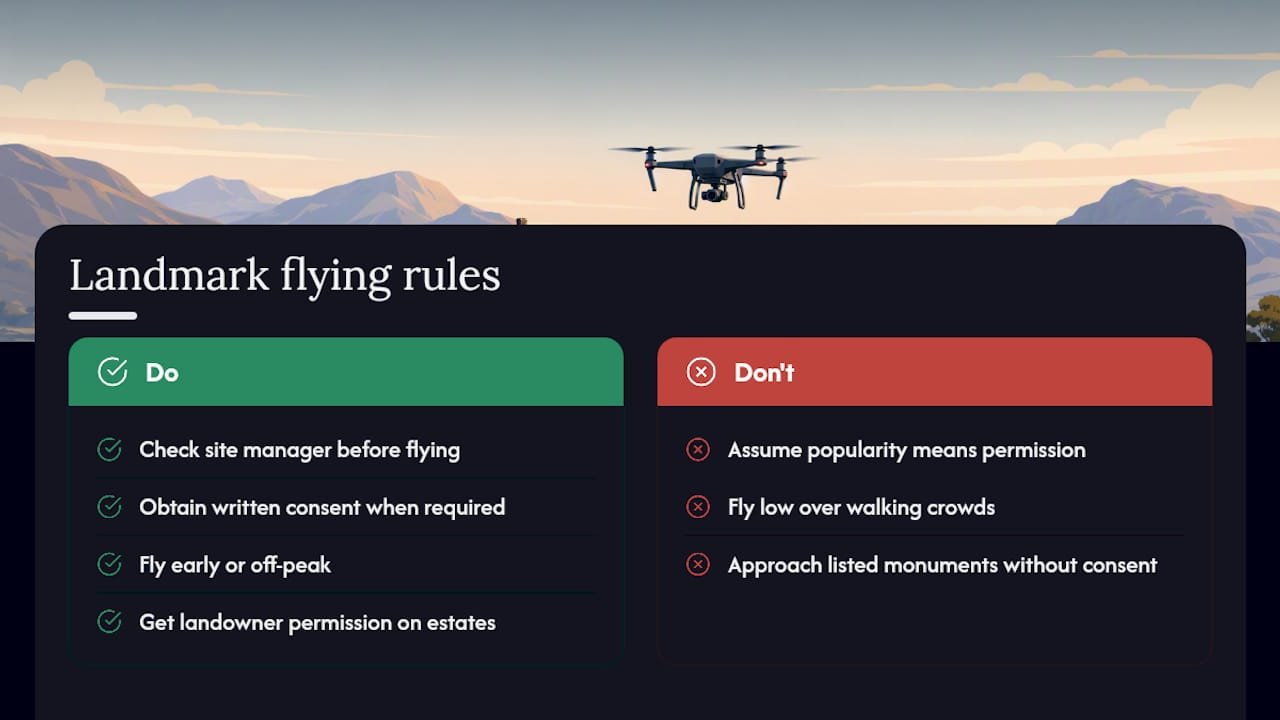
Popular does not mean permitted. Glenfinnan Viaduct, the Old Man of Storr, and the shores of Loch Ness draw thousands of visitors with cameras and drones every summer, and that popularity is exactly why several sites now carry informal or formal restrictions.
Historic Environment Scotland manages a number of scheduled monuments and castles where drone use requires prior written consent, since flights near listed structures can affect visitor safety and, in some cases, breach heritage protection rules. Loch-side and glen locations often sit on private estate land even when they look like open countryside, which brings you straight back to the landowner permission issue covered earlier.
The Isle of Skye’s most photographed spots, the Quiraing, Neist Point, the Fairy Pools, get busy enough in peak season that a low-flying drone over walking crowds breaches the minimum distance rules almost by default. If you’re picturing an empty landscape shot at Neist Point in July, you’re picturing the wrong month. Early mornings or shoulder-season visits solve both the legal problem and the crowd in your shot.
Before flying at any landmark, a quick search for the site’s managing body, whether that’s Historic Environment Scotland, a National Trust for Scotland property, or a private estate, tells you whether consent is needed. Our guide to Scotland’s finest highland glens flags a few locations where access arrangements are worth checking ahead of a visit.
Local council rules on drones in Scottish parks and towns
Local authorities can and do add their own restrictions on top of national drone law, usually through park bylaws or land management conditions rather than aviation legislation itself. Several Scottish councils, including those managing Edinburgh’s parks and Glasgow’s green spaces, restrict or ban drone launches from council-owned land without prior written consent.
These bylaws don’t override the CAA’s rules; they sit alongside them as a separate condition of using that specific piece of land, much like the landowner permission issue affecting estates and forests. A council park is publicly accessible but not necessarily open to drone launches, and enforcement typically comes through park wardens or environmental health rather than Police Scotland.
If you’re planning an urban flight anywhere in Scotland, check the specific local authority’s website for a drone or model aircraft policy before you go. Most publish this under “parks and open spaces” rather than under aviation, which is why so many pilots miss it entirely.
Weather considerations that make Scottish drone flights harder
Scotland’s weather is genuinely different from flying conditions in most of England, and it catches out plenty of visiting pilots who assume their usual settings will transfer.
Wind is the biggest factor. Highland glens and coastal headlands funnel wind speeds well beyond what’s forecast for the nearest town, and a drone rated for 12m/s gusts can struggle badly on an exposed ridge or clifftop where local acceleration pushes well past that figure. Check a mountain-specific forecast, not just a general weather app, before flying anywhere above 300 metres elevation.
Rain and moisture matter too, since few consumer drones carry a genuine waterproof rating, and Highland drizzle rolls in faster than most forecasts predict. Battery performance also drops noticeably in cold temperatures, common at altitude even in summer, so budget for shorter flight times than the manufacturer’s spec sheet promises.
Fast-changing cloud base is the other trap. A clear launch site can lose visual line of sight within minutes if hill fog rolls in, which is a real hazard given the VLOS requirement covered earlier. Checking conditions on the day, not the night before, is worth the extra five minutes.
How local guides handle drone requests on Scottish tours
Guests on guided tours ask about drone photography often enough that it comes up on nearly every Skye or Glencoe itinerary. Our guides know which viewpoints sit on land where permission has already been arranged, and which look identical from the road but sit on private estate ground requiring a written request weeks in advance.
That local knowledge, built from years of running the same routes, saves visitors from finding out the hard way that a stunning glen shot needs landowner consent they don’t have time to secure mid-trip. Photography etiquette matters just as much on a guided tour as the legal side, since a traveller’s guide to photography on tours makes clear how much smoother the experience runs when a guide manages access rather than a guest improvising on the day.
— Alin
Let a local guide handle the access, not just the itinerary
Using a local tour operator is an alternative to solo drone planning for landscape photography in the Highlands: guides may already know which glens, lochs and viewpoints have permission sorted, so you spend your visit shooting rather than emailing estate offices. That’s the real difference between a DIY trip and a guided one when the location depends on someone else’s land.
Our private tours cover the Scottish Highlands with routes built around the same landmarks covered in this guide, Glenfinnan, Loch Ness, the Black Isle, and Skye’s most photographed corners, minus the guesswork over who owns the land you’re standing on. Itineraries are built around your interests, whether that’s a whisky-focused day or a family trip with photography stops built in, and our team can point you toward viewpoints where access has already been agreed. Check availability and start planning your custom Highland itinerary today.
Sources
- The Drone and Model Aircraft Code (CAA)
- The Unmanned Aircraft (Offences and Consequential Amendments) Regulations 2025 No. 1284
- Gov
- Getting what you need to fly legally | UK Civil Aviation Authority
FAQ
Can I fly a drone anywhere in Scotland?
No. You must obey the UK-wide Drone Code (height, distance and airspace limits), and you also need landowner permission for take-off and landing plus awareness of wildlife protection rules and airport FRZs.
Can I fly my 249g drone anywhere?
A drone under 250g without a camera avoids Flyer and Operator ID requirements, but it still must respect airspace restrictions, FRZs, and land access rules if it carries any camera at all.
Is it legal for a neighbour to fly a drone over my house?
It can breach privacy or nuisance law depending on the circumstances, and persistent or reckless flying over private property can also fall foul of the Drone Code’s distance rules and, in serious cases, harassment law; Police Scotland can advise on specific incidents.
What are the new drone laws for 2026?
The 2026 update centres on class marks (C0 to C4) and expanded Remote ID requirements for UK1 to UK3 class drones, alongside the offences and registration duties set out in the Unmanned Aircraft (Offences and Consequential Amendments) Regulations 2025.