
Your cart is empty Continue Shopping
The role of special interests in tours: your 2026 guide
Special interest tourism (SIT) is defined as the practice of organising tours around a specific passion, theme, or area of expertise, creating immersive experiences that go far beyond standard sightseeing. Where mass-market tours move travellers through a checklist of landmarks, SIT builds every element of a trip around a core subject, whether that is whisky distilling, wildlife ecology, culinary heritage, or ancient history. Industry analyses in 2026 identify cultural and gastronomic tourism as high-value segments, driven by purpose-seeking travellers willing to pay a premium for depth and authenticity. The role of special interests in tours is not a niche trend. It is the defining shift in how serious travellers choose to spend their time and money. Skyehighlandstours builds its entire offering around this principle, designing private Highland experiences that serve each traveller’s specific passions.
What motivates travellers to choose special interest tours?
SIT aligns directly with Maslow’s higher-level psychological needs, specifically self-actualisation, cognitive growth, and aesthetic appreciation. Travellers who choose passion-driven tours are not seeking relaxation alone. They want mastery, understanding, and a sense of personal development that a beach holiday or a city hop simply cannot provide.
Researchers identify four broad traveller types within SIT:
- Novelty seekers want experiences they have never had before and are drawn to rare or unusual themes.
- Active tourists prioritise physical engagement, such as hiking, foraging, or hands-on craft activities.
- Expert tourists arrive with existing knowledge and want to go deeper, often engaging guides as intellectual peers.
- Enthusiasts have a strong personal passion, such as Scotch whisky or birdwatching, and treat the tour as an extension of that identity.
Each type shares one quality: the desire to go beyond the surface. A standard sightseeing tour delivers facts about a place. A special interest tour delivers understanding of a subject, with the place as the setting. That distinction changes everything about how a tour is planned, paced, and experienced.
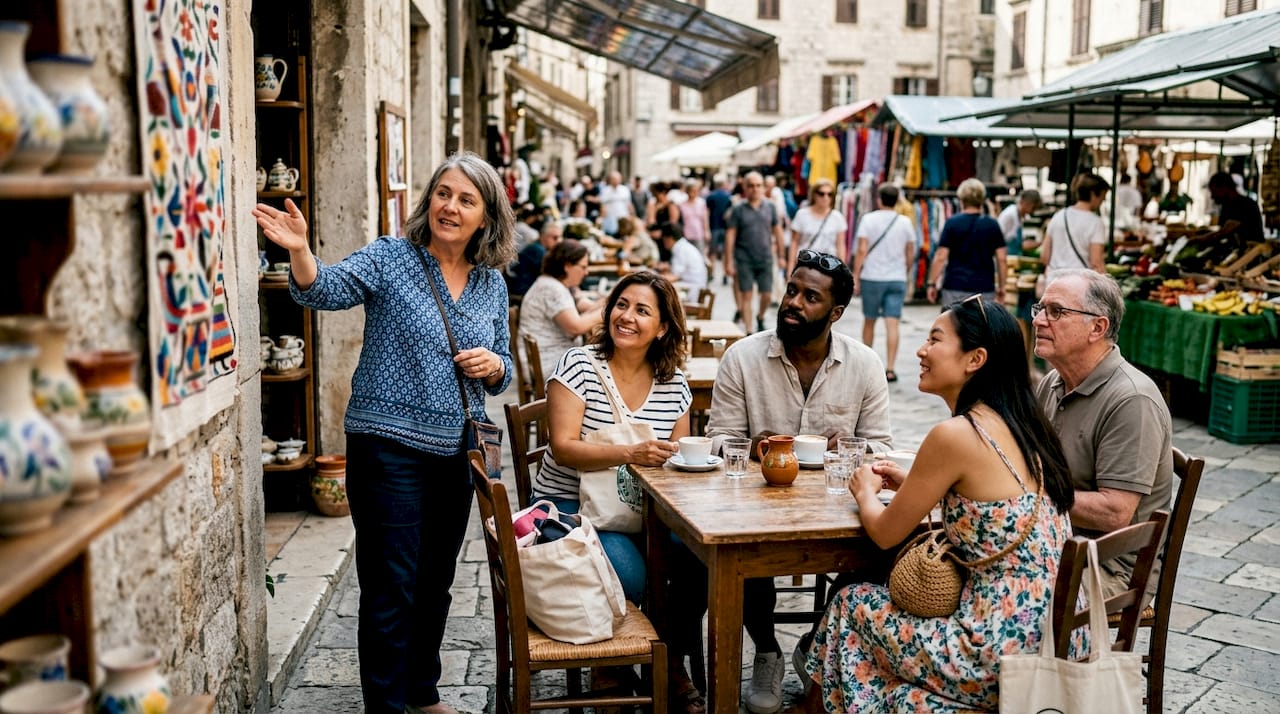
The motivation also has a social dimension. Travellers who choose SIT are self-selecting into a group of like-minded people. They arrive knowing the group shares their values and curiosity. That shared starting point accelerates connection in a way that random group tours rarely achieve.
Pro Tip: Before booking any tour marketed as “special interest,” ask the operator what percentage of the itinerary is dedicated to the core theme. If the answer is less than 70%, the tour is likely a standard itinerary with a single themed activity added on.
How are special interest tours designed differently from standard sightseeing tours?
Effective SIT design requires what tourism product developers call “disciplined choice.” The operator must select one clear, distinctive theme and build every component of the trip around it. Accommodation, food, transport, and scheduled stops must all reinforce the core passion. Nothing is included simply because it is nearby or popular.
This is where most tours that claim the SIT label fail. Adding a single workshop to an otherwise standard itinerary does not create a genuine special interest experience. It creates a standard tour with a premium price tag. Authentic SIT requires the theme to be present at every stage, from the first briefing to the final meal.
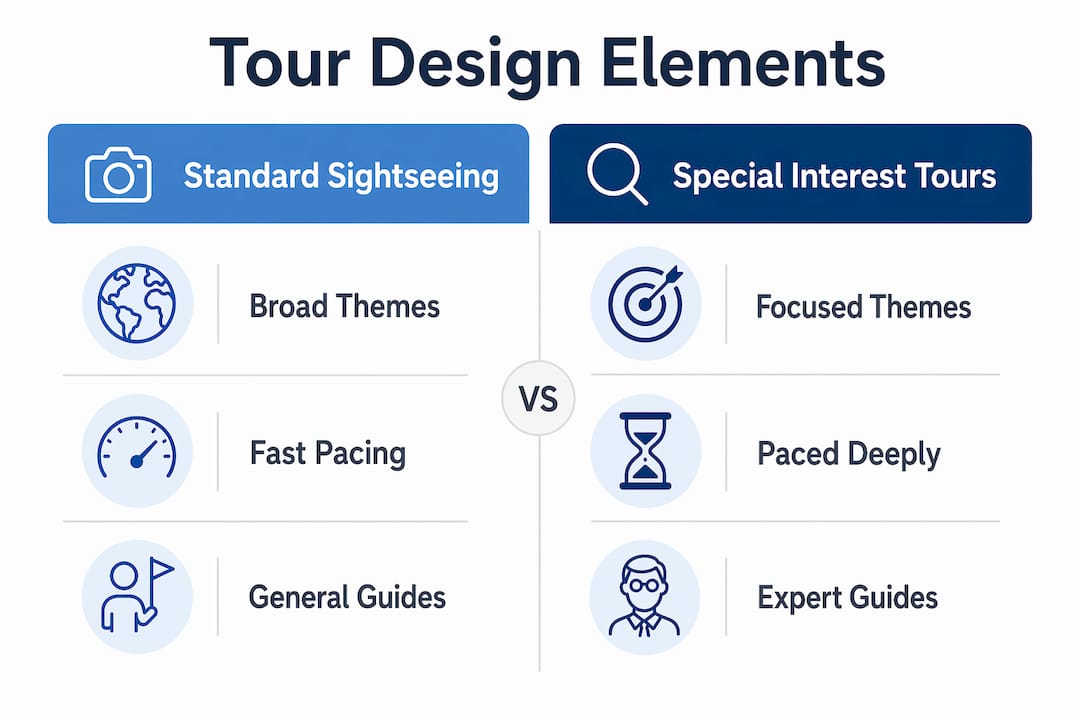
Pacing is one of the clearest differences between genuine SIT and mass-market tours. Low-cost tours often spend as little as 45 minutes at a site before moving on. High-quality SIT allocates 2–3 hours per location, allowing for genuine engagement, questions, and reflection. That difference in time is not just logistical. It changes the quality of understanding a traveller takes home.
| Design element | Standard sightseeing tour | Special interest tour |
|---|---|---|
| Theme focus | Broad, destination-based | Narrow, passion-based |
| Time per site | 30–60 minutes | 2–3 hours |
| Accommodation | Convenient, generic | Chosen to reinforce the theme |
| Guide expertise | General local knowledge | Subject-matter specialist |
| Group composition | Random mix of travellers | Self-selected by shared interest |
The table above shows that the differences are structural, not cosmetic. A whisky-focused tour in the Scottish Highlands, for example, would stay at a distillery-adjacent inn, eat at a restaurant pairing food with single malts, and spend full afternoons at working distilleries rather than passing through for a quick dram. Skyehighlandstours applies this principle directly to its Speyside Whisky Tour, where every stop serves the theme.
Pro Tip: Check whether the tour operator lists the guide’s specific credentials for the theme, not just general guiding experience. A whisky tour led by a certified whisky educator delivers a fundamentally different experience from one led by a generalist.
What impact do special interests have on social dynamics within tours?
The social dimension of SIT is its least discussed and most powerful feature. Genuine special interest groups form strong social bonds quickly because every member has already self-selected by shared passion. There is no awkward period of finding common ground. The common ground is the reason everyone is there.
This creates four distinct social effects that standard tours rarely produce:
- Accelerated trust. Shared expertise or enthusiasm removes the social friction that slows bonding in mixed groups.
- Peer learning. Expert tourists teach each other. A group of serious whisky drinkers will collectively know more than any single guide, creating a collaborative learning environment.
- Intellectual depth. Conversations go further because everyone has the vocabulary and context to engage at a high level.
- Lasting connection. Participants frequently describe SIT experiences as “before and after” events in their lives, not simply holidays.
The guide’s role shifts in this environment. Rather than being the sole source of information, a skilled SIT guide acts as an intellectual anchor, directing the group’s collective knowledge toward new discoveries. The role of storytelling in guided tours becomes especially important here, as narrative connects facts to meaning and keeps the group emotionally engaged throughout.
The social intensity of a well-run SIT group is also what produces the most memorable travel experiences. When you are surrounded by people who care as deeply as you do about the subject, every conversation adds to the experience. That quality of shared attention is something a solo visit to a landmark simply cannot replicate.
How do market factors and pricing reflect the value of special interest tours?
Pricing in the SIT market reflects both genuine value and, in some cases, market concentration. Markups on rare or exclusive experiences can exceed ten times the standard pricing for comparable services, indicating that the price reflects access and exclusivity rather than basic service costs alone. Travellers need to understand what they are paying for before they book.
Genuine SIT commands higher prices for three legitimate reasons. First, subject-matter expert guides earn more than generalist guides and are harder to find. Second, authentic venues, such as private distillery access or closed archaeological sites, carry access fees that standard tours do not face. Third, smaller group sizes, which are standard in quality SIT, mean costs are spread across fewer travellers.
The risk is that the “special interest” label has become a marketing tool for operators who offer none of these things. A tour that spends 45 minutes at each stop, uses a generalist guide, and adds one themed activity is not SIT. It is a standard tour with a premium label. Travellers can protect themselves by asking three direct questions before booking: Who is the guide and what are their credentials? How much time does the itinerary allocate to the core theme? What makes the access or experience exclusive?
Gastronomy tourism offers a useful example of how genuine SIT pricing works. A food-focused tour that includes a private cooking lesson with a local chef, a visit to a working farm, and a guided market tour with a culinary historian costs more than a standard food tour. Each element has a clear, verifiable cost attached to it. When operators cannot explain what drives their pricing, that is a signal worth heeding.
Understanding what a specialised tour actually includes is the most reliable way to assess whether a price reflects genuine value. Transparency in itinerary design is the mark of a serious SIT operator.
Key takeaways
Special interest tourism delivers its greatest value when every element of the tour, from guide expertise to pacing and accommodation, is built around a single, clearly defined passion.
| Point | Details |
|---|---|
| SIT is theme-first by design | Every logistical element must reinforce the core passion, not just one activity. |
| Pacing separates genuine SIT | Quality tours spend 2–3 hours per site; budget tours average as little as 45 minutes. |
| Social bonds form faster | Shared interest removes social friction, creating peer learning and lasting connections. |
| Pricing reflects access and expertise | Higher costs are justified by specialist guides, exclusive access, and smaller group sizes. |
| Authenticity requires scrutiny | Ask about guide credentials and theme time allocation before booking any SIT product. |
Why I think most travellers underestimate what special interest travel can do
Most travellers I speak with treat special interest tours as a luxury add-on, something for the obsessive enthusiast rather than the everyday curious person. That framing is wrong, and it costs people some of the best travel experiences available.
The real value of SIT is not the subject matter. It is the quality of attention it produces. When you are on a tour built around something you genuinely care about, you are present in a way that standard sightseeing rarely achieves. You ask better questions. You notice more. You remember more. The Isle of Skye looks different when you are there to understand its geology or its Gaelic heritage rather than simply to photograph it.
The misconception I encounter most often is that SIT requires deep prior knowledge. It does not. Enthusiast-level curiosity is enough. The best SIT guides I have observed are skilled at meeting travellers where they are, whether that is a first-time whisky drinker or a seasoned collector. What matters is genuine interest, not expertise.
My honest advice is this: choose one thing you love and find a tour built entirely around it. Do not compromise on the theme for the sake of covering more ground. Depth beats breadth every time in travel, and personalised Highland tours are proof of what happens when that principle is applied with care.
— Alin
How Skyehighlandstours brings special interest travel to the Scottish Highlands
Skyehighlandstours designs private guided tours across the Scottish Highlands with a clear commitment to theme-first travel. Whether your passion is Scotch whisky, Highland history, dramatic landscapes, or Scottish wildlife, each itinerary is built to serve that interest from start to finish, not to tick off a list of popular stops.
The North Whisky Tour and Speyside Whisky Tour are two examples of how Skyehighlandstours applies genuine SIT principles, with expert local guides, distillery access, and itineraries paced for depth rather than volume. For travellers who want to shape their own experience, the custom itinerary workflow makes it straightforward to build a tour around what matters most to you.
FAQ
What is special interest tourism?
Special interest tourism (SIT) is the practice of organising tours around a specific passion or theme, such as whisky, wildlife, or cultural heritage, rather than general sightseeing. Every element of the itinerary is designed to deepen the traveller’s engagement with that core subject.
How do special interests affect the quality of a tour?
Special interests raise tour quality by driving deeper pacing, specialist guide selection, and curated access that standard tours do not offer. High-quality SIT allocates 2–3 hours per site compared to as little as 45 minutes on budget alternatives.
Why are special interest tours often more expensive?
Prices are higher because genuine SIT requires subject-matter expert guides, exclusive venue access, and smaller group sizes, all of which carry real costs. Market analysis shows markups on exclusive experiences can exceed ten times standard pricing, reflecting genuine scarcity rather than arbitrary inflation.
How can I tell if a tour is genuinely special interest?
Ask the operator how much of the itinerary is dedicated to the core theme, what the guide’s specific credentials are, and what makes the access unique. Tours that cannot answer these questions clearly are likely standard itineraries with a themed label applied for marketing purposes.
What types of travellers benefit most from special interest tours?
SIT suits four traveller types: novelty seekers, active tourists, expert tourists, and enthusiasts. All four share a desire for depth and personal growth over passive sightseeing, making SIT the right choice for any traveller who wants to come home knowing more than when they left.
1 Comment