Your cart is empty Continue Shopping
What is highland wildlife: the complete species guide
The Scottish Highlands hold one of the most ecologically rich and underestimated wildernesses in Europe, and understanding what is highland wildlife means going far beyond the postcard image of a solitary stag on a misty hillside. Yes, red deer are magnificent. But they share their territory with creatures most visitors never see: Scottish wildcats prowling ancient pine forests, capercaillie crashing through the understorey, moths navigating skies so dark they are internationally protected. This guide cuts through the surface to reveal the true depth of Highland fauna, from its most iconic species to the nocturnal residents most people walk straight past.
Table of Contents
- Key takeaways
- What is highland wildlife and why it matters
- The habitats that shape highland fauna
- Notable highland wildlife species: icons and the overlooked
- Conservation challenges and real solutions
- Wild encounters versus conservation parks
- How to experience highland wildlife responsibly
- My honest take on Highland wildlife
- See the Highlands with expert eyes
- FAQ
Key takeaways
| Point | Details |
|---|---|
| Highland wildlife is highly diverse | The Highland ecosystem supports mammals, birds, insects, and aquatic species across multiple distinct habitats. |
| Some species are critically endangered | Scottish wildcats number fewer than 100 purebred individuals in the wild, making every sighting genuinely significant. |
| Conservation is specific and targeted | Broad protection alone is insufficient; species like capercaillie require precise, habitat-sensitive management to survive. |
| Dark Skies status protects nocturnal fauna | Reducing light pollution in the Highlands directly improves habitat quality for bats, moths, and other nocturnal species. |
| Responsible tourism actively helps | Ethical wildlife observation and guided tours contribute to conservation funding and community biodiversity programmes. |
What is highland wildlife and why it matters
The term “highland wildlife” refers to the full spectrum of animal life native to or regularly found within the Scottish Highlands: an expansive region of mountains, glens, ancient forests, peat bogs, and freshwater lochs covering roughly 26,000 square kilometres of northern Scotland. It is not simply a collection of charismatic species. It is a functioning ecological web in which each organism, from the smallest moth to the largest red deer stag, plays a measurable role.
What makes Highland biodiversity unusual is the combination of geographic isolation, low human population density, and habitat variety that exists in such close proximity. You can travel from ancient Caledonian pine forest to open moorland to a deep freshwater loch within a single hour. Each transition brings an entirely different community of wildlife in highlands, shaped by soil type, altitude, water availability, and human land use history.
The misconception that this is sparse or monotonous territory persists largely because Highland wildlife is not always visible. Many of the most significant species are elusive, nocturnal, or active only during narrow seasonal windows. Understanding the ecology of the place is what turns a walk through moorland from a pretty stroll into a genuinely revelatory experience.
The habitats that shape highland fauna
Before you can understand which highland animal species live here and why, you need to understand the terrain that produced them. The Highlands are not one habitat. They are several, layered and interlocking.
- Caledonian pine forests: Ancient Scots pine woodlands, remnants of a forest that once covered much of Scotland, support capercaillie (Tetrao urogallus), red squirrels (Sciurus vulgaris), crested tits (Lophophanes cristatus), and pine martens (Martes martes). These forests are fragmented and irreplaceable.
- Heather moorlands: Vast stretches of open ground dominated by heather (Calluna vulgaris), supporting red grouse (Lagopus lagopus scotica), mountain hares (Lepus timidus), and golden eagles (Aquila chrysaetos) hunting overhead.
- Peat bogs and wetlands: Home to specialist plants and insects, these waterlogged habitats are critical for common lizards, adders, and numerous invertebrate species that form the base of many food chains.
- Freshwater lochs and rivers: Providing habitat for otters (Lutra lutra), ospreys (Pandion haliaetus), Atlantic salmon (Salmo salar), and water voles (Arvicola amphibius).
The landscape also matters for nocturnal highland wildlife habitats. The Dark Skies planning policy being considered by Highland Council recognises that reducing artificial light pollution directly improves habitat quality for bats, moths, and other species that navigate and feed after dark. Dark Skies status is not simply an asset for stargazers. It is a serious conservation tool with measurable benefits for wildlife health.
Pro Tip: If you plan to watch wildlife at dusk or after dark, visit areas away from villages and roads where light pollution is minimal. The northern Highlands near Caithness and Sutherland offer some of the darkest skies in Europe.
Notable highland wildlife species: icons and the overlooked
Most people can name three Highland species without thinking. What follows goes deeper into both the familiar and the overlooked.
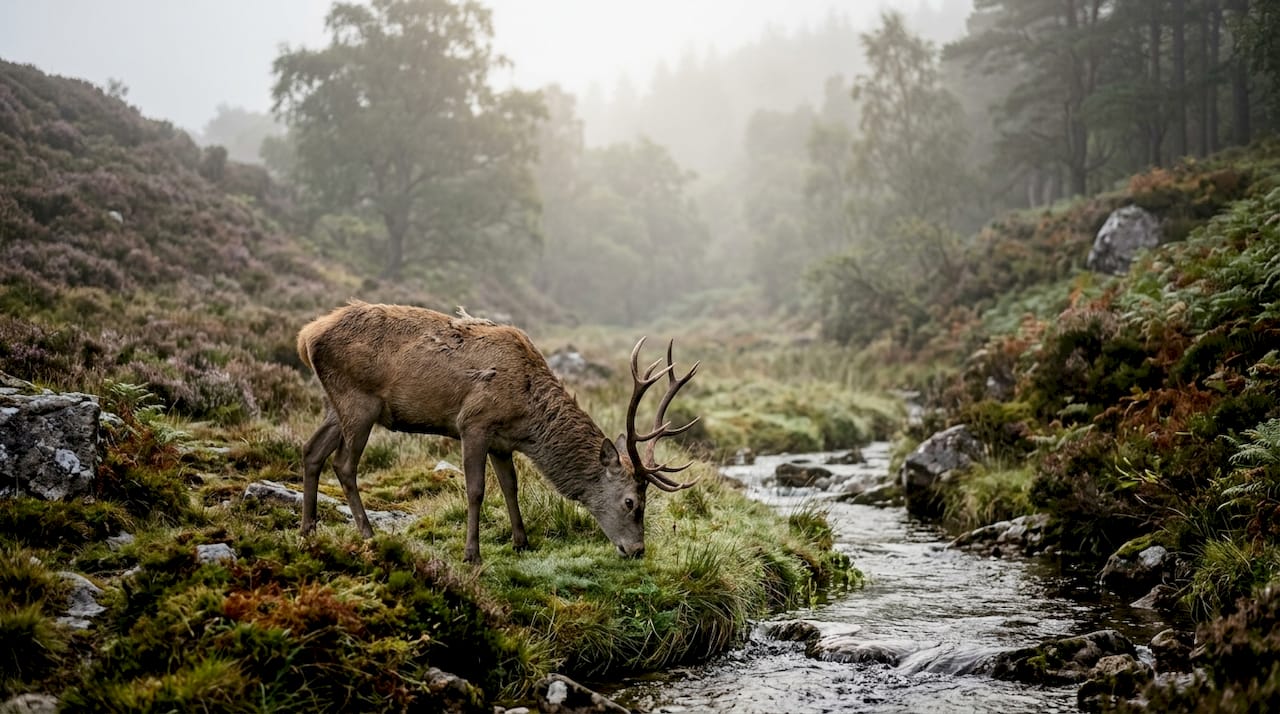
Red deer (Cervus elaphus) are the largest land mammals in Britain and almost impossible to miss in open glen and moorland. Stags can weigh over 190 kilograms and the autumn rut, when males bellow across the hills in October, is one of the great wildlife spectacles on these islands.
Scottish wildcat (Felis silvestris grampia) is a different matter entirely. Fewer than 100 purebred individuals are thought to survive in the wild. Hybridisation with feral domestic cats has made identification extremely difficult. The wildcat is physically similar to a tabby but stockier, with a blunt, distinctly banded tail and no white markings. It is one of Britain’s most endangered native animals.
Capercaillie (Tetrao urogallus) is the largest member of the grouse family and a species that encapsulates the fragility of Highland wildlife conservation. Males are enormous, black-plumed birds producing a sequence of extraordinary sounds during their spring display. They are a Schedule 1 protected species, meaning disturbing them during the breeding season is a criminal offence. Their dependence on mature Scots pine forests with specific ground cover makes habitat management critical to their survival.
Then there are the species most visitors never consider. Bats: the Highlands host several species including Daubenton’s bat (Myotis daubentonii), which hunts insects directly above loch surfaces at night with extraordinary precision. Moths: often dismissed as dull brown cousins of butterflies, they are vital pollinators and a critical food source for bats, birds, and small mammals. The Highlands host hundreds of species, many of which are poorly recorded because they are active only in darkness.
Other notable highland fauna includes golden eagles, white-tailed eagles (Haliaeetus albicilla), ospreys, otters, red squirrels, pine martens, and mountain hares that turn white in winter. The list is long. Highland biodiversity, when you look closely, is genuinely extraordinary.
Conservation challenges and real solutions
The native wildlife of highlands faces pressures from multiple directions simultaneously. Habitat loss through overgrazing, commercial forestry monoculture, and peat extraction has reduced the quality and connectivity of key habitats. Climate change is altering flowering and insect emergence times, disrupting the food webs that migratory and resident species depend upon. Human disturbance, even well-intentioned wildlife watching, can cause breeding failure in sensitive species.
The responses to these challenges are more targeted than many people realise.
- Diversionary feeding for capercaillie protection: Researchers found that providing alternative food sources for nest predators during the capercaillie breeding season delivered dramatic results. Brood detection rose from 37% to 85%, and productivity increased from 0.82 to 1.90 chicks per hen. This is a 130% increase in brood success without harming any predator species.
- Community moth-trap lending programmes: In 2026, High Life Highland launched a moth trap lending scheme through libraries in Wick, Thurso, and Ullapool, accompanied by ranger-led workshops. The data collected helps scientists understand how climate and land-use changes affect nocturnal biodiversity across the region.
- Dark Skies planning policy: By formally embedding light pollution reduction into planning decisions, Highland Council can protect the nocturnal habitat quality that bats, moths, and other wildlife depend upon across vast areas of the region.
“Conservation success often depends on specific, habitat-sensitive management rather than broad protection measures. Specialist species like capercaillie require targeted actions to survive.” — Cairngorms National Park
Pro Tip: You can contribute directly to Highland conservation by borrowing a moth trap from High Life Highland libraries and submitting your records. Even a single night of trapping in your garden adds to the scientific dataset.
Wild encounters versus conservation parks
There is an honest conversation to have about the difference between spotting highland wildlife in genuinely wild settings and visiting a managed conservation facility like the Highland Wildlife Park near Kingussie.
| Experience type | Wild setting | Conservation park |
|---|---|---|
| Species visibility | Unpredictable and often limited | Consistent and guaranteed |
| Conservation benefit | Supports habitat and ethical tourism | Funds breeding and global programmes |
| Educational value | High if guided | Very high with expert staff |
| Disturbance risk | Significant if unguided | Minimal with managed access |
| Rarity of species | Possible but elusive | Includes species impossible to see wild |
The Highland Wildlife Park takes a genuinely significant conservation role. It is one of only two UK locations housing polar bears and breeds rare global species including Amur leopards (Panthera pardus orientalis) and Przewalski’s horses (Equus ferus przewalskii) as part of European endangered species programmes. Scottish wildcats are kept in habitat-mimicking enclosures specifically designed to maintain natural predatory behaviours.
The park does not replace wild encounters. It complements them. For species like the Scottish wildcat, where wild sightings are extraordinarily rare, the park may be the only realistic way most people ever see one. For capercaillie, where approaching a wild bird during breeding can constitute a criminal offence, understanding the species through managed environments first makes field encounters far more responsible.
How to experience highland wildlife responsibly
Seeing elusive native wildlife in the wild requires specific habitat knowledge, patience, and genuine respect for ethical observation practices. Here is how to approach it well.
- Research the species before you go. Know the habitat, the seasonal activity patterns, and the legal protections. Disturbing capercaillie during breeding is a criminal offence, not a minor inconvenience.
- Use binoculars and telephoto lenses. Getting physically close to wildlife causes stress, breeding failure, and habituation to humans. Distance is respect.
- Go with a knowledgeable local guide. A guide who knows the terrain reads signs you would miss: pellets, prints, scratching posts, feeding patterns. The encounter becomes real information, not a fleeting glimpse.
- Participate in citizen science. Moth trap lending, breeding bird surveys, and otter monitoring programmes all welcome volunteers. You learn more and contribute something meaningful.
- Support conservation-conscious tourism. Choose operators who follow wildlife codes of conduct and whose revenue feeds back into local conservation and community programmes.
Pro Tip: Dawn is consistently the most productive time for wildlife observation across nearly every Highland habitat. Mammals are returning from nocturnal activity, birds are at peak calling, and light conditions favour both visibility and photography.
A tailored Highland tour built around your specific interests, whether that means sitting quietly at a loch edge for otters or tracking golden eagles across open moorland, transforms wildlife watching from chance encounters into something deliberately rewarding.
My honest take on Highland wildlife
I have spent years watching people arrive in the Highlands expecting to photograph a wildcat on their first afternoon and leave disappointed. The disappointment is understandable but preventable. What I have learned is that the Highlands rewards a different kind of attention.
The species that move me most are rarely the ones on the brochures. A mountain hare in full winter white against grey rock. A pine marten moving through a forest edge at last light. A golden eagle holding position against a gale without a single wingbeat. These moments require you to slow down, to understand something about the animal’s world before you enter it.
What I find genuinely compelling about Highland wildlife conservation is that the most effective solutions are precise rather than sweeping. The capercaillie research showing that diversionary feeding strategies can almost double chick survival without harming a single predator is the kind of elegant, targeted thinking that actually moves the needle. Broad protections help. Specific ones save species.
My honest advice: visit with curiosity rather than expectation. Let the place surprise you. The Highlands will, reliably, if you give it time.
— Alin
See the Highlands with expert eyes
If this guide has sparked the desire to actually experience Highland wildlife rather than simply read about it, Skyehighlandstours makes that straightforward and genuinely worthwhile.

The team at Skyehighlandstours offers private wildlife tours designed around the specific species, habitats, and experiences you care most about. Whether you want to track otters along a river, watch eagles from a hillside at dawn, or explore the ancient Caledonian pine forests where capercaillie survive, local guides bring the kind of habitat knowledge that makes the difference between a frustrating morning and a sighting you remember for years. Family groups, solo travellers, and dedicated wildlife photographers are all accommodated with itineraries built around your pace and priorities. Every booking also supports responsible, conservation-aware Highland tourism. You can explore the full range of available Scottish Highlands tours and begin planning your visit today.
FAQ
What animals live in the Scottish Highlands?
The Scottish Highlands are home to red deer, Scottish wildcats, capercaillie, golden eagles, ospreys, otters, red squirrels, pine martens, mountain hares, and numerous bat and moth species, among many others.
Is the Scottish wildcat really endangered?
Yes. Fewer than 100 purebred Scottish wildcats are believed to survive in the wild, making it one of the most endangered mammals in Britain. Hybridisation with feral cats is the primary threat.
What is the Highland ecosystem made up of?
The Highland ecosystem includes Caledonian pine forests, heather moorlands, peat bogs, freshwater lochs, and river systems, each supporting distinct communities of native wildlife.
How does the Dark Skies policy help Highland wildlife?
Reducing artificial light pollution improves habitat quality for nocturnal species including bats, moths, and owls. The Highland Council’s Dark Skies planning policy aims to formalise this protection across the region.
Can visitors legally watch capercaillie in the wild?
Capercaillie are a Schedule 1 protected species. Disturbing them during the breeding season is a criminal offence. Responsible observation requires significant distance and ideally guidance from a knowledgeable local expert.
Recommended
- Discover Highland Heritage: Culture, Clans, and Scenic Scotland – Skye Highlands Tours
- Why the Scottish Highlands are a perfect family adventure – Skye Highlands Tours
- Discover Highland Whisky Tasting: Flavors, Tours, and Tradition – Skye Highlands Tours
- Family-Friendly Highland Excursions for Every Age – Skye Highlands Tours