Your cart is empty Continue Shopping
Cultural tourism explained: what it is and why it matters
What is cultural tourism?
Cultural tourism is travel driven by a desire to engage with the history, traditions, arts, and living culture of a destination, rather than simply passing through it. The UN Tourism General Assembly formally defined it in 2017 as a type of tourism in which the visitor’s essential motivation is “to learn, discover, experience and consume the tangible and intangible cultural attractions/products in a tourism destination,” encompassing arts, architecture, culinary heritage, music, creative industries, and living traditions.
What separates cultural tourism from a standard holiday is the quality of engagement. Cultural tourism focuses on immersion and education rather than leisure alone, distinguishing it clearly from mass tourism, which tends to seek standardised, interchangeable experiences. A traveller visiting Edinburgh Castle to understand the Stuart dynasty is doing something fundamentally different from one who photographs the exterior and moves on.
The motivations vary widely. Some travellers are drawn to tangible heritage: castles, cathedrals, archaeological sites. Others seek intangible culture: local festivals, traditional crafts, regional food, or the Gaelic language still spoken in parts of the Scottish Highlands. Both count. Cultural tourism contributed to over 39% of international tourism arrivals worldwide in 2017, and demand for immersive, authentic experiences has grown since.
The core activities include:
- Visiting museums, historic sites, and monuments
- Attending local festivals and performing arts events
- Participating in culinary experiences such as market visits or cooking classes
- Exploring religious and pilgrimage sites
- Engaging with living traditions through workshops, craft demonstrations, or guided heritage tours
Table of Contents
- What forms does cultural tourism take?
- What are the benefits of cultural tourism?
- How do you practise responsible cultural tourism?
- Cultural tourism in the Scottish Highlands: a case study
- How did cultural tourism develop over time?
- Who shapes cultural tourism?
- What are the main challenges facing cultural tourism?
- How do you plan a cultural tourism trip well?
- How does cultural tourism affect local culture and economy?
- Experience the Scottish Highlands with Skyehighlandstours
- FAQ
- Key takeaways
What forms does cultural tourism take?
Cultural tourism covers a broad range of travel styles, and understanding the main types helps you choose experiences that genuinely match your interests.
Heritage tourism centres on places of historical significance: UNESCO World Heritage Sites, ancient ruins, battlefields, and preserved townscapes. Scotland’s Skara Brae, a Neolithic village on Orkney, draws visitors specifically because of its extraordinary state of preservation.
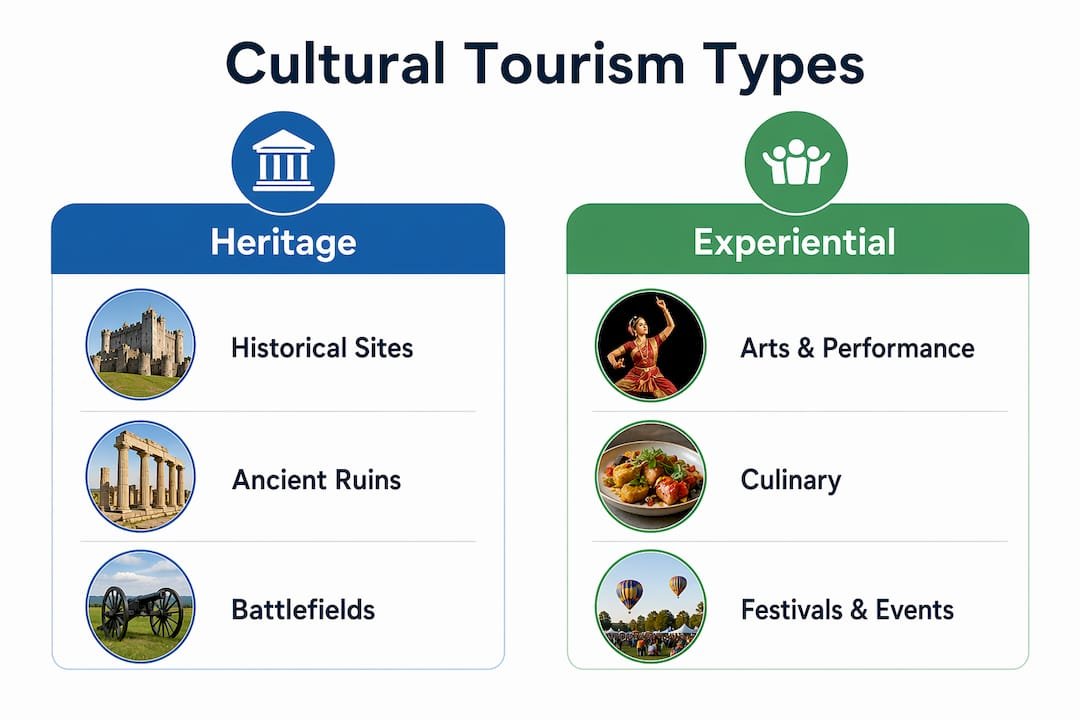
Arts tourism involves travelling to experience live performance, galleries, museums, and literary landmarks. It was historically associated with elite culture, but the arts community has increasingly prioritised accessibility, making this form far more inclusive than it once was.

Culinary tourism connects travellers with a destination through its food and drink traditions. Local cuisine is one of the most direct routes into a culture’s identity, whether that means a whisky distillery tour in Speyside, a street food market in Marrakech, or a farmhouse cheese-making session in Somerset.
Festival and events tourism brings visitors to seasonal celebrations that express a community’s identity: Hogmanay in Edinburgh, Carnival in Trinidad, or the Beltane Fire Festival on Calton Hill. These events are not staged for tourists; they are living cultural expressions that visitors are invited to witness.
Religious and pilgrimage tourism draws millions annually to sites such as Santiago de Compostela, Varanasi, and Lourdes. The motivation is often personal and spiritual, but the cultural dimension is inseparable from the experience.
Creative tourism, defined by researchers Greg Richards and Crispin Raymond in 2000, goes a step further: it involves active participation in cultural learning, such as taking a traditional weaving class or joining a local choir, rather than observing from the outside.
The industry has also shifted its understanding of what counts as culture. Contemporary arts, culinary habits, and living traditions now sit alongside grand historical monuments. This democratisation means a visit to a local farmers’ market or a conversation with a traditional boat-builder qualifies as genuine cultural engagement.
What are the benefits of cultural tourism?
The benefits run in two directions: towards the traveller, and towards the communities they visit.
For travellers, cultural tourism builds empathy and broadens perspective in ways that passive sightseeing rarely achieves. Learning about a community’s history, beliefs, and daily life challenges assumptions and creates lasting memories. Heritage travellers also tend to stay longer and spend more at their destinations than other visitor types, according to research cited by the National Trust for Historic Preservation, and heritage travellers spend on average £166 more per trip than other visitors.
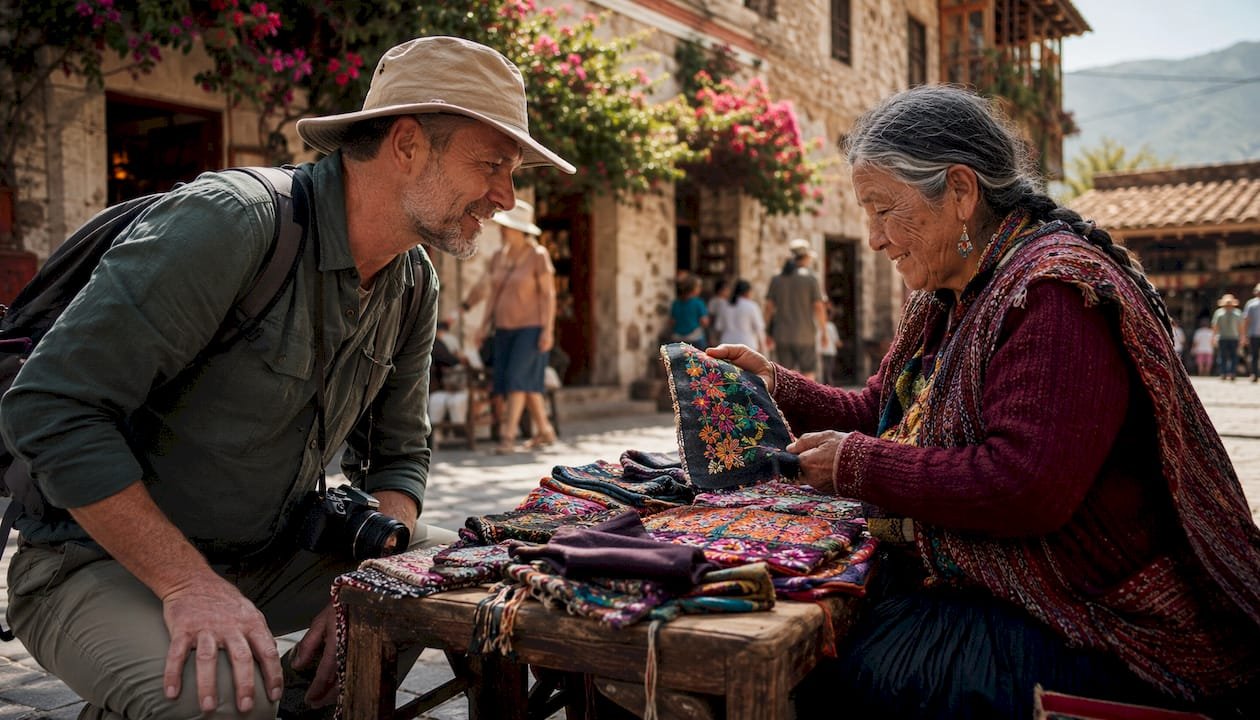
For host communities, the economic case is well established. Tourism creates jobs, generates tax revenue, and funds the upkeep of cultural sites that might otherwise deteriorate. Choosing locally owned guesthouses, small-scale tours, and local markets creates a multiplier effect, keeping revenue within the community rather than flowing to international chains.
Cultural preservation is perhaps the less obvious benefit. When a community’s traditions attract visitors, those traditions gain economic value and social recognition. Gaelic language courses, traditional Highland games, and clan history tours all receive support partly because they draw interested visitors. Community participation in cultural tourism amplifies local employment and income, with studies in culturally rich rural areas confirming that local empowerment is critical for inclusive development.
The exchange also works both ways. Cultural tourism acts as a bridge for mutual understanding, transforming travel into a two-way dialogue rather than a one-sided sightseeing exercise. Locals gain exposure to different perspectives; visitors gain depth and context they could not find online.
How do you practise responsible cultural tourism?
Responsible cultural tourism requires active thought, not just good intentions. The risks of getting it wrong are real: rapid or poorly managed cultural tourism can increase local living costs, strain the environment, and disrupt social life.
The practical principles are straightforward:
- Research before you go. Successful cultural tourists prepare by studying the destination’s history and culture in advance, turning a passive visit into informed engagement.
- Support community-led initiatives. Book with local guides, stay in locally owned accommodation, and spend at local markets rather than resort shops.
- Respect local customs and boundaries. Dress appropriately at religious sites, ask permission before photographing people, and follow posted guidelines at heritage sites.
- Avoid exploitative experiences. If an activity feels staged purely for tourist consumption, with no connection to living community practice, it probably is.
- Engage with the present, not just the past. Culture is living and changing. Seeking authenticity as a fixed historical state is a common pitfall; genuine engagement means appreciating contemporary lifestyles alongside traditional heritage.
Pro Tip: Before booking any cultural experience, check whether the operator employs local guides, reinvests in the community, or holds recognised responsible tourism credentials. A guide who grew up in the region will always offer more than one who learned the script from a brochure.
Cultural tourism in the Scottish Highlands: a case study
The Scottish Highlands offer one of the most compelling examples of cultural tourism in the United Kingdom. The region carries layers of history: Pictish standing stones, Jacobite battlefields, clan territories, and a Gaelic-speaking tradition that predates the Norman Conquest of England by centuries. For travellers seeking Scotland’s living history, the Highlands deliver cultural depth that few destinations in Europe can match.
Skyehighlandstours operates private guided tours across this landscape, covering destinations including the Isle of Skye, Loch Ness, Glenfinnan Viaduct, and the Black Isle. What distinguishes the approach is personalisation: itineraries are built around the traveller’s specific interests, whether that means clan genealogy, Gaelic language and song, traditional whisky production, or the archaeology of the Iron Age. Groups range from solo travellers to families, and tours can be adapted for different physical abilities and durations.
The cultural experiences woven into these tours go well beyond scenic viewpoints. Visitors engage with the stories behind the landscapes: why certain glens were cleared of their populations in the 18th and 19th centuries, how illicit whisky distilling shaped Highland communities, and what the ruins of a blackhouse actually tell us about daily life before the clearances. This is the kind of historical context that transforms a landscape from beautiful to meaningful.
Responsible tourism is embedded in the model. Using local guides keeps knowledge and income within the community. Smaller private groups reduce the footprint on sensitive sites. And the emphasis on understanding, rather than simply viewing, encourages the kind of respectful engagement that heritage sites need to survive.
How did cultural tourism develop over time?
Cultural tourism is not a modern invention, though the term is relatively recent. The Grand Tour of the 17th and 18th centuries sent young European aristocrats through France, Italy, and Greece to absorb classical culture, art, and architecture. It was explicitly educational, and it established the idea that travel could be a form of self-improvement rather than mere movement.
Mass tourism in the 20th century initially pushed in the opposite direction, prioritising volume, convenience, and standardised comfort. Package holidays to the Costa del Sol or Florida offered sun and relaxation, but little cultural depth. By the 1980s and 1990s, a reaction set in. Travellers began seeking experiences that felt more meaningful, more connected to place. UNESCO’s World Heritage List, established in 1972, gave cultural sites a formal international status that helped channel visitor interest towards heritage destinations.
The internet accelerated the shift. Travellers could research destinations in depth before arriving, connect with local guides directly, and share experiences that went beyond beach photographs. Cultural tourism has since evolved from an elite-oriented activity to one embraced broadly, with travellers increasingly seeking everyday cultural experiences that reflect living traditions and local lifestyles, not just grand monuments.
Who shapes cultural tourism?
Cultural tourism involves four main groups, and the experience only works well when all four are aligned.
Tourists are the primary drivers. Their spending, choices, and behaviour determine whether cultural tourism benefits or harms a destination. A tourist who books a local guide, eats at a family-run restaurant, and treats heritage sites with care contributes positively. One who books through an international operator, ignores local customs, and crowds a fragile site does not.
Local communities are both the hosts and the custodians of the culture being visited. Their involvement is not optional. Research confirms that community participation is the critical mediating factor between tourist spending and genuine local development. When communities control how their culture is presented and who benefits financially, outcomes improve for everyone.
Governments and heritage bodies set the frameworks: planning permissions, site management, conservation funding, and tourism policy. UN Tourism works with member states to strengthen cultural tourism policy and governance, while bodies such as UNESCO maintain international standards for heritage protection.
Businesses ranging from tour operators and accommodation providers to local artisans and food producers form the commercial infrastructure. The best operators act as intermediaries who connect visitors to authentic experiences while protecting the communities and sites involved. Local experiences delivered by community-rooted businesses consistently outperform generic alternatives on both cultural depth and economic benefit.
What are the main challenges facing cultural tourism?
The problems are well documented, even if solutions remain contested.
Overtourism is the most visible challenge. When visitor numbers exceed what a site or community can absorb, the consequences include physical damage to heritage structures, rising rents that price out local residents, and a loss of the authentic character that attracted visitors in the first place. Venice, Dubrovnik, and Machu Picchu have all faced this problem acutely.
Commodification occurs when cultural practices are stripped of their meaning and packaged for tourist consumption. A traditional dance performed three times nightly for coach parties bears little resemblance to the same dance performed at a community celebration. The line between sharing culture and selling a caricature of it is not always obvious, but it matters.
Environmental damage accumulates quietly. Increased foot traffic erodes ancient paths, air pollution from tourist transport corrodes stone monuments, and coastal heritage sites face growing risk from climate-related flooding.
Unequal distribution of benefits is a structural problem. Tourism revenue often concentrates in the hands of large operators or flows out of the destination entirely, leaving local communities with the costs of visitor pressure but little of the income.
Misrepresentation affects indigenous and minority cultures particularly. When outside operators control the narrative, cultural tourism can reinforce stereotypes rather than challenge them.
How do you plan a cultural tourism trip well?
Good planning is what separates a genuinely enriching cultural trip from an expensive disappointment.
Start with a clear sense of what you want to understand, not just what you want to see. A trip organised around a question (“What shaped Highland identity after the Jacobite rising?”) will produce richer experiences than one organised around a checklist of famous sites.
Research the destination’s history and contemporary culture before you travel. Read a local author, watch a documentary, or listen to music from the region. This preparation gives you the context to appreciate what you encounter, rather than arriving cold.
Choose operators and guides with genuine local roots. A guide who grew up in a community brings knowledge, personal connection, and cultural nuance that no amount of training can fully replicate. For cultural experiences in Scotland, this means seeking out guides with deep regional knowledge rather than generic tour packages.
Build in time for unplanned encounters. The most memorable cultural moments often happen outside the itinerary: a conversation with a local craftsperson, a chance visit to a village market, or an invitation to a community event. Over-scheduling leaves no room for these.
Finally, reflect on what you have experienced. Cultural tourism works best when it changes how you think, not just what you have seen.
How does cultural tourism affect local culture and economy?
The economic impact of cultural tourism, when managed well, extends well beyond ticket sales. Tourism creates direct employment for guides, hospitality workers, and artisans, and indirect employment across supply chains. Heritage travellers, as noted earlier, spend more and stay longer than average visitors, deepening the economic effect.
Cultural preservation receives a direct boost when heritage sites generate visitor income. Conservation projects that struggle for government funding often rely on tourism revenue to maintain buildings, train specialists, and digitise archives. The economic incentive to preserve becomes self-reinforcing.
The cultural impact is more complex. Positive effects include renewed community pride, revitalisation of traditional crafts and languages, and the transmission of cultural knowledge to younger generations who might otherwise see it as irrelevant. Negative effects include the risk of cultural dilution, where traditions are simplified or distorted to meet tourist expectations, and social disruption when visitor numbers overwhelm local infrastructure.
Spatial clustering of cultural activities into what researchers call “cultural nodes” tends to amplify both economic and social outcomes. When artisan workshops, performance spaces, and culinary venues concentrate in the same area, visitor spending multiplies and community collaboration strengthens. The challenge is ensuring that concentration does not tip into overcrowding.
Experience the Scottish Highlands with Skyehighlandstours
Private guided tours of the Scottish Highlands offer something that self-drive itineraries and group coaches cannot: a guide who knows the land personally and shapes every hour around what you actually want to understand.

Skyehighlandstours provides private, tailored tours across the Highlands, covering the Isle of Skye, Loch Ness, Glenfinnan Viaduct, and beyond. Every itinerary is built around your interests, whether that is clan history, Gaelic culture, Highland whisky, or the archaeology of the clearances. Groups of any size are welcome, and tours adapt to different physical abilities and trip lengths. There are no fixed coach routes and no compromise on depth. You get the cultural context that turns a beautiful landscape into a story you will carry home. Browse the Scottish Highlands tours and book a private experience built around what matters to you.
FAQ
What is the concept of cultural tourism?
Cultural tourism is travel motivated by a desire to learn, experience, and engage with the culture, heritage, and living traditions of a destination, as defined by UN Tourism in 2017. It covers arts, architecture, culinary heritage, music, festivals, and everyday cultural life.
What are the five types of cultural tourists?
Definitions vary, but a widely used framework identifies heritage tourists, arts tourists, culinary tourists, festival and events tourists, and creative tourists who participate actively in cultural learning. Each type engages with culture at a different level of depth and involvement.
How does cultural tourism differ from other types of travel?
Cultural tourism prioritises immersion, learning, and meaningful engagement over leisure or recreation alone. Where mass tourism seeks standardised comfort and convenience, cultural tourism seeks depth, context, and genuine connection with a place and its people.
What is cultural tourism in travel and tourism?
Within the broader travel industry, cultural tourism refers to trips where cultural engagement is the primary or significant motivation, including visits to heritage sites, museums, festivals, and local communities. It is one of the fastest-growing segments of global tourism, accounting for over 39% of international arrivals as of 2017.
Key takeaways
Cultural tourism delivers its greatest value when travellers engage actively, choose local operators, and treat cultural heritage as something to protect rather than consume.
| Point | Details |
|---|---|
| Definition and scope | UN Tourism defines cultural tourism as travel to learn, discover, and experience tangible and intangible cultural attractions, from arts to living traditions. |
| Global scale | Cultural tourism contributed to over 39% of international tourism arrivals worldwide in 2017, reflecting its strong and growing global significance. |
| Community benefit | Community participation amplifies local employment and income; inclusive governance is the critical factor in converting visitor spending into development. |
| Responsible practice | Choosing local guides, locally owned accommodation, and community-led experiences keeps revenue within the destination and supports heritage preservation. |
| Skyehighlandstours | Skyehighlandstours offers private, personalised Highland tours built around clan history, Gaelic culture, and whisky heritage, with expert local guides shaping every itinerary. |
Recommended
- The role of historical context in tours: a 2026 guide – Skye Highlands Tours
- Why family tours matter: benefits for every age – Skye Highlands Tours
- The role of special interests in tours: your 2026 guide – Skye Highlands Tours
- The role of Scottish cultural heritage in identity and arts – Skye Highlands Tours