
Your cart is empty Continue Shopping
Beat the Queue at Glenfinnan Monument: summit slots, avoid £5 parking
Glenfinnan Monument is an 1815 memorial standing at the head of Loch Shiel, marking where the Jacobite standard was raised in August 1745. Entry to the grounds is free, but climbing the tower is ticketed with limited summit slots, the National Trust for Scotland car park fills fast in summer, and the best photographs come from the hillside path rather than the car park itself. This guide covers the times, costs, history and access details you need before you go.
TL;DR:
- The monument climb is limited to six visitors at a time during two daily windows, so booking ahead is essential for the summit experience.
- The best views of the viaduct and Loch Shiel are from a hillside path that offers a wider perspective than the roadside viewpoint.
- Visiting in September or October reduces crowds and offers better autumn scenery, while early morning or late afternoon visits improve light conditions for photography.
- Arriving before 10:00 or after 15:30 in summer minimizes parking issues and allows for easier access to the site and viewpoints.
- A private guided tour simplifies logistics by handling bookings, timing, and accessible routes, making the experience more relaxed and personalized.
Table of Contents
- Glenfinnan Monument opening times, prices and membership perks
- How to plan parking and arrival at Glenfinnan Monument
- What to see and do at Glenfinnan: monument, viaduct and viewpoints
- The history behind Glenfinnan Monument
- Climbing the monument: what to expect and accessibility options
- When to visit Glenfinnan for fewer crowds and better light
- Why a private guided visit changes how Glenfinnan works for you
- Book a private Glenfinnan visit with Skye Highlands Tours
- Sources
- FAQ
Glenfinnan Monument opening times, prices and membership perks
The visitor centre and monument grounds follow seasonal hours set by the National Trust for Scotland, typically open longer through spring and summer and scaling back in winter. Always check current times before travelling, since NTS adjusts opening windows around the year and around special events on the estate.
Climbing the monument itself isn’t a walk-up affair. Access to the summit runs on timed windows, usually 11:00 to 12:30 and again from 13:30 to 16:00, with only six people permitted at the top at any one time. Book ahead where possible, particularly during the Jacobite steam train season when the site gets busy fast.
Here’s what you need to know at a glance:
- Visitor centre and grounds: Free entry; seasonal opening hours apply, shorter in winter.
- Monument climb: Ticketed, with capped summit slots (typically 11:00 to 12:30 and 13:30 to 16:00).
- Car park: Around £5 for non-members, free for NTS members.
- NTS membership: Covers parking and entry to hundreds of NTS properties across Scotland.
- Rail 2-for-1 offer: NTS runs a rail travel incentive giving discounted entry for visitors arriving by train, part of a wider push toward car-free visits.
If you already hold NTS membership, bring your card. If not, weigh up whether a family day of Highland sightseeing might make joining worthwhile, since membership pays for itself quickly across multiple properties.
How to plan parking and arrival at Glenfinnan Monument
Driving is the most common way to reach Glenfinnan, and it’s also where most visitors run into friction. The NTS car park charges roughly £5 for non-members, and it’s free if you’re a member. During peak summer weeks, and especially around steam train departure times, the car park fills. NTS points drivers toward the adjacent community car park as an overflow option when that happens, so don’t circle the main lot for twenty minutes hoping for a space that isn’t coming.
Motorhomes and campervans should head straight for the community car park rather than trying to squeeze into standard bays. Coaches operate differently again: large vehicles pay a per-passenger charge and typically use dedicated spaces nearer the visitor centre, which is worth knowing if you’re travelling with a group or booking a minibus transfer.
Pro Tip: Arrive before 10:00 or after 15:30 if you’re driving in July or August. Those windows consistently see lighter car park pressure and better light for photographs, without the midday scrum around the viaduct viewpoints.
Car-free travel is genuinely practical here, not just a box-ticking alternative. Glenfinnan has its own train station on the West Highland Line, and NTS actively encourages visitors to arrive this way. A few reasons it works well:
- ScotRail services stop directly at Glenfinnan station, a short walk from the monument and visitor centre.
- Local buses connect Glenfinnan with Fort William and Mallaig, useful if you’re basing yourself in either town.
- The NTS 2-for-1 rail initiative rewards train travellers with discounted entry, easing both cost and parking pressure at once.
- Walking from the station to the monument takes only a few minutes on a clear path.
One legal note worth flagging: verges and passing places along the A830 are not parking spots. Police Scotland and NTS both discourage roadside parking near the site, and it causes genuine safety problems on a road that carries steam train traffic-watchers, cyclists and local residents alike.
What to see and do at Glenfinnan: monument, viaduct and viewpoints
Start at the visitor centre. It houses an exhibition on the 1745 Rising, along with a café and shop, and it’s the natural orientation point before you head out to the monument or the viaduct. Many visitors skip the exhibition entirely and head straight for photographs, which is a mistake: the history on display gives real context to what you’re about to see, and ten minutes here changes how the monument reads once you’re standing in front of it.
From there, a sensible order for a first visit looks like this:
- Visitor centre (30 to 45 minutes). Take in the exhibition, use the facilities, and grab a coffee before you head out.
- Monument climb (20 to 30 minutes), if booked. The tower itself takes only a few minutes to ascend, but factor in queuing and waiting for your slot.
- Walk to the viaduct viewpoints (30 to 45 minutes round trip). The path to the classic viaduct photography spot runs roughly 1.2km from the visitor centre, mostly gentle but with some uneven ground.
- Hillside viewpoint (15 to 20 minutes extra). Climbing slightly higher on the hill above the path gives you the monument, Loch Shiel and the viaduct in a single frame, which the trackside spots can’t offer.
If you’re timing things around the Jacobite steam train, the hillside vantage point is worth the extra few minutes of climbing. It’s the angle behind most of the famous photographs you’ll have seen of the viaduct, and it lets you capture the train, the loch and the surrounding hills together rather than just a close crop of the arches. For more detail on reaching that specific spot quickly, it’s worth reading up on the best viaduct viewpoint and how to get there before you set off, since the path splits in a couple of places that aren’t obvious on a first visit.
The history behind Glenfinnan Monument
Alexander MacDonald of Glenaladale commissioned the monument in 1815, roughly seventy years after the events it commemorates. It marks the spot where the Jacobite standard was raised in August 1745, the opening act of the rising that would end disastrously the following year at Culloden. The tower stands at the head of Loch Shiel not by accident: this was the gathering point where Highland clans mustered before marching south, and the location carries real weight beyond its photogenic setting.
Here’s the detail most visitors get wrong. The kilted figure standing atop the tower is often assumed to be Bonnie Prince Charlie himself. It isn’t. The statue represents an anonymous Highland soldier, a deliberate choice by MacDonald to honour the ordinary clansmen who fought and died rather than the prince who led them into a rising that cost so many their lives, their land, and in many cases their lives twice over through the Clearances that followed. It’s a subtler piece of commemoration than the postcard version of the story suggests, and once you know it, the monument reads differently.
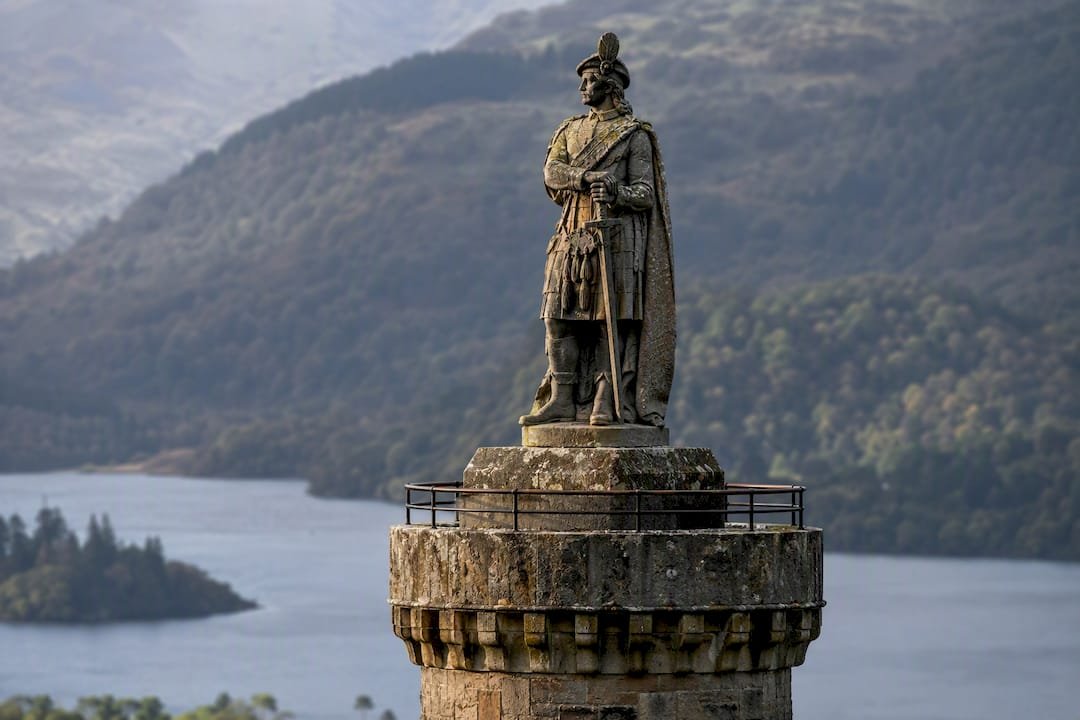
The tower has undergone conservation work over the decades since, maintaining the stonework against the weather that batters this stretch of the west coast. What you see today is largely the original 1815 structure, restored rather than rebuilt, standing on ground that had already been significant to Jacobite history for a generation before MacDonald put up a memorial to mark it permanently.
Climbing the monument: what to expect and accessibility options
The climb is short but not gentle. Inside the tower, a spiral staircase of 62 uneven stone steps winds up to the top, narrow enough that passing another visitor coming down requires a bit of patience. At the summit, you don’t simply step out onto a platform. You climb through a small hatch and have to physically pull yourself up, and that final stretch can feel tight and claustrophobic if you’re not expecting it.
Capacity is capped at a small number of visitors at the top at once, which is why booking ahead matters more here than at most Highland attractions. A few practical points:
- Children under 12 must be accompanied by an adult throughout the climb.
- If you’re prone to claustrophobia or have concerns about tight spaces, the hatch is the point to think hardest about.
- Slots run in windows through the day; arriving without a booking risks disappointment on busy dates.
If climbing isn’t right for you, or you simply prefer not to, you’re not missing the core experience. NTS maintains step-free access to the exhibition and café, an all-ability path leading to the monument’s exterior, and accessible parking bays close to the entrance. Seeing the tower up close from ground level, with Loch Shiel behind it, gives you most of what makes the site memorable without needing the summit at all.
When to visit Glenfinnan for fewer crowds and better light
September and October reward visitors with noticeably quieter grounds and richer autumn colour than the high-summer months, when coach parties and steam train enthusiasts converge on the site in numbers. If your schedule is flexible, shoulder season is the easiest lever you can pull to improve the whole visit.
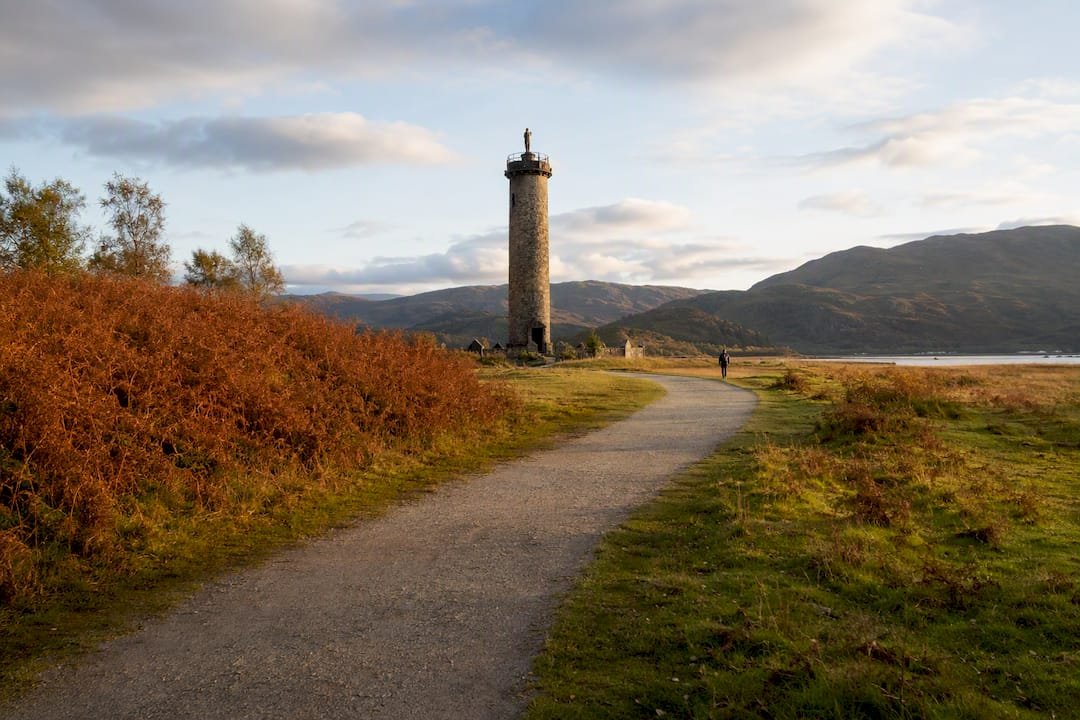
The Jacobite steam train typically runs from April through October, so if seeing it cross the viaduct is part of your plan, you’ll want to visit within that window and check the current timetable before travelling, since departure times shift through the season. Early morning or late afternoon works well whatever month you visit: light is softer, the car park is calmer, and you’re not competing with a coach party for the same ten square metres of viewpoint.
Weather on this stretch of coast changes quickly. Even in summer, pack a waterproof layer and decent footwear, since the path to the viaduct viewpoint has uneven and sometimes wet sections regardless of season.
Why a private guided visit changes how Glenfinnan works for you
Because only six visitors can reach the summit at once, timing is everything here, and that’s where local knowledge earns its keep. A guide who knows the booking windows can build your day around securing that summit slot rather than hoping one’s free when you arrive, and can time your arrival at the viaduct viewpoints to dodge the coach parties without you ever noticing the effort involved.
If you’re combining Glenfinnan with Loch Ness, Skye or the Black Isle in a single trip, the value compounds. A private guide sequences the stops, handles the driving, and fills the gaps between viewpoints with the stories that don’t make it onto a plaque.
— Alin
Book a private Glenfinnan visit with Skye Highlands Tours
If the logistics above sound like a lot to juggle on holiday, that’s the honest reason a private guided visit earns its cost: no watching the clock for your summit slot, no circling for a parking space, and no missing the hillside viewpoint because nobody told you it existed. Private guided excursions across the Highlands, including Glenfinnan alongside Loch Ness, Skye and the Black Isle, can offer itineraries built around your group’s pace and interests rather than a fixed coach schedule.

A booking gets you door-to-door transport, timed stops planned around booking windows and quieter light, and a guide who can talk through the accessible route options if climbing the tower isn’t for everyone in your party. The Glenfinnan Viaduct and Mallaig tour covers this exact stretch of coastline in one well-paced day, and if you’d rather build something entirely your own, our guide to Highland destinations worth visiting is a good place to start planning what else to fit in around it.
Sources
For live opening times, ticket booking and accessibility details, always check the primary sources rather than relying on older guides:
- Glenfinnan Monument | National Trust for Scotland
- Glenfinnan Monument — History and Visitor Guide | Jacobite Trail
FAQ
Where is the best viewpoint for the Glenfinnan Viaduct?
The hillside path above the main trackside spot gives the widest view, framing the viaduct, Loch Shiel and the monument together, and it’s the angle behind most published photographs of the site.
How long do I need at Glenfinnan Monument?
Budget around two hours for a full visit: 30 to 45 minutes at the visitor centre, 30 to 45 minutes walking to the viaduct viewpoints, and 20 to 30 minutes for the monument climb if you’ve booked a slot.
Is it worth visiting Glenfinnan Viaduct?
Yes. Beyond its film fame, it sits at a genuinely significant historical site, and the combination of Highland scenery, the monument’s story and the chance to see the steam train cross make it worth the detour for most visitors travelling this stretch of the west coast.
Can you see the Glenfinnan Viaduct by car?
You can reach the site by car and view the viaduct from the NTS car park area, but the best photographic angles require a short walk up the hillside path rather than viewing from the car park itself.