

Your cart is empty Continue Shopping
Wild Camping in Scotland: Law, the 1–3 Night Rule and a Trip Checklist
Yes, wild camping is legal in Scotland under the Land Reform (Scotland) Act 2003, provided you camp responsibly and follow the Scottish Outdoor Access Code. That means lightweight kit, small groups, a few nights in one place, and steering clear of enclosed farmland or private gardens. A handful of hotspots, including Loch Lomond & The Trossachs, add seasonal byelaws on top.
TL;DR:
- Wild camping is permitted on unenclosed land in Scotland if campers use lightweight equipment, stay for a few nights only, and avoid private gardens or farmland.
- Fires are discouraged; stoves are recommended, and open fires should only be lit on safe, non-flammable surfaces with caution during dry spells.
- Parking must be in proper roadside or designated areas, as access rights do not cover motorised vehicles, and blocking roads or damaging ground can lead to legal offences.
- In popular areas like Loch Lomond, permits are required within seasonal management zones and should be booked in advance, with outside zones free of permit requirements.
- Following the Scottish Outdoor Access Code, planning, responsible behaviour, and respectful communication with landowners help ensure ongoing access rights.
Table of Contents
- What the law actually says: the Land Reform Act and the Access Code
- Where you can camp and where you should never pitch up
- Fires, stoves and the wildfire risk nobody plans for
- Vehicles, parking and roadside camping: the pitfalls
- Byelaws, permits and what happens if you’re asked to move
- Your pre-trip, on-site and post-trip checklist
- How permits work in restricted zones like Loch Lomond
- How Skye Highlands Tours treats access rights on guided trips
- Wild camping or a guided Highland day, without the legal guesswork
- Official resources to check before you go
- Sources
- FAQ
What the law actually says: the Land Reform Act and the Access Code
Scotland gives you something most of the UK doesn’t: a statutory right to be on most land and inland water for recreation, and that right explicitly covers wild camping. The Land Reform (Scotland) Act 2003 created this statutory right of responsible access to most land and inland water, and it’s the reason Scotland’s approach differs so sharply from England and Wales.
The Scottish Outdoor Access Code turns that broad legal right into something workable on the ground. It defines wild camping as lightweight camping in small numbers, staying no more than a few nights in any one spot, with responsible behaviour as the price of admission rather than an optional extra. That word, responsible, does a lot of work. It isn’t a technicality. It’s the entire hinge on which your legal right swings, and SOAC keeps the rules deliberately flexible so they suit everywhere from a Highland corrie to a lowland riverbank.
Access rights don’t apply everywhere, though. Private gardens, houses, and the enclosed land immediately around a dwelling, known as its curtilage, sit outside your right of access entirely. Farmed fields with crops or livestock are also generally off limits. And access rights never override other law. Fire safety rules, public order offences, and road traffic law all still apply whether or not you’re exercising a right to roam.
Where you can camp and where you should never pitch up
Good wild camping ground in Scotland is unenclosed: open hillside, moorland, remote glens, and forestry where access rights genuinely apply. The trouble usually starts when campers assume any patch of grass qualifies.
Steer well clear of the following:
- Enclosed fields containing crops or grazing livestock
- Land close to houses, farm buildings, or private gardens
- Ground within a close distance of a water source used for drinking supply
- Sites near historic monuments or scheduled ancient sites
- Anywhere already showing heavy fire damage, litter, or erosion from overuse
That last point matters more than most campers realise. The Access Code’s own framing treats cumulative impact as the real threat to long-term access, not any single tent. A few dozen groups repeatedly camping on the same fragile shoreline can turn a legal grey area into a permanent byelaw within a couple of seasons. If you’re heading somewhere popular such as Glen Etive, Loch Lomond, or Skye’s coastal machair in July, expect real pressure on ground, and consider a managed campsite instead. It costs you nothing legally to be flexible, and it takes the strain off spots that are already struggling.
Fires, stoves and the wildfire risk nobody plans for
Use a stove, not an open fire. That’s the plain guidance from Scottish Fire and Rescue Service, and it’s worth taking seriously given how quickly Highland peat and dry heather can catch. An open fire built on peat can smoulder underground for days after you’ve packed up and left, then resurface as a genuine wildfire.
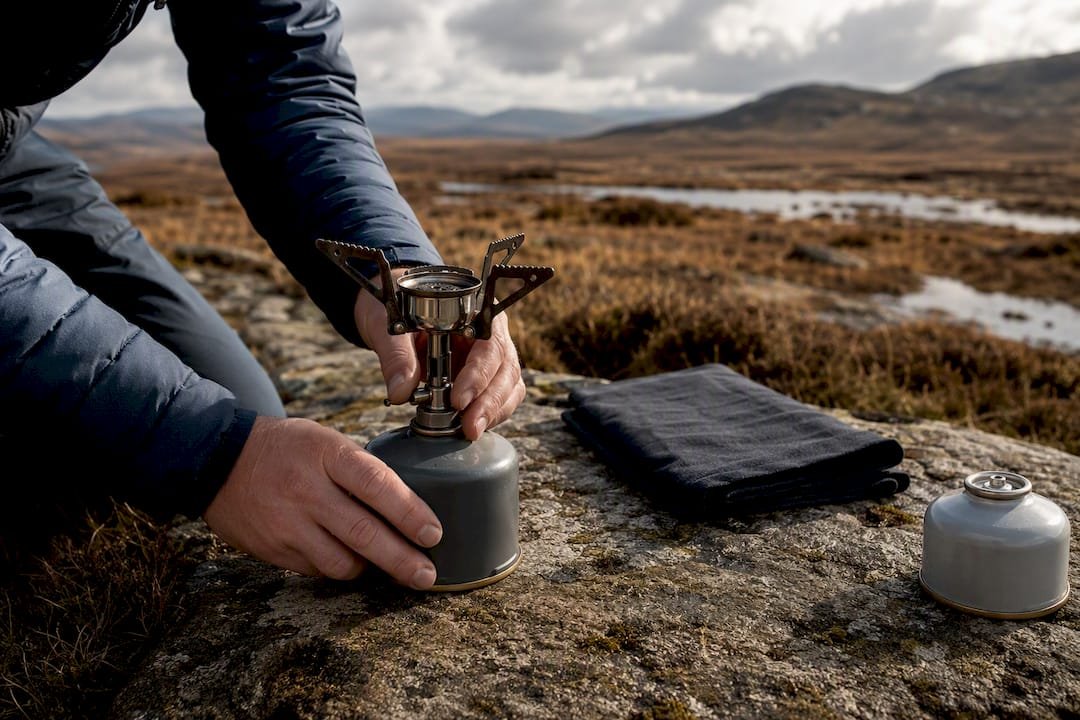
SFRS advises against lighting any open fire during dry spells, on peaty ground, near forestry, or close to historic sites, full stop. If you do use an open fire where it’s genuinely safe and legal to do so, keep it small, set it on a non-flammable surface such as bare rock or a fire blanket, never cut live wood, and remove every trace of ash before you move on.
There’s a legal dimension too. A fire that endangers people, property, or livestock can expose you to offences under the Civic Government (Scotland) Act, and if it spreads onto a road or verge, the Roads (Scotland) Act comes into play as well. Romantic as a campfire looks in the photos, it’s the single biggest way a legal camp turns into an actionable incident.
Vehicles, parking and roadside camping: the pitfalls
Your right of responsible access covers you and your tent on foot. It does not extend to motorised activity, and that distinction catches out more people than any other rule in this guide.
Park sensibly and the risk mostly disappears:
- Use a proper car park or wide passing place, never a farm gateway or field entrance
- Never block a road, verge, or another vehicle’s access
- Remember landowners and local authorities can restrict parking even where walking access rights apply
- Treat a vehicle parked beside your tent as a step up in risk, since it shifts you from wild camping into roadside camping territory where enforcement is far more likely
Guidance on managing camping with tents in Scotland is explicit that access rights don’t cover motorised use, and that driving or parking causing damage or danger can amount to an offence under road traffic law. Roadside camping in laybys along the North Coast 500, in particular, has generated real local friction over litter and blocked passing places, which is exactly the kind of pressure that leads to new restrictions for everyone.
Byelaws, permits and what happens if you’re asked to move
Local authorities and national parks can lawfully tighten the general right of access through byelaws, and Loch Lomond & The Trossachs National Park is the clearest working example. Seasonal camping byelaws there require camping only within designated management zones or on a permit between March and September, a direct response to years of overcrowding and litter on the loch shores.
Outside byelaw zones, if you’d rather camp somewhere sensitive or closer to a farmstead than the Code strictly allows, asking the landowner is worth the two-minute conversation. Landowners frequently agree to a discreet, small-group camp when approached courteously, and it costs you nothing to check.
If a ranger or landowner does challenge you, the usual response is advice and a polite request to move on. Fines and prosecution are reserved for genuinely irresponsible or criminal conduct, such as fly-tipping, deliberate damage, or repeated defiance of a byelaw, not for an honest mistake corrected on the spot.
Your pre-trip, on-site and post-trip checklist
Turning the law into habit is simpler than it sounds. Run through this before, during, and after every trip:
- Check the current Scottish Outdoor Access Code guidance and any national park pages for the area you’re heading to.
- Check SFRS wildfire warnings and current byelaw status for hotspots like Loch Lomond.
- Line up a backup site and, where possible, a public transport option in case your first choice is closed or overrun.
- Pitch a small, low-impact tent well away from buildings, gardens, and water sources.
- Keep your stay to one to three nights maximum in any single spot.
- Cook on a stove rather than an open fire wherever there’s any doubt.
- Pack out all litter, including cigarette ends, and deal with waste properly rather than leaving it behind.
- Before leaving, check the ground shows no trace you were ever there.
- Report any fire risk or wildfire immediately on 999.
Pro Tip: Photograph your pitch before you leave. It takes ten seconds, and it’s the fastest way to prove you left the ground exactly as you found it if a ranger or landowner ever raises a question later.
Our Leave No Trace guidance and Highland packing checklist go into more depth on kit choices that keep your footprint small.
How permits work in restricted zones like Loch Lomond
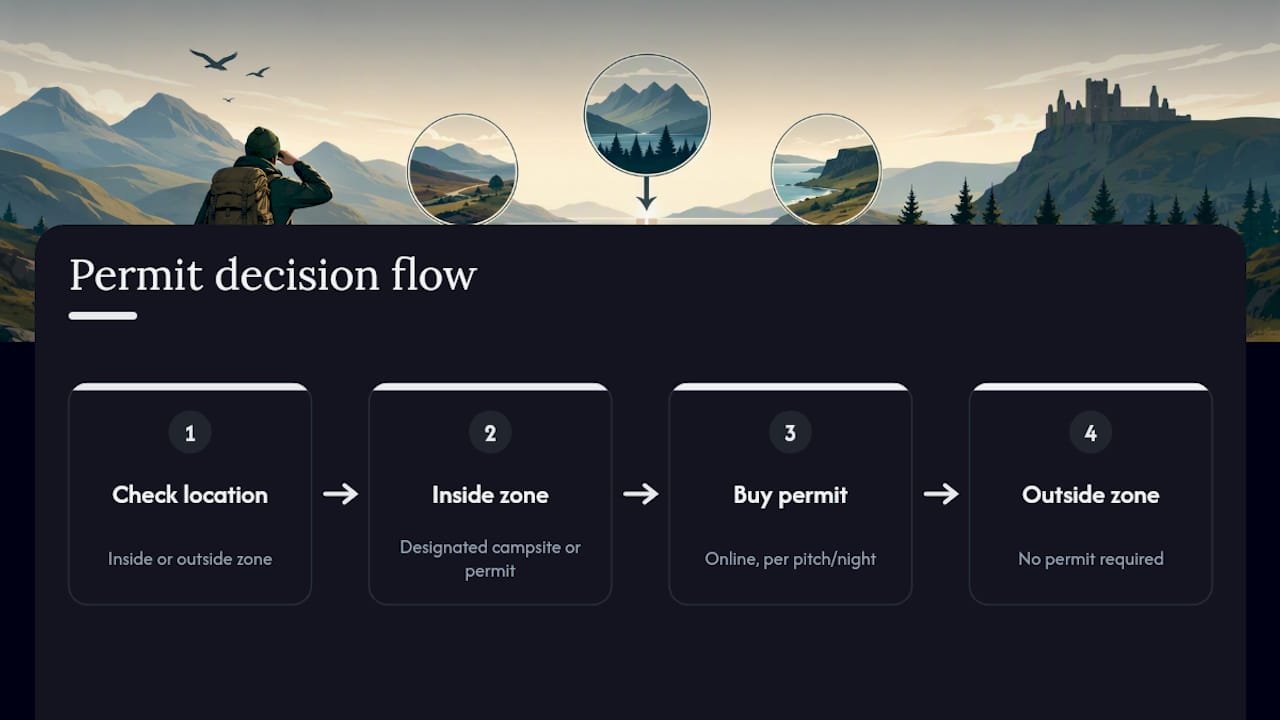
Where byelaws apply, such as the seasonal management zones around Loch Lomond & The Trossachs, you generally have two lawful options: pitch at a designated campsite within the zone, or buy a camping permit for one of the specific permit areas set aside for it.
Permits for the national park’s camping management zones are usually bought online in advance through the park authority’s own booking system, and they’re priced per pitch per night rather than per person, with the exact figure varying by zone and season. Booking ahead matters more than most visitors expect. Popular loch-side permit areas sell out weeks in advance during the peak summer months, particularly around school holidays, leaving latecomers with nothing but a formal campsite as a fallback.
Outside the managed zones, no permit is required at all, since ordinary access rights under the Land Reform Act apply as normal. The practical lesson is to check which side of the zone boundary your planned route falls on well before you set off, because the difference between “no permit needed” and “permit required” can be a single field boundary on a map. National park and local authority websites publish current maps and permit portals, and it’s worth checking these close to your trip date rather than relying on older guides, since zone boundaries and permit pricing are reviewed periodically.
How Skye Highlands Tours treats access rights on guided trips
The rules above aren’t abstract for us. The itineraries built for tours across Skye, Loch Ness, Glenfinnan, and the Black Isle follow the same access principles, choosing routes and stopping points that respect sensitive ground and local byelaws rather than testing their edges.
Guests who prefer a guided day out over pitching a tent still benefit from that local knowledge. Our packing checklist and Leave No Trace resource apply equally whether you’re wild camping independently or joining us for a scenic day.
Wild camping or a guided Highland day, without the legal guesswork
If working out exactly where the Loch Lomond permit zone ends and open access begins sounds like more admin than holiday, there’s a simpler route to the same landscapes. Private guided tours across the Highlands with local guides who already know which glens are sensitive, which byelaws are live that season, and which viewpoints deliver the scenery without the risk of camping on the wrong side of a boundary are available.

That local knowledge is the real difference. Rather than researching access maps and permit portals yourself, a guide plans the day around ground that’s already compliant, whether that’s a whisky trail, a family day out, or a full loop of the Scottish Highlands. Itineraries can adjust to group size and physical ability, providing flexibility beyond a fixed coach route.
If camping still appeals for part of your trip, pair it with a guided day for the sections where local rules feel murkiest. Check availability and browse tour options to see what a compliant, guided day in the Highlands actually looks like.
Official resources to check before you go
- Scottish Outdoor Access Code: camping guidance
- Land Reform (Scotland) Act 2003 explained
- SFRS wildfire prevention advice
- Loch Lomond & The Trossachs camping byelaws
Always check the relevant national park or local authority page for current byelaw and permit details before setting off.
This article is general information, not a substitute for advice from a qualified lawyer. Consult a qualified legal professional about your own circumstances before acting on anything here.
Sources
- Camping | Scottish Outdoor Access Code
- Land Reform (Scotland) Act 2003 — Orkney guidance
- Wildfire prevention — Scottish Fire and Rescue Service
- Camping byelaws — Loch Lomond & The Trossachs National Park
FAQ
Is wild camping legal in Scotland?
Yes. The Land Reform (Scotland) Act 2003 gives a statutory right of responsible access that covers wild camping on most unenclosed land, provided you follow the Scottish Outdoor Access Code.
How many nights can you wild camp in one spot?
The Access Code defines wild camping as typically one to three nights in any one place, using lightweight kit and small group numbers.
Can you light a fire while wild camping in Scotland?
Scottish Fire and Rescue Service advises using a stove rather than an open fire, and warns against lighting fires during dry spells or on peaty ground, forests, or historic sites.
Do you need a permit to wild camp near Loch Lomond?
Within Loch Lomond & The Trossachs National Park’s seasonal camping management zones, yes, you need a permit or must use a designated site; outside those zones, ordinary access rights apply with no permit needed.
Can you wild camp anywhere with a car?
No. Access rights don’t cover motorised activity, so you must park in a proper car park or passing place rather than beside your tent, and parking that blocks access or causes damage can be an offence.
Is roadside camping treated differently from wild camping?
Yes. Parking a vehicle near your tent shifts you into roadside camping, which carries a higher risk of parking offences and local enforcement than remote, on-foot wild camping.
Wild camping across Scotland’s glens, lochs, and hillsides remains one of the most freeing legal rights in the UK. Getting the small details right, stove over fire, permit where needed, tent well away from the farmhouse, is what keeps that right intact for the next person who pitches up after you.
— Alin