
Your cart is empty Continue Shopping

Invergordon travel guide: culture, history and whisky
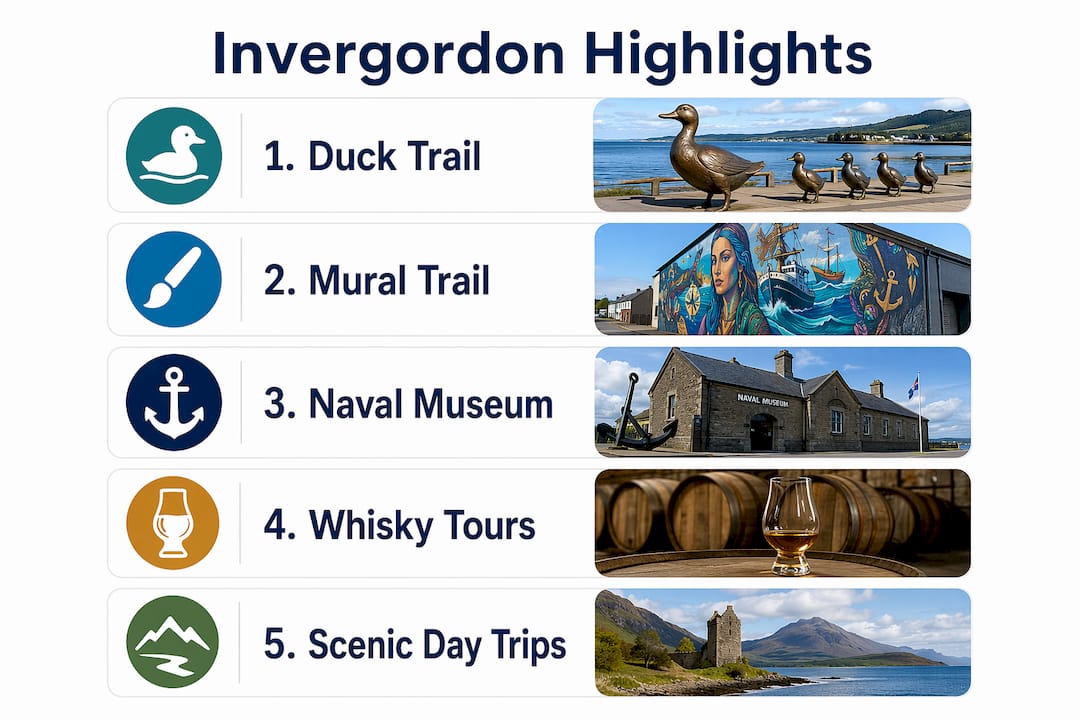
Invergordon is a Scottish Highland port town celebrated for its vibrant Mural Trail, interactive Duck Trail, naval heritage, and close proximity to the Glenmorangie distillery. Sitting on the Cromarty Firth in Easter Ross, the town punches well above its size as a cultural destination. Cruise passengers arriving at the Port of Cromarty Firth discover a compact town centre where public art, local history, and whisky culture converge within easy walking distance. Whether you have two hours ashore or a full day to explore, Invergordon rewards visitors who look beyond the waterfront.
What is the Invergordon Duck Trail and why does it matter?
The Invergordon Duck Trail is a self-guided walking experience built around 11 hidden duck stops, each marked with a themed duck decal and a QR code in a local shop window. Scanning the code reveals the duck’s story and links visitors directly to that business. The format is deliberately playful, but the purpose is serious: it draws cruise passengers off the ship and into the town’s independent shops, cafes, and services.
Port officials describe the trail as an “off the ship” strategy designed to boost visitor engagement and direct economic benefit to local traders. This matters because cruise tourism typically concentrates spending near the port. By gamifying the town walk, the Duck Trail redistributes foot traffic across the high street and side streets alike.
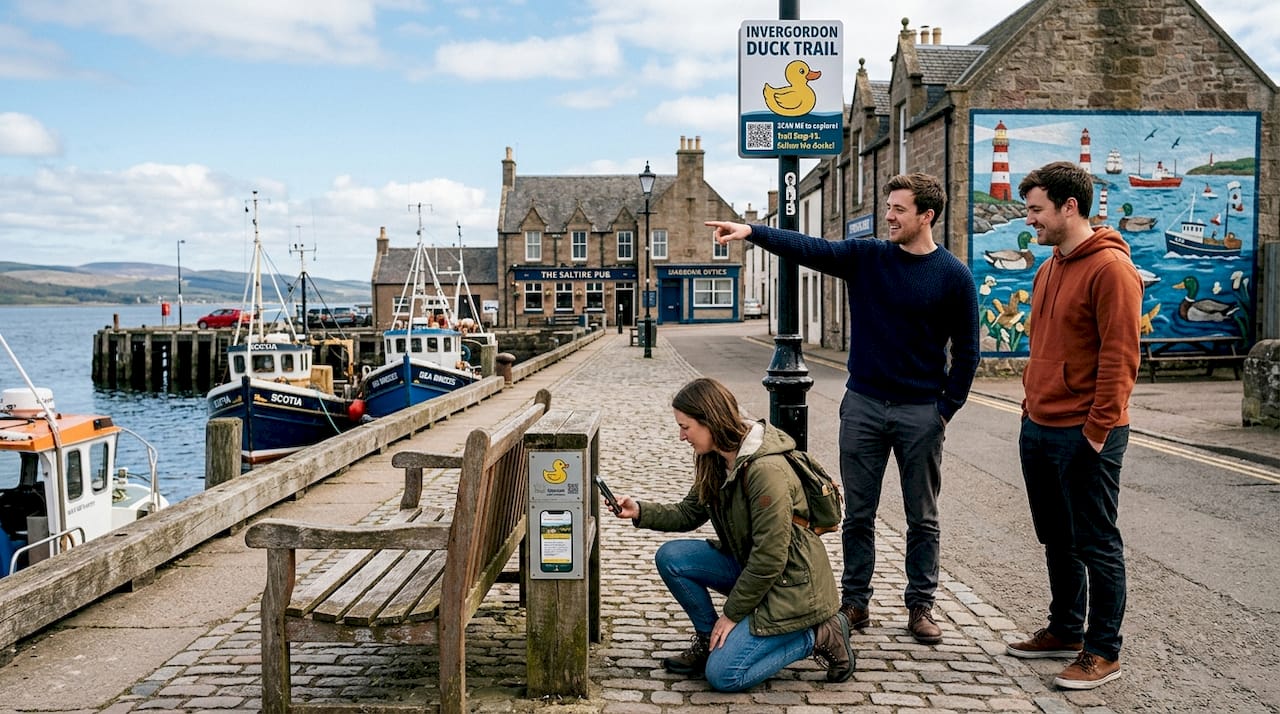
The trail is concentrated around the port and town centre, making it practical for visitors with limited time ashore. All 11 stops are within comfortable walking distance of the cruise terminal. Souvenir rubber ducks are available for purchase, with proceeds contributing to a community fund. This model is described as a UK first, adapting the rubber duck craze that has spread across cruise ships themselves into a shore-side attraction.
Key facts about the Duck Trail:
- 11 stops within walking distance of the Port of Cromarty Firth
- QR codes at each stop link to the duck’s story and the host business
- Souvenir ducks available for purchase, supporting a local community fund
- Designed for cruise visitors with limited time, but open to all travellers
- Pairs naturally with the Mural Trail for a fuller town-centre walk
Pro Tip: Download a QR code scanner before you arrive, as mobile signal near the waterfront can be patchy. Starting at the port end of the trail and working inland keeps the walk logical and saves backtracking.
How do the Invergordon murals enrich the heritage experience?
The Invergordon Mural Trail features 11 large-scale murals painted across the town centre, each depicting a chapter of local history. The route covers roughly half a mile and connects directly with the Duck Trail, allowing visitors to experience both in a single walk. Each mural carries a QR code linking to a written description, making the trail fully self-guided via smartphone.
The subjects span centuries of Invergordon’s story. Highlights include:
- The Invergordon Mutiny of 1931, when Royal Navy sailors staged a pay protest that reverberated through global financial markets
- The sinking of HMS Natal in 1915, a wartime tragedy that claimed hundreds of lives in the Cromarty Firth
- Industrial and environmental themes reflecting the town’s oil industry past and its relationship with the firth
- Social history panels celebrating the lives of ordinary residents across different eras
The murals function as an outdoor gallery that is free, accessible, and open at all hours. For history enthusiasts, the Invergordon Mutiny panel alone justifies the walk. The mutiny is one of the most significant acts of collective naval protest in British history, yet it remains little known outside specialist circles. Seeing it depicted at scale on a town-centre wall brings that history into sharp focus. The half-mile route is flat and manageable for most visitors, including those with limited mobility or young children in tow.
What are the latest developments at Invergordon Naval Museum?
The Invergordon Naval Museum is undergoing its most significant transformation in decades. The Port of Cromarty Firth is investing £20,000 across 2025 and 2026 to relocate the museum to a larger, purpose-fitted facility. The investment is structured as £8,000 in 2025 and £12,000 in 2026, forming part of a three-year matched regeneration project.
| Development | Detail |
|---|---|
| New museum location | Larger facility with improved exhibition space |
| Total investment | £20,000 from the Port of Cromarty Firth |
| Virtual reality feature | VR tours of Inchindown oil storage tunnels planned |
| Bouchardon bust | £3.1 million artefact to be securely displayed |
| Former museum building | Being repurposed as a Community Hub |
The planned virtual reality tours of the Inchindown oil tunnels are a genuinely exciting addition. Inchindown holds the world record for the largest underground oil storage facility ever built, yet most visitors have never heard of it. A VR experience brings those vast subterranean chambers to life without requiring physical access to the site itself.
The Bouchardon bust of Sir John Gordon, valued at £3.1 million, is another centrepiece of the new museum’s collection. The bust was purchased by the town council in 1930 for just £5. A crowdfunding campaign has been launched to keep it in the Highlands, and the new museum will provide the secure, climate-controlled display conditions the artefact requires.
Pro Tip: Because the museum is mid-relocation through 2025 and 2026, verify current opening times and the exhibition address before your visit. The new facility will offer a significantly richer experience than the former premises.
How can you combine Invergordon’s highlights with whisky and scenic tours?
Invergordon sits at the centre of a day-trip network that few Scottish port towns can match. The Glenmorangie distillery in Tain is less than 20 minutes by road, making it one of the most accessible whisky experiences in the Highlands for visitors arriving by cruise ship or train. Glenmorangie produces one of Scotland’s best-known single malts and offers guided tours, tastings, and a visitor centre.
For visitors wanting to extend their day, the options divide naturally into two directions:
- North towards Sutherland: Dunrobin Castle, the seat of the Earls and Dukes of Sutherland, sits roughly 45 minutes north of Invergordon. Its French-inspired architecture and falconry displays make it one of Scotland’s most photogenic stately homes. Combining Dunrobin with a Glenmorangie tasting creates a full-day itinerary that covers both history and whisky.
- South towards Inverness: The Invergordon railway station (station code IGD, opened 1863) provides multiple daily ScotRail services to Inverness, approximately 50.6 km away. From Inverness, visitors can access Loch Ness, Culloden Battlefield, and the Black Isle within the same day.
- Moray Firth wildlife: Chanonry Point near Fortrose is one of the most reliable dolphin-watching spots in Europe. Bottlenose dolphins regularly come within metres of the shore, particularly on an incoming tide. This works well as a short detour on the return from Inverness.
- Town-first, then excursion: For cruise passengers, the most efficient approach is to complete the Duck Trail and Mural Trail in the morning, then join a guided excursion for the afternoon. The combined trails take around 90 minutes at a relaxed pace, leaving ample time for a half-day trip.
| Option | Best for | Approx. travel time from Invergordon |
|---|---|---|
| Glenmorangie distillery | Whisky enthusiasts | 20 minutes by road |
| Dunrobin Castle | History and architecture | 45 minutes by road |
| Inverness by train | City culture and onward connections | 50 minutes by rail |
| Chanonry Point | Wildlife and nature | 40 minutes by road |
What practical tips make visiting Invergordon easier?
Invergordon is a genuinely walkable town. The port, railway station, high street, and all major cultural attractions sit within a 10-minute walk of each other. This compactness is one of its greatest assets, particularly for cruise visitors working to a strict return time.
Practical points worth knowing before you arrive:
- Rail access: ScotRail services from Invergordon station connect to Inverness several times daily, with onward connections to Edinburgh and Glasgow. The station is a five-minute walk from the port.
- Self-guided tools: Both the Duck Trail and Mural Trail use QR codes throughout. Download a reliable QR scanner and a basic offline map before disembarking, as mobile data coverage near the waterfront is inconsistent.
- Timing: Weekday mornings are quietest. On days when multiple cruise ships are in port simultaneously, the town centre becomes noticeably busier, particularly around the Duck Trail stops.
- Dining: The high street has several cafes and a small number of restaurants. For a sit-down lunch, arriving before noon avoids the post-ship rush.
- Booking tours in advance: Guided excursions to Glenmorangie, Dunrobin Castle, and Moray Firth fill quickly on cruise days. Book before your ship arrives in port.
- Accessibility: The Mural Trail and Duck Trail are both flat and paved, making them suitable for wheelchairs and pushchairs throughout.
For a broader look at Scottish heritage sites worth pairing with an Invergordon visit, the wider Highlands offer considerable depth for history-focused travellers.
Key takeaways
Invergordon delivers a concentrated cultural experience through its integrated trails, naval history, and proximity to world-class whisky and scenic destinations, all within easy walking distance of the port.
| Point | Details |
|---|---|
| Duck Trail format | Eleven QR-coded stops link visitors to local businesses, supporting the town economy directly. |
| Mural Trail depth | Eleven murals cover the Invergordon Mutiny, HMS Natal, and other key local history in a half-mile walk. |
| Museum investment | A £20,000 Port of Cromarty Firth investment is relocating the Naval Museum with VR and improved displays. |
| Whisky and day trips | Glenmorangie distillery and Dunrobin Castle are both accessible within 45 minutes for a full-day itinerary. |
| Practical access | All main attractions are walkable from the port, and ScotRail connects Invergordon to Inverness in under an hour. |
Why Invergordon surprised me more than most Highland ports
I have visited a lot of Scottish port towns in the course of working with Skyehighlandstours, and most follow a predictable pattern: a waterfront, a heritage centre, a gift shop, and not much reason to linger. Invergordon is different, and the reason is integration. The Duck Trail and Mural Trail are not separate attractions bolted onto a town that happens to have a port. They are designed to work together, to pull visitors through the high street, past the independent businesses, and into the fabric of the community. That is genuinely rare.
What struck me most on my last visit was how much the murals do for the town’s sense of identity. The Invergordon Mutiny panel in particular stops you in your tracks. This was a moment of real historical consequence, and it happened here, in this town, on these waters. Seeing it rendered at scale on a building wall makes it feel present rather than archived.
The museum relocation is the development I am watching most closely. The Bouchardon bust alone would justify a dedicated visit, and the planned VR experience of the Inchindown tunnels could become one of the most distinctive heritage attractions in the north of Scotland. My advice: do not wait for the museum to be fully settled before visiting. The town itself is worth the trip right now, and the museum will only add to it.
For visitors arriving by cruise ship, the instinct to book a long-distance excursion immediately is understandable, but resist it for at least an hour. Walk the trails first. You will leave with a far better understanding of where you are and why it matters.
— Alin
Explore Invergordon and the Highlands with Skyehighlandstours
Invergordon is the starting point for some of the most rewarding day trips in the Scottish Highlands, and Skyehighlandstours specialises in making those connections seamless for cruise visitors and independent travellers alike.

The Dunrobin Castle and Glenmorangie tour combines two of the north’s finest attractions in a single private excursion, with expert local guides who know the region’s history in depth. For visitors wanting a fully tailored day, the shore excursions from Invergordon cover everything from whisky tastings to wildlife watching, with flexible timings designed around cruise schedules. Small groups, private vehicles, and itineraries built around your interests are the standard, not the exception.
FAQ
What is the Invergordon Duck Trail?
The Duck Trail is a self-guided walking route with 11 stops near the port, each featuring a duck decal and QR code linking to a local business. It was designed specifically to encourage cruise passengers to explore the town centre.
How long does the Mural Trail take to walk?
The Mural Trail covers approximately half a mile and takes around 45 to 60 minutes at a relaxed pace. It connects directly with the Duck Trail, so both can be completed together in roughly 90 minutes.
What is the Bouchardon bust and why is it significant?
The Bouchardon bust is a sculpture of Sir John Gordon valued at £3.1 million, purchased by Invergordon Town Council in 1930 for just £5. It is a centrepiece of the Naval Museum’s collection and the subject of an active campaign to keep it in the Highlands.
How do I get to Invergordon by train?
Invergordon railway station offers multiple daily ScotRail services to Inverness, approximately 50.6 km away, with connections to the wider Highland rail network. The station is a five-minute walk from the cruise port.
Can I visit Glenmorangie distillery on a day trip from Invergordon?
Yes. The Glenmorangie distillery in Tain is around 20 minutes by road from Invergordon and is easily combined with a morning town walk and an afternoon excursion to Dunrobin Castle for a full-day itinerary.