
Your cart is empty Continue Shopping
Why celebrate anniversaries in Scotland: traditions and ideas
Anniversaries in Scotland are defined by something most countries cannot replicate: a living cultural framework that makes every milestone feel both personal and historically grounded. Whether you are marking a wedding anniversary, a family reunion, or a national date, the Scottish approach to celebration draws on centuries of ritual, landscape, and shared identity. Understanding why celebrate anniversaries Scotland means understanding Burns Night, Hogmanay, handfasting, and the quiet power of a quaich passed between two people. Scotland does not simply mark the passage of time. It transforms it into ceremony.
Why celebrate anniversaries in Scotland?
Scotland’s anniversary culture is rooted in the belief that milestones deserve more than acknowledgement. They deserve ritual. The country’s Highland heritage and clan traditions have always treated shared history as something to be actively performed, not merely remembered. This is what separates Scottish anniversary observance from a generic birthday dinner or a card in the post.
The cultural significance of anniversaries in Scotland connects the personal to the communal. A couple celebrating ten years of marriage is, in the Scottish tradition, also participating in a broader story of belonging, continuity, and renewal. That connection to something larger than the individual is precisely why these celebrations carry such emotional weight. It is not sentiment for its own sake. It is identity reinforced through action.
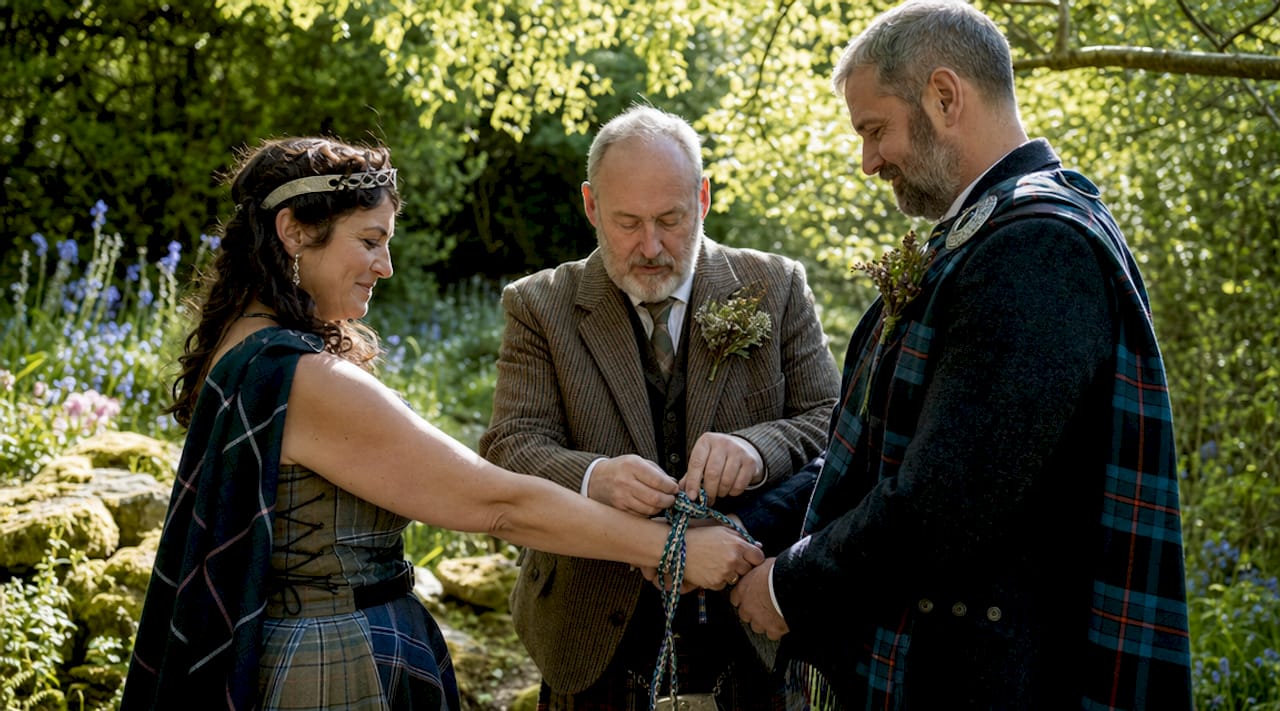
Three elements define this approach: shared ritual, physical symbolism, and community participation. Burns Night, Hogmanay, and handfasting ceremonies each demonstrate how Scotland has built anniversary culture into the national fabric. These are not niche customs. They are practised by millions of people across Scotland and the Scottish diaspora worldwide.
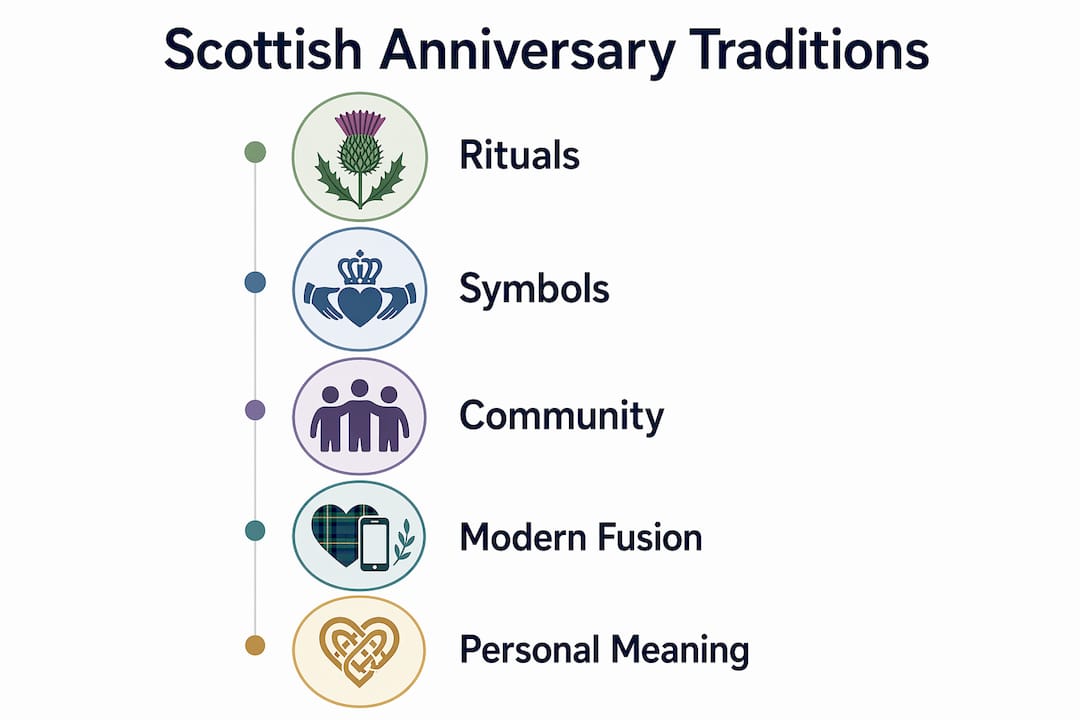
What are the traditional Scottish anniversary customs and their significance?
Scottish anniversary traditions are best understood as physical acts of belonging. They use objects, songs, and gestures to make abstract feelings concrete and communal.
Handfasting is one of the oldest Scottish binding rituals, predating the Church of Scotland by centuries. In its original form, a couple’s wrists were bound together with cord or ribbon to symbolise union, often for a trial period of a year and a day. Modern ceremonies have revived handfasting as a meaningful addition to wedding anniversaries and renewal of vows, precisely because the physical act of binding carries emotional weight that words alone cannot match.
Burns Night, celebrated on 25th January each year, is the world’s largest social gathering linked to a single writer. Over 9.5 million people celebrate Burns Night annually, making it a genuinely global anniversary of Scottish cultural identity. The evening follows a precise programme: the Selkirk Grace, the Address to a Haggis, the Toast to the Lassies, and readings from Robert Burns. This structure is itself a form of anniversary ritual, repeated year after year to reinforce collective memory.
Hogmanay and first footing represent Scotland’s most communal anniversary tradition. The first footing custom, where the first person to cross a threshold after midnight brings gifts of coal, whisky, shortbread, or salt, has roots stretching back over 1,000 years to the Viking era. The gifts are not decorative. Each one carries specific meaning: coal for warmth, whisky for good cheer, shortbread for prosperity. This transforms a simple visit into a ceremony of renewal and protection.
“The song involves crossing arms and joining hands in a chain of union, running in and out of the circle during singing.” This description of ‘Auld Lang Syne’ reveals that the song is not merely sung. It is physically performed as reunion, with its roots in Masonic chain of union practices. Every Hogmanay gathering that ends with linked arms is, without knowing it, enacting a centuries-old ritual of friendship and continuity.
Key traditions and their symbolic roles:
- Handfasting: physical binding representing union and commitment, now used in anniversary renewals
- Burns Supper: structured communal meal honouring Scotland’s national poet, repeated annually as cultural affirmation
- First footing: threshold ritual using symbolic gifts to mark renewal at the new year
- Auld Lang Syne: performative song of reunion, sung with linked arms to physically embody friendship across time
- The quaich: a two-handled drinking cup shared between people as a gesture of trust and mutual bond
How do anniversary celebrations in Scotland blend history with modern practice?
Scotland’s approach to tradition is best described as living heritage. Peter Hewitt at Museums Galleries Scotland has argued that traditions must serve current community relevance to survive. This is not a compromise of authenticity. It is the mechanism by which Scottish anniversary culture has remained vital across generations rather than becoming a museum exhibit.
The Burns Supper is the clearest example of this evolution. At 225 years old, the format has absorbed fusion dishes like haggis pakora and multilingual toasts, reflecting Scotland’s multicultural present without abandoning its structure or purpose. The Address to a Haggis still happens. The poetry still matters. But the table now reflects a broader Scotland, and that inclusivity has strengthened rather than diluted the tradition.
Scotland has also begun celebrating intellectual anniversaries with the same seriousness it gives to cultural ones. The 300th anniversary of James Hutton, the geologist whose work founded modern earth science, prompted interpretation trails and public exhibitions across Edinburgh and beyond. This reflects a shift in how Scotland defines its heritage: not only through poetry and clans, but through the Scottish Enlightenment figures whose ideas shaped the modern world.
Pro Tip: When planning a personal anniversary celebration in Scotland, consider anchoring it to an existing cultural date. Celebrating a wedding anniversary on Burns Night or renewing vows at Hogmanay connects your personal milestone to a communal one, giving it a resonance that a standalone event cannot achieve.
What are unique and meaningful anniversary celebration ideas in Scotland?
Scotland offers a range of settings and traditions that make anniversary celebrations genuinely distinctive. The following ideas move from intimate to communal, allowing you to choose the depth of cultural engagement that suits you.
Host or attend a Burns Supper. The structured format of a Burns Night dinner, with its toasts, poetry, and traditional food, makes it one of the most culturally rich anniversary celebration ideas Scotland offers. Robert Burns’s work generates £203 million annually for Scotland’s economy, a figure that reflects the depth of public engagement with his legacy. Hosting a private Burns Supper for an anniversary adds personal meaning to a national tradition.
Incorporate symbolic objects. The quaich, a shallow two-handled cup used in Scottish ceremonies for centuries, is a powerful anniversary gift. Sharing a dram of whisky from a quaich with your partner or family members transforms a drink into a ritual. First footing gifts such as coal, shortbread, and salt can also be adapted for personal anniversary exchanges, with each item carrying its traditional meaning into a new context.
Choose a Scottish heritage venue. Castles, historic estates, and Highland landscapes provide settings that no urban venue can replicate. Sites across the Scottish Highlands carry centuries of history in their stones, making them natural backdrops for milestone celebrations. The Isle of Skye, Eilean Donan Castle, and the Glenfinnan Viaduct each offer a sense of scale and permanence that reinforces the significance of the occasion.
Participate in a ceilidh. A ceilidh is a traditional Scottish social gathering involving folk music, communal dancing, and storytelling. Booking a ceilidh band for an anniversary celebration brings the communal dimension of Scottish culture directly into the event. The dances are participatory by design, pulling guests into shared physical movement that mirrors the bonding function of older rituals.
| Celebration idea | Cultural tradition it draws from | Best suited for |
|---|---|---|
| Burns Supper dinner | Burns Night, 25th January | Couples and groups wanting structured cultural depth |
| Quaich sharing ceremony | Clan hospitality and handfasting | Intimate anniversary renewals |
| Highland venue celebration | Clan heritage and landscape identity | Milestone anniversaries and proposals |
| Ceilidh evening | Communal folk tradition | Group celebrations and family milestones |
| First footing gift exchange | Hogmanay renewal ritual | New Year anniversaries and fresh starts |
How do Scottish anniversary traditions contribute to personal and community well-being?
The emotional value of anniversary celebrations in Scotland is not incidental. It is built into the structure of the traditions themselves. Tokens like coal, whisky, and shortbread transform abstract feelings of goodwill into tangible, shared actions. This is why Scottish anniversary rituals feel more meaningful than a simple exchange of gifts. The objects carry agreed cultural meaning, so the act of giving them communicates something specific and understood by both parties.
The social benefits of these traditions are equally significant:
- Shared rituals create belonging. Participating in Hogmanay or a Burns Supper connects individuals to a community of millions, reducing the isolation that modern life can produce around personal milestones.
- Physical acts deepen emotional bonds. Handfasting, the chain of union in ‘Auld Lang Syne’, and the passing of a quaich all use the body to express what words approximate. This physicality makes the emotional connection more durable.
- Generational transmission preserves identity. Wearing tartan at Hogmanay or teaching children the words to ‘Auld Lang Syne’ passes cultural knowledge across generations without formal instruction. The celebration itself is the lesson.
- Renewal rituals counter stagnation. Hogmanay and Burns Night are annual, which means they provide a structured opportunity to reflect, reconnect, and recommit. This regularity is psychologically valuable, giving relationships and communities a predictable moment of affirmation.
The importance of anniversaries in Scotland, then, is not simply about marking time. It is about using time as a prompt for the kinds of connection that sustain people across years and decades.
Key takeaways
Celebrating anniversaries in Scotland matters because the country’s traditions transform personal milestones into communal acts of identity, renewal, and belonging through physical ritual and shared cultural memory.
| Point | Details |
|---|---|
| Living heritage drives relevance | Scottish traditions evolve to include multicultural elements, keeping them meaningful rather than merely historical. |
| Physical ritual deepens connection | Objects like the quaich and acts like handfasting make emotional bonds tangible and memorable. |
| Burns Night is a global anniversary | Over 9.5 million people celebrate Burns Night annually, making it one of the world’s most widely observed cultural milestones. |
| Communal participation strengthens well-being | Ceilidhs, first footing, and ‘Auld Lang Syne’ rituals build social cohesion and reduce isolation around personal milestones. |
| Scotland’s landscape amplifies meaning | Historic venues across the Highlands add a sense of permanence and cultural weight that enhances any anniversary occasion. |
Why Scottish anniversaries stay with you long after the celebration
I have attended Burns Suppers in Edinburgh dining rooms and on hillsides in Skye, and the ones that stay with me are never the grandest. They are the ones where someone took the Address to a Haggis seriously, where the quaich was passed without irony, where the room actually crossed arms for ‘Auld Lang Syne’ instead of standing awkwardly. What I have come to understand is that the ritual is the point. Not the food, not the venue, not the guest list.
What Scottish anniversary traditions do better than almost any other cultural framework is give people permission to mean it. The structure of a Burns Supper or a Hogmanay first footing removes the self-consciousness that modern celebrations often carry. You are not inventing the evening from scratch. You are stepping into something that has been practised for centuries, and that continuity is itself a form of comfort and significance.
My honest observation, after years of guiding people through Scottish cultural experiences, is that couples and families who anchor their personal anniversaries to these traditions report something different from those who do not. They describe the celebration as feeling earned rather than arranged. That distinction matters more than any venue or menu choice you will ever make.
— Alin
Make your Scottish anniversary unforgettable with a Highland tour

A private tour through the Scottish Highlands turns an anniversary into an experience rooted in the landscape and culture that define these traditions. Skyehighlandstours designs bespoke private tours for couples and groups seeking meaningful celebration settings, from the dramatic cliffs of the Isle of Skye to the historic shores of Loch Ness. You can incorporate Scottish culinary traditions into your itinerary, including whisky tastings and traditional Highland meals, or visit heritage sites that bring the history behind these anniversary customs to life. Every tour is tailored to your occasion, your pace, and your story.
FAQ
What is the cultural significance of anniversaries in Scotland?
Anniversaries in Scotland carry cultural significance because they connect personal milestones to shared national traditions such as Burns Night, Hogmanay, and handfasting. These rituals use physical objects and communal acts to reinforce identity, belonging, and renewal across generations.
Why is Burns Night considered an anniversary celebration?
Burns Night on 25th January is an annual anniversary of Robert Burns’s birth, celebrated by over 9.5 million people worldwide through a structured programme of food, poetry, and toasts. It functions as a cultural anniversary that affirms Scottish identity and literary heritage on a global scale.
What is handfasting and how is it used in Scottish anniversaries?
Handfasting is an ancient Scottish binding ritual in which a couple’s wrists are tied together with cord or ribbon to symbolise union. It is now widely used in anniversary renewals of vows and wedding ceremonies as a meaningful physical expression of commitment.
How can couples incorporate Scottish traditions into an anniversary celebration?
Couples can incorporate Scottish traditions by hosting a Burns Supper, sharing whisky from a quaich, choosing a Highland castle or heritage site as a venue, or participating in a ceilidh. First footing gifts such as coal, shortbread, and whisky can also be adapted for personal anniversary exchanges.
What makes Scotland’s approach to anniversaries different from other countries?
Scotland’s approach is defined by living heritage: traditions that evolve to remain culturally relevant while retaining their physical and communal character. The combination of landscape, ritual objects, shared music, and structured ceremony gives Scottish anniversary celebrations a depth that is difficult to replicate elsewhere.
Recommended
- Examples of Scottish Heritage Sites Worth Visiting – Skye Highlands Tours
- Discover Highland Heritage: Culture, Clans, and Scenic Scotland – Skye Highlands Tours
- What Is Authentic Scottish Travel: A Real Traveler’s Guide – Skye Highlands Tours
- Experience Scotland food: Highland flavors & culinary traditions – Skye Highlands Tours