
Your cart is empty Continue Shopping
Examples of Scottish Heritage Sites Worth Visiting
Scotland holds more history per square mile than almost anywhere on earth. Between UNESCO-designated landmarks, ancient stone circles, and preserved medieval burghs, choosing which examples of Scottish heritage sites to visit first is genuinely hard. This guide cuts through the noise. It covers both the famous landmarks that defined Scotland’s cultural identity and the lesser-known sites that reward curious travelers willing to look beyond the obvious. You’ll get the historical context, practical visitor details, and honest comparisons you need to plan a trip that goes deeper than a postcard.
Table of Contents
- Key takeaways
- What makes examples of Scottish heritage sites worth visiting
- 1. The Old and New Towns of Edinburgh
- 2. The Heart of Neolithic Orkney
- 3. The Antonine Wall
- 4. New Lanark
- 5. St Kilda
- 6. The Forth Bridge
- 7. Culloden Battlefield
- 8. Bachelors’ Club, Ayrshire
- 9. Culross
- 10. Staffa and Fingal’s Cave
- 11. Traprain Law and its treasure
- Comparing Scotland’s top heritage sites
- My honest take on Scottish heritage tourism
- Plan your Scottish heritage experience with Skyehighlandstours
- FAQ
Key takeaways
| Point | Details |
|---|---|
| UNESCO sites are the foundation | Scotland has six UNESCO World Heritage Sites, each representing a distinct period and type of heritage. |
| Intangible culture matters too | Language, festivals, and traditions are part of Scottish heritage and enrich any physical site visit. |
| Non-UNESCO sites offer depth | Places like Culloden Battlefield and Culross deliver powerful historical experiences without the crowds. |
| Combine sites with museums | Artifacts from sites like Traprain Law are housed elsewhere, so planning museum stops adds crucial context. |
| Local guides unlock stories | Expert guides reveal layers of meaning at heritage sites that no audio tour or sign can match. |
What makes examples of Scottish heritage sites worth visiting
Not every old building or rocky hill qualifies as a meaningful cultural experience. When evaluating Scotland’s cultural heritage sites, four factors actually determine the quality of your visit: historical significance, accessibility, preservation status, and depth of visitor interpretation.
UNESCO designation is a strong signal of global importance, but it is not the only marker. Some of Scotland’s most emotionally powerful sites have no UNESCO badge at all. Historical period matters too: prehistoric, medieval, industrial, and Romantic-era sites each attract different types of travelers. An archaeology enthusiast and a fan of Robert Burns will have completely different priorities.
Intangible heritage adds another layer. Scottish Highland culture includes Gaelic language, clan traditions, and labor practices preserved through festivals and living communities. Visiting a stone circle gains meaning when you understand the oral traditions surrounding it. Visitor facilities matter practically. Remote sites with no signage or parking can frustrate even dedicated history buffs. The best sites balance authenticity with the infrastructure that helps visitors actually understand what they are looking at.
Pro Tip: Before you book anything, identify which historical era excites you most. Scotland covers everything from 5,000-year-old Neolithic villages to Victorian-era engineering. Narrowing your focus turns a trip into an experience rather than a checklist.
There are four main types of Scottish cultural heritage sites to consider: architectural sites like Edinburgh’s Old Town, archaeological sites like the Heart of Neolithic Orkney, industrial heritage like New Lanark, and natural-cultural combinations like St Kilda. Most memorable itineraries blend at least two.
1. The Old and New Towns of Edinburgh
Edinburgh’s dual identity is literally built into its streets. Edinburgh’s World Heritage status stretches back 30 years, recognizing the extraordinary contrast between two urban planning philosophies existing within walking distance of each other.
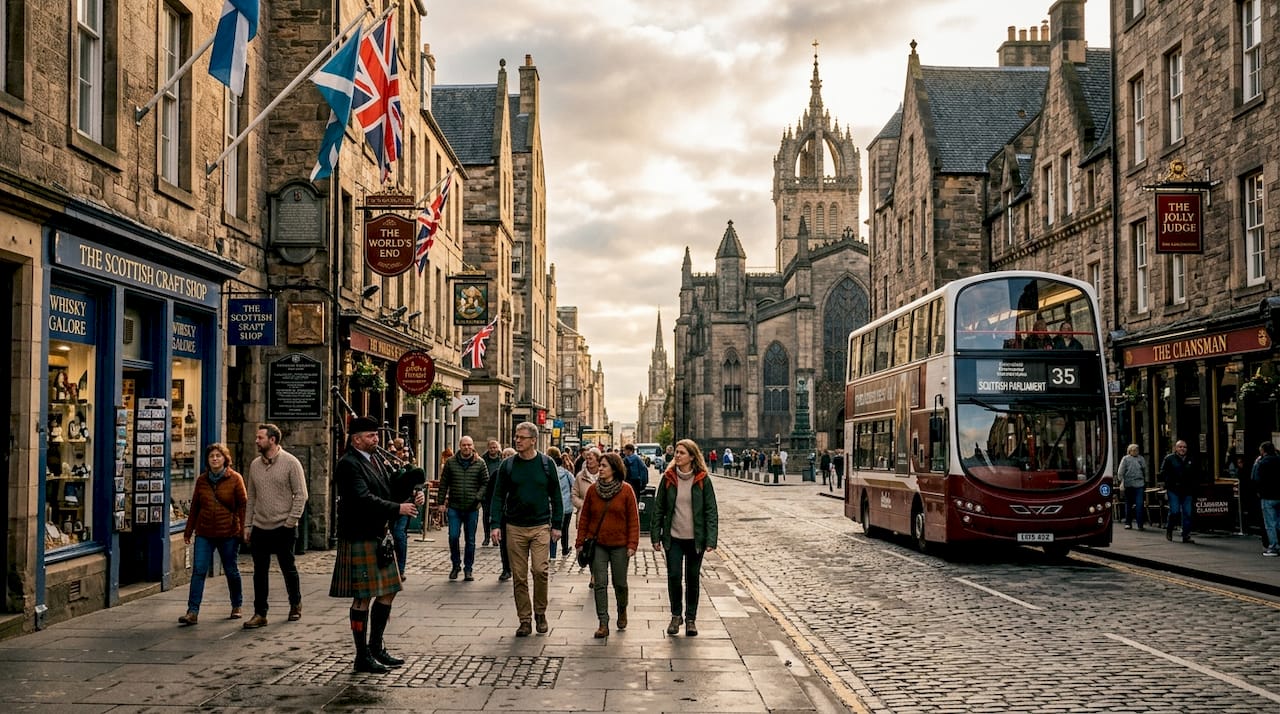
The Old Town follows the medieval ridge running from Edinburgh Castle down to the Palace of Holyroodhouse. Its buildings are tall, narrow, and dark, stacked along the volcanic ridge because there was nowhere else to build. The New Town showcases neoclassical planning, constructed between 1767 and 1890 with wide streets, formal squares, and Georgian townhouses. The contrast is not just aesthetic. It reflects a political moment when Scotland’s Enlightenment thinkers wanted to project rationality and modernity to the world.
For visitors, Edinburgh rewards slow walking more than organized tours. The closes (narrow alleyways) off the Royal Mile each have their own story, and many lead to hidden courtyards that most tourists walk straight past.
2. The Heart of Neolithic Orkney
Orkney delivers a shock of scale. The cluster of prehistoric sites on mainland Orkney, including Skara Brae, the Ring of Brodgar, Maeshowe, and the Stones of Stenness, represents one of the most complete Neolithic landscapes anywhere in the world. Skara Brae alone contains stone furniture inside homes that were occupied around 3,100 BCE. That is older than Stonehenge and the Egyptian pyramids.
What makes the cultural heritage of the Scottish Highlands and islands exceptional here is preservation. Orkney’s northern climate and sandy soil actually protected Skara Brae for millennia. You can look through the doorway into a 5,000-year-old living room and see the stone dresser still standing where it was built. That level of intimacy with prehistoric life is rare anywhere on earth.
3. The Antonine Wall
Most visitors to Scotland have heard of Hadrian’s Wall. Far fewer know that the Romans built a second, more northerly frontier directly across central Scotland. The Antonine Wall ran 37 miles from the Firth of Forth to the Firth of Clyde, constructed around 142 CE from turf rather than stone. It was occupied for only about 20 years before the Romans pulled back south.
This is one of Scotland’s heritage landmarks that rewards visitors who do their homework first. The wall’s remains are modest. What you are really visiting is the idea: Rome’s northernmost frontier, the edge of the known world. The site holds UNESCO World Heritage status as part of the broader Frontiers of the Roman Empire designation.
4. New Lanark
New Lanark is one of the most unusual Scottish cultural sites because it tells an industrial story with a utopian edge. Built in the 1780s beside the Falls of Clyde, it was transformed by social reformer Robert Owen into a model industrial community that offered workers housing, education, and decent working conditions. This was genuinely radical thinking for the early 19th century.
The entire village is a UNESCO-designated industrial heritage site, and it still functions as a living community. Visitors can walk through restored mill buildings, Owen’s school, and workers’ tenements, then take a short walk to reach the dramatic Falls of Clyde. It is an ideal destination for anyone interested in labor history alongside architectural heritage.
5. St Kilda
St Kilda sits 40 miles west of the Outer Hebrides. It is the most remote of Scotland’s heritage landmarks and arguably the most haunting. St Kilda holds dual designation as both a natural and cultural World Heritage Site, reflecting the extraordinary interplay between the island’s seabird colonies and the human community that survived there for thousands of years until evacuation in 1930.
The stone village on Hirta, the main island, sits largely intact. Cleits (stone storage structures) dot the hillsides by the hundreds. The landscape speaks to an isolated culture that developed completely unique survival practices. Getting there requires a boat journey from the Outer Hebrides, and weather can cancel trips at short notice.
6. The Forth Bridge
The Forth Bridge outside Edinburgh is the kind of site that earns UNESCO status through sheer engineering audacity. Completed in 1890, it was the world’s first major steel structure built using the cantilever method. When it opened, it demonstrated that steel could do what no one believed possible.
The bridge remains a working railway crossing today. You can view it from South Queensferry, take a guided tour across parts of its structure, or frame it from the water on a Firth of Forth boat trip. Its visual presence is immediate. Even travelers who have no interest in engineering history tend to stop and stare.
7. Culloden Battlefield
No list of historic sites in Scotland is complete without Culloden. The battlefield outside Inverness marks the site of the last battle fought on British soil, in April 1746, where Jacobite forces supporting Bonnie Prince Charlie were defeated by government troops in under an hour. The aftermath was catastrophic for Highland clan culture.
The Culloden Battlefield and Clava Cairns tour offered by Skyehighlandstours pairs the battlefield with nearby prehistoric cairns, which gives the experience a powerful historical depth. The visitor center at Culloden uses immersive storytelling technology that does not trivialize what happened there. Clan grave markers stand across the moor, and the silence of the site carries genuine weight.
8. Bachelors’ Club, Ayrshire
This one surprises people. The Bachelors’ Club in Tarbolton, Ayrshire, is a rare surviving 17th-century thatched building where Robert Burns and friends co-founded a debating and social society in 1780. Entry is just £5 for adults and £3.50 for concessions, making it one of Scotland’s most accessible heritage experiences.
Burns tourism tends to concentrate on his birthplace in Alloway, but the Bachelors’ Club tells a more interesting story about his intellectual life and the community he built around ideas. Historic sites like this one undergo phased conservation work, so it is always worth checking for seasonal closures before you visit.
9. Culross
Culross in Fife is one of the best-preserved examples of a Scottish burgh from the 16th and 17th centuries. The ochre-painted buildings, cobbled streets, and market cross have remained largely unchanged because the town’s commercial importance declined before Victorian developers could alter it. Poverty preserved it perfectly.
The National Trust for Scotland manages the palace and multiple other properties here. Walking through Culross feels less like a museum visit and more like a genuine time slip. It is also where the television series Outlander filmed several scenes, which brings in a specific category of visitor but should not overshadow the site’s authentic historical value.
10. Staffa and Fingal’s Cave
Staffa is a small uninhabited island in the Inner Hebrides formed by hexagonal basalt columns identical to those at Giant’s Causeway in Northern Ireland. Fingal’s Cave, carved by the sea into those columns, inspired Felix Mendelssohn’s Hebrides Overture in 1829. Staffa is recognized simultaneously as a National Nature Reserve and a site of cultural and literary significance.
Access to Staffa depends entirely on boat tours from Mull or Iona, and weather determines whether those tours operate. When conditions allow, visitors can walk into the cave entrance along a narrow ledge path. The acoustic effect of waves inside the cave is extraordinary and explains exactly why Mendelssohn found musical inspiration there.
11. Traprain Law and its treasure
Traprain Law in East Lothian is an ancient hilltop settlement that produced one of the most significant archaeological finds in Scottish history. The Traprain Law Treasure, a hoard of Roman silver discovered in 1919, was initially interpreted as plunder. Updated scholarly interpretation now suggests much of it arrived through diplomatic gifting between local leaders and the Roman world, which tells a much more nuanced story about cross-cultural contact in late Roman Britain.
The Traprain Law artifacts are housed in the National Museum of Scotland in Edinburgh rather than on site, so planning a museum visit alongside the hill itself gives visitors the complete picture. The hill itself is a free and open site with sweeping views across East Lothian.
Comparing Scotland’s top heritage sites
| Site | Type | Era | UNESCO Status | Accessibility |
|---|---|---|---|---|
| Edinburgh Old/New Towns | Architectural | Medieval to Georgian | Yes | High |
| Heart of Neolithic Orkney | Archaeological | Prehistoric | Yes | Moderate |
| Antonine Wall | Archaeological | Roman | Yes | Moderate |
| New Lanark | Industrial | 18th to 19th century | Yes | High |
| St Kilda | Natural/Cultural | Prehistoric to 1930 | Yes | Low (boat only) |
| Culloden Battlefield | Historical | 18th century | No | High |
| Staffa | Natural/Cultural | Geological/19th-century | No | Low (weather dependent) |
| Culross | Architectural | 16th to 17th century | No | High |
| Bachelors’ Club | Literary/Cultural | 17th century | No | Moderate |
For travelers focused on archaeology, Orkney and Traprain Law are the standout choices. Urban architecture enthusiasts will get the most from Edinburgh and New Lanark. Anyone drawn to the cultural heritage of the Scottish Highlands, particularly its military and clan history, should prioritize Culloden. Remote natural-cultural sites like St Kilda and Staffa reward travelers with flexibility and a high tolerance for weather-dependent logistics.
Pro Tip: Scotland’s weather is genuinely variable year-round. For remote sites like St Kilda and Staffa, plan your visit between May and September and build in at least one backup day. Boat tour operators will not run in rough seas, and the sites are worth waiting for.
My honest take on Scottish heritage tourism
I’ve visited a lot of these sites over the years, and the single biggest mistake I see travelers make is treating heritage visits like items on a checklist. You arrive, photograph the stone circle or castle, and leave without really absorbing what you are standing in front of.
What I’ve found genuinely transforms a heritage visit is engaging with the human story behind a site rather than just its physical facts. Culloden hits differently when you understand what Highland clan life looked like before 1746, and what was deliberately dismantled afterward. The Bachelors’ Club feels alive when you realize Burns was not yet famous when he debated there. He was just a young farmer with ideas.
In my experience, local guides are the single best investment you can make at a Scottish heritage site. Not because they know more dates, but because they know the local lore, the contested histories, and the details that never make it onto information panels. I’ve heard stories at sites that completely changed my understanding of what I was looking at. That kind of context is available through expert Highland guides in ways that no guidebook replicates.
I’d also push back on the idea that UNESCO status equals importance. Some of the most moving Scotland historical attractions I’ve visited have no official designation at all. Culross on a quiet morning, or Traprain Law at dusk with no one else around, is as powerful as any World Heritage Site. The designation helps with preservation funding. It does not determine the quality of your experience.
— Alin
Plan your Scottish heritage experience with Skyehighlandstours
Scotland’s heritage sites are extraordinary. Getting the most out of them takes more than a map and a rental car.
Skyehighlandstours designs private Highland tours that put cultural and historical depth at the center of every itinerary. Whether you want to stand on Culloden Moor with someone who can tell you exactly what happened in those 60 minutes, explore the Glenfinnan Viaduct’s place in Scottish history, or build a custom route through the sites that matter most to you, the team at Skyehighlandstours makes it happen. Their expert local guides bring Scotland’s stories to life in ways that stick long after the trip ends. Browse the full Scottish Highlands tours catalog and start building an itinerary that actually does Scotland justice.
FAQ
What are the main UNESCO sites in Scotland?
Scotland has six UNESCO World Heritage Sites: the Old and New Towns of Edinburgh, the Heart of Neolithic Orkney, the Antonine Wall, New Lanark, St Kilda, and the Forth Bridge. Each represents a distinct type and era of Scottish heritage.
What is Scottish Highland culture?
Scottish Highland culture includes clan traditions, Gaelic language, traditional music, and agricultural practices shaped by the region’s geography and history. It also encompasses intangible heritage like festivals and oral storytelling traditions passed through generations.
Is Culloden Battlefield worth visiting?
Yes. Culloden is one of the most significant historic sites in Scotland, marking the last battle fought on British soil in 1746 and the subsequent dismantling of Highland clan culture. The visitor center and open moor deliver an emotionally powerful experience.
How do you get to remote Scottish heritage sites like Staffa?
Staffa is accessible only by boat tour, typically departing from Mull or Iona between May and September. Trips are weather-dependent, so building flexibility into your schedule is important for anyone planning to visit.
Are there Scottish heritage sites beyond the well-known landmarks?
Absolutely. Sites like the Bachelors’ Club in Ayrshire, Culross in Fife, and Traprain Law in East Lothian offer rich historical and cultural experiences that most tourists overlook entirely, often with smaller crowds and lower admission costs.
Recommended
- Discover Highland Heritage: Culture, Clans, and Scenic Scotland – Skye Highlands Tours
- Famous viaducts in Scotland: iconic stops every traveler needs – Skye Highlands Tours
- Experience Scotland food: Highland flavors & culinary traditions – Skye Highlands Tours
- Culloden Battlefield – Clava Cairns & Cawdor Castle – Skye Highlands Tours