Your cart is empty Continue Shopping
Scottish clan history: origins, decline, and legacy
Scottish clan history is the study of kinship groups that served as the primary social, political, and military units of Highland Scotland from the medieval period onwards. These were not simply extended families gathered around a fire. Scottish clans held legal standing under Scots law, with chiefs recognised by the Court of the Lord Lyon and bearing heraldic arms that defined their authority. Understanding what a Scottish clan actually was requires separating three distinct layers: the medieval community, the legal erosion of the 17th and 18th centuries, and the romantic revival that followed.
What is scottish clan history and how did clans begin?
The history of Scottish clans does not begin with a single founding moment. Clan origins stem from political power shifts after the 12th century, not from pure bloodlines or ethnic homogeneity. Warlords consolidated territory, and those who followed them became clan members through allegiance and proximity as much as through birth.
This is the detail most popular accounts miss entirely. A clan called MacDonald did not arise because every MacDonald shared a common grandfather. It arose because a dominant figure named Domhnall commanded loyalty across a territory, and those who sheltered under his protection took his name or were recorded as his people. The same pattern repeated across the Highlands with Gaelic, Norse-Gaelic, and Norman influences all shaping different clan lineages.
Consider the range of origins among famous Scottish clans:
- Clan Campbell traces Norman and Gaelic roots, with its name likely derived from the Gaelic cam beul (crooked mouth), and rose through strategic royal alliances.
- Clan MacDonald, the Lords of the Isles, drew heavily on Norse-Gaelic heritage from the Kingdom of the Isles.
- Clan Fraser carries a Norman surname, reflecting the wave of French-speaking nobles who entered Scotland under David I in the 12th century.
- Clan Gordon similarly arrived via Norman settlement before becoming one of the most powerful houses in the north-east.
The connection to landholding was central. Clans existed within Scotland’s feudal framework, and chiefs held land from the Crown or from more powerful nobles. That land tenure shaped who belonged to a clan and what obligations they carried.
Pro Tip: When researching Scottish clan origins, always check whether a clan’s founding figure held land by royal charter or by military conquest. The difference tells you a great deal about how stable and legally recognised that clan’s position was.
How did clans govern and organise highland society?
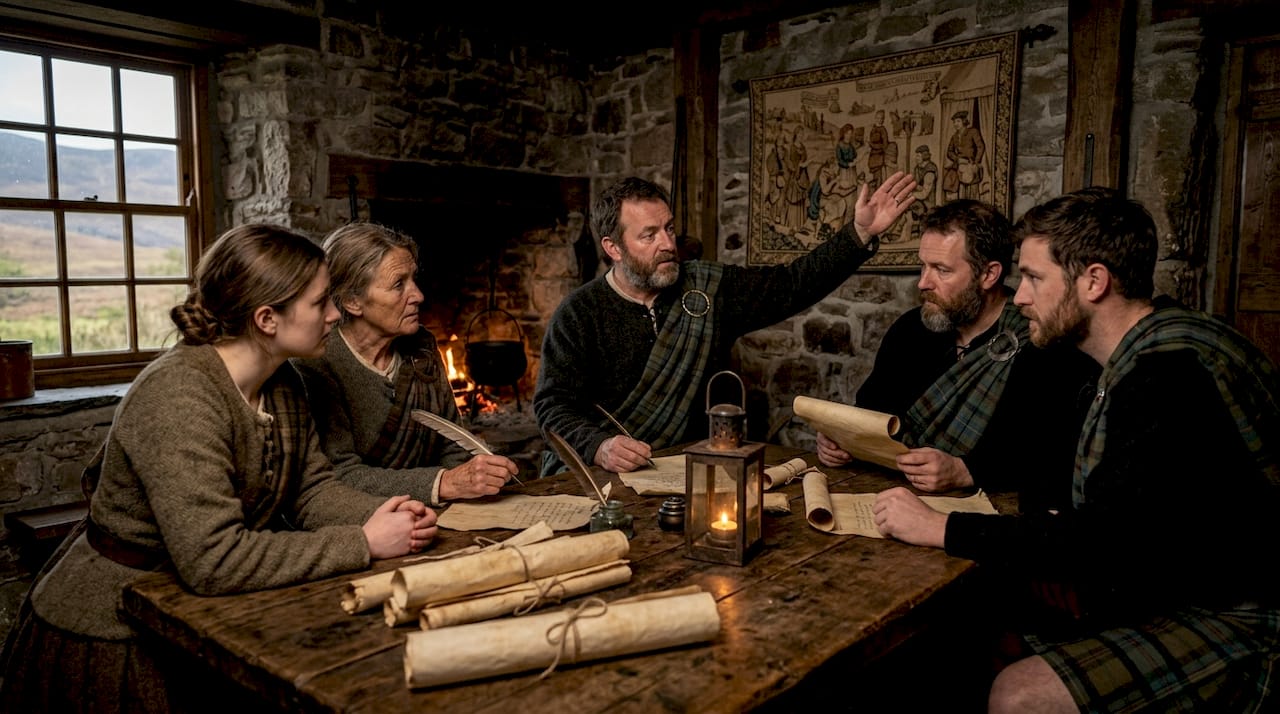
The clan system provided political and social governance, not simply ethnic or military identity. This is what separates it from ancient tribalism. A clan chief was not a chieftain in the romantic sense. He was a local ruler with defined obligations and real legal authority over those within his territory.
The governance structure worked through a set of mutual obligations that ran in both directions:
- The chief’s duty to protect. A chief was expected to defend clan members from external threats, whether from rival clans or from the Crown’s agents. Failure to protect weakened his authority and could trigger a succession challenge.
- The chief’s duty to administer justice. Under heritable jurisdictions, chiefs held baronial courts with the power to try cases and impose penalties. This was genuine judicial authority, not symbolic leadership.
- The tanistry succession system. Rather than strict primogeniture, clan chiefs were chosen from among capable male relatives of the previous chief. The most able candidate within the derbfine (the recognised kin group) took precedence. This produced stronger leaders but also more succession disputes.
- Members’ obligations in return. Clan members owed military service, labour, and loyalty to the chief. In practice, this meant fighting in the chief’s wars, working his land, and supporting his political ambitions.
This structure contrasted sharply with Lowland Scotland, where feudal relationships were more formalised and the Crown’s authority was stronger. Highland clans operated in a space where geography reinforced autonomy. Mountains and sea lochs made central enforcement difficult, and clans filled that governance gap.
Clan membership historically included families connected by allegiance or territory, not only blood descent. A blacksmith who moved into MacDonald territory and swore loyalty to the chief could become a MacDonald in every practical sense. This social flexibility was a feature, not a flaw. It allowed clans to grow rapidly and absorb neighbouring communities.
When and why did the clan system decline?
The clan system’s decline was gradual, driven by a sequence of central government policies across two centuries. The Battle of Culloden in 1746 is the symbolic marker most people cite, but the erosion began far earlier and continued long after.
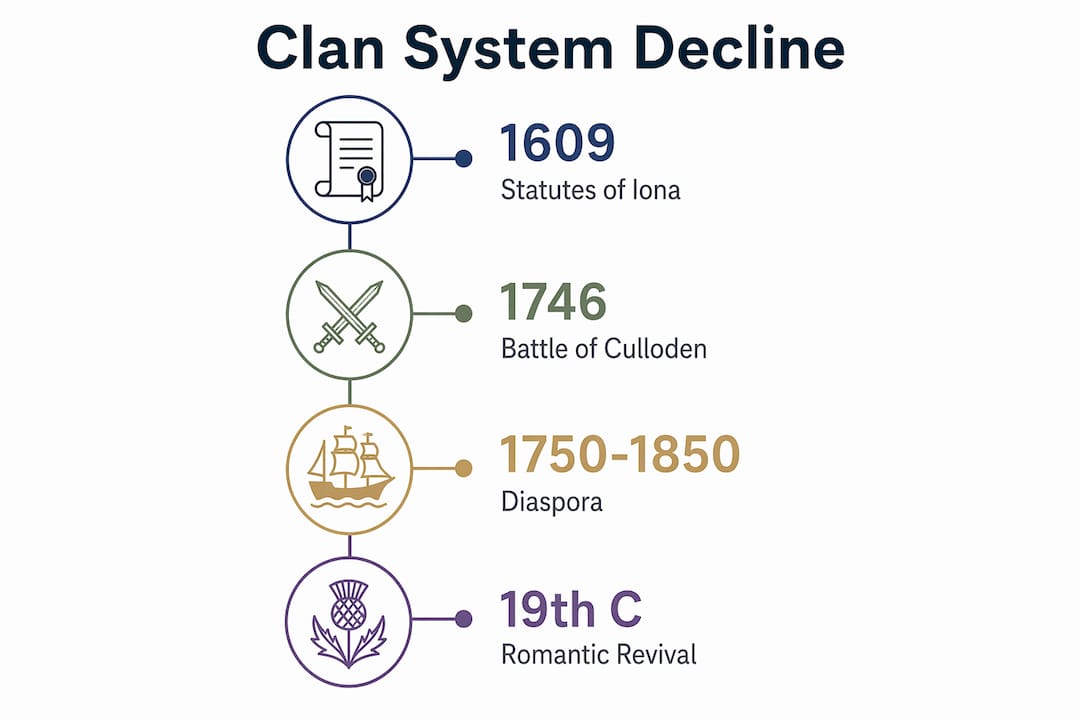
| Period | Event | Effect on Clans |
|---|---|---|
| 1609 | Statutes of Iona | Chiefs compelled to send sons to Lowland schools; Gaelic culture suppressed |
| 1707 | Acts of Union | Scottish Parliament dissolved; Westminster authority extended northward |
| 1746 | Battle of Culloden | Jacobite defeat accelerated punitive legislation against Highland culture |
| 1747 | Abolition of Heritable Jurisdictions | Chiefs lost their baronial courts and judicial authority permanently |
| 1750–1860 | Highland Clearances | Mass displacement of tenant farmers replaced communities with sheep farming |
Each of these events removed a layer of clan authority. The Statutes of Iona targeted cultural reproduction. The abolition of heritable jurisdictions removed the legal power that made chiefs genuinely powerful. The Clearances scattered the communities that gave clans their human substance.
The diaspora that followed was enormous. Scots from clan territories settled across Canada, the United States, Australia, and New Zealand. They carried surnames, traditions, and a sense of clan identity with them, even as the original system ceased to function at home.
Pro Tip: If you are researching clan genealogy in Scotland, the period 1750–1850 is the most disruptive for records. Many families were displaced during the Clearances, and parish records from this era are incomplete. The Scotland’s People database held by the National Records of Scotland is the most reliable starting point.
How did clan identity survive into the modern era?
The 19th-century romanticisation by Sir Walter Scott and others did not revive the clan system. It created something new: a cultural identity built on the memory of the original system. Scott’s novels, particularly Waverley (1814) and Rob Roy (1817), presented Highland clan life as noble, dramatic, and worth celebrating. King George IV’s visit to Edinburgh in 1822, stage-managed by Scott, turned tartan into a symbol of Scottish national identity almost overnight.
The Lord Lyon King of Arms provided the legal anchor for this revival. The Lyon Register, dating from 1672, records heraldic arms granted to clan chiefs. A chief recognised by the Lord Lyon holds undifferenced arms and is the official head of their clan under Scots law. This formal recognition ensures that clan chiefship is not merely ceremonial. It carries genuine legal weight within Scotland’s heraldic system.
Modern clan identity expresses itself through several channels:
- Clan societies operate worldwide, maintaining records, hosting gatherings, and connecting members of the diaspora. Clan Donald USA and the Clan Campbell Society are among the largest.
- Highland Games held across Scotland and internationally provide a focal point for clan gatherings. The Braemar Gathering, attended annually by the Royal Family, remains the most prominent.
- Tartan registration through the Scottish Register of Tartans, established by Act of Parliament in 2008, gives clans an official record of their distinctive patterns.
- Heraldic crests and mottos displayed on clan badges carry specific legal meaning. Only the chief may wear the full heraldic achievement. Members wear the chief’s crest within a strap and buckle, signifying that they follow the chief.
Clan heritage remains significant in Scottish diaspora cultures globally, with many people tracing family roots through surnames linked to specific clans. The genealogical implications are real but require care. Sharing a surname with a clan does not automatically make you a member. Cross-referencing documentary evidence with clan traditions, as the National Library of Scotland’s resources recommend, produces far more accurate results.
Key takeaways
Scottish clan history is best understood as three overlapping layers: medieval governance, legal erosion, and cultural revival, each requiring separate analysis.
| Point | Details |
|---|---|
| Clans were political units | Clan chiefs held legal judicial authority, not just symbolic leadership, under Scots law. |
| Origins were diverse | Gaelic, Norse-Gaelic, and Norman influences all shaped famous Scottish clans like MacDonald, Fraser, and Gordon. |
| Decline was gradual | The Statutes of Iona, abolition of heritable jurisdictions, and the Clearances each removed a layer of clan power across two centuries. |
| Legal recognition persists | The Lord Lyon King of Arms still formally recognises clan chiefs, giving modern clan identity genuine legal standing. |
| Genealogy requires care | Clan membership was historically based on allegiance and territory, not blood alone, so surname research must be cross-referenced with heraldic records. |
Why the clan story is more complicated than most people realise
People often ask me whether Scottish clans were real or romanticised. My honest answer is that they were both, at different times, and conflating the two is where most misunderstandings begin.
The medieval clan was a functioning governance structure. It was not a costume or a cultural performance. Chiefs held courts, raised armies, and made binding decisions over life and property. That reality deserves to be taken seriously, not reduced to tartan and bagpipes.
What happened in the 19th century was genuinely different. Sir Walter Scott and the Romantic movement took the ruins of that system and built something new from them. The result was powerful and emotionally resonant, but it was not a continuation of the original. Treating the two as the same thing leads people to believe that clans ended at Culloden, which is wrong, or that modern clan societies are direct descendants of medieval governance structures, which is also wrong.
The most productive approach I have seen, whether you are a historian, a genealogist, or simply someone curious about Highland heritage, is to treat clan history in three distinct layers. Ask first what the medieval community looked like. Then ask how legal and political changes eroded it. Then ask what the revival preserved and what it invented. That sequence produces clarity where most popular accounts produce confusion.
The physical landscape of the Highlands holds all three layers simultaneously. Standing at Culloden Battlefield and understanding what actually happened there, rather than what the myth says happened, changes how you read every clan story that follows.
— Alin
Explore scottish clan history on the ground
Reading about clan history is one thing. Standing in the glens where these events unfolded is something else entirely.

Skyehighlandstours offers private guided Highland tours designed for travellers who want more than scenic photographs. Expert local guides bring clan history to life at sites including Culloden Moor, Eilean Donan Castle, and the Great Glen, explaining the political and social forces that shaped each location. Tours are tailored to your interests, whether your focus is genealogy, heraldry, battlefield history, or the broader story of Highland culture. If you want to connect what you have read here to the actual terrain where it happened, a personalised Scottish Highlands itinerary from Skyehighlandstours is the most direct way to do it.
FAQ
What is a scottish clan in simple terms?
A Scottish clan is a kinship group with legal recognition under Scots law, headed by a chief whose authority is formally confirmed by the Court of the Lord Lyon. Membership historically included people connected by allegiance and territory, not only by blood.
Which are the most powerful clans in scottish history?
Clan Donald, Clan Campbell, and Clan MacKenzie were among the most politically dominant clans in Scottish history. Clan Donald held the Lordship of the Isles, giving it quasi-royal authority over much of western Scotland and the Hebrides for over a century.
Did the clan system end at the battle of culloden?
Culloden in 1746 is a symbolic marker, but the clan system’s decline was gradual, driven by the Statutes of Iona in 1609, the abolition of heritable jurisdictions in 1747, and the Highland Clearances across the following century.
How do i research my scottish clan genealogy?
Cross-reference your surname with heraldic records held by the Lord Lyon and documentary sources in the National Records of Scotland. The Scotland’s People database is the most reliable starting point for tracing clan genealogy, particularly for records from the 18th and 19th centuries.
Are scottish clan tartans historically authentic?
Most clan tartans were formalised or invented during the 19th-century romantic revival sparked by Sir Walter Scott. The Scottish Register of Tartans, established by Act of Parliament in 2008, now provides an official record, but the historical depth of individual patterns varies considerably by clan.
Recommended
- Discover Highland Heritage: Culture, Clans, and Scenic Scotland – Skye Highlands Tours
- Why celebrate anniversaries in Scotland: traditions and ideas – Skye Highlands Tours
- Scottish Highland Romance: Stories, Culture & Real Experiences – Skye Highlands Tours
- Examples of Scottish Heritage Sites Worth Visiting – Skye Highlands Tours