


Your cart is empty Continue Shopping
Types of nature discovery activities for families and educators
The main types of nature discovery activities children can do today are: nature scavenger hunts (short activities suitable for ages 3+, completable in 15–20 minutes), creative nature art and sensory crafts (30–45 minutes, ages 3+), habitat-building projects such as bird feeders and bee hotels (45–60 minutes, ages 5+), minibeast and pond exploration (30–45 minutes, ages 4+), birdwatching (20–40 minutes, ages 5+), observation studies including tree and sky journals (ongoing, all ages), citizen science and recording (30–60 minutes, ages 7+), nature games and sensory walks (5–30 minutes, all ages), and indoor adaptations for wet weather (15–30 minutes, all ages). Trusted organisations including the Natural History Museum, the Scottish Wildlife Trust, and Twinkl all frame these outdoor exploration activities as core to children’s environmental education and scientific development.
Table of Contents
- 1. What does each nature discovery activity look like in practice?
- 2. Creative and sensory nature activities: art, crafts, and photography
- 3. How to build wildlife habitats with children
- 4. Exploration and observation: minibeasts, pond dipping, rockpooling, and birdwatching
- 5. Nature games, sensory walks, and indoor adaptations for bad weather
- 6. Citizen science, recording methods, and simple journal templates
- 7. Practical tips for educators and carers: adapting by age, site, and accessibility
- Key takeaways
- Why child-led curiosity matters more than correct answers
- Guided family nature discovery in the Scottish Highlands with Skyehighlandstours
- Useful sources and trusted UK resources
- FAQ
1. What does each nature discovery activity look like in practice?
Nature scavenger hunts
A scavenger hunt is the most adaptable entry point into outdoor learning. Set a theme — colour, texture, animal signs, or season — and give children a simple checklist or printed card. Scavenger hunts are developmentally appropriate from early years through primary age and can be completed in as little as 15–20 minutes with nothing more than a pencil and a printed sheet.
How to run it (3 steps):
- Choose a theme (e.g. “five things that are brown”, “find something smooth, rough, and spiky”).
- Hand each child a checklist or bingo card; set a clear boundary for the search area.
- Gather back together and share findings — photograph rather than collect living material.
Ages 3–5: use pictures instead of words on the card. Ages 6–8: add a tally or simple sketch column. Ages 9+: ask children to categorise findings and write one observation sentence per item.
Works in a small garden, a school playground, or a park. A four-seasons printable turns this into an ongoing family record across the year.
Observation studies: trees, sky, and seasonal change
Pick one tree, one patch of sky, or one corner of a garden and return to it repeatedly. Children record what changes: leaf colour, bird visitors, cloud types, insect activity. The repetition is the point. The “One Square Foot” method focuses attention on a tiny, defined plot and prevents the overwhelm that comes from trying to notice everything at once — practitioners report it produces some of the most engaged sessions they run.
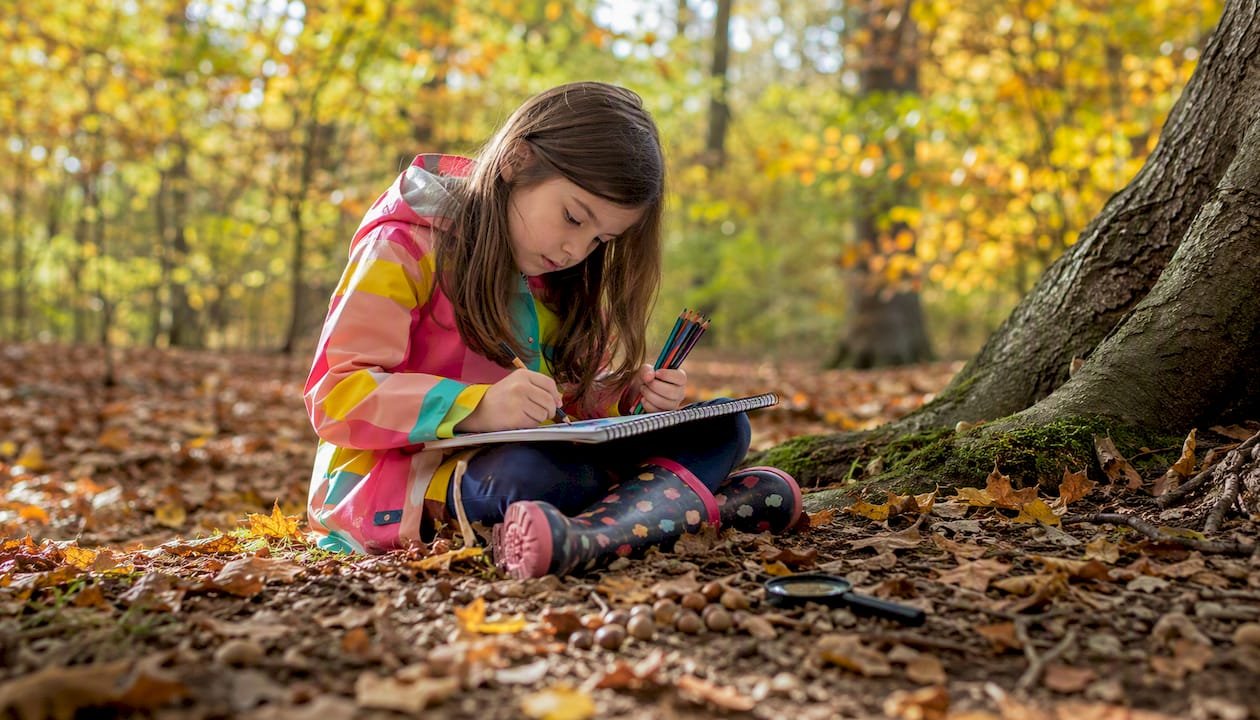
Ages 3–5: draw what they see. Ages 6–8: add weather notes and a date. Ages 9+: compare entries across weeks and identify patterns.
Kit: notebook, pencil, ruler to mark the plot. Time: 10–15 minutes per visit.
Minibeast and pond exploration
Turn over a log, lift a stone, or dip a white tray into a pond and children are immediately scientists. Minibeast hunts work in any garden or school grounds; pond dipping needs a suitable freshwater site and basic water-safety rules in place.
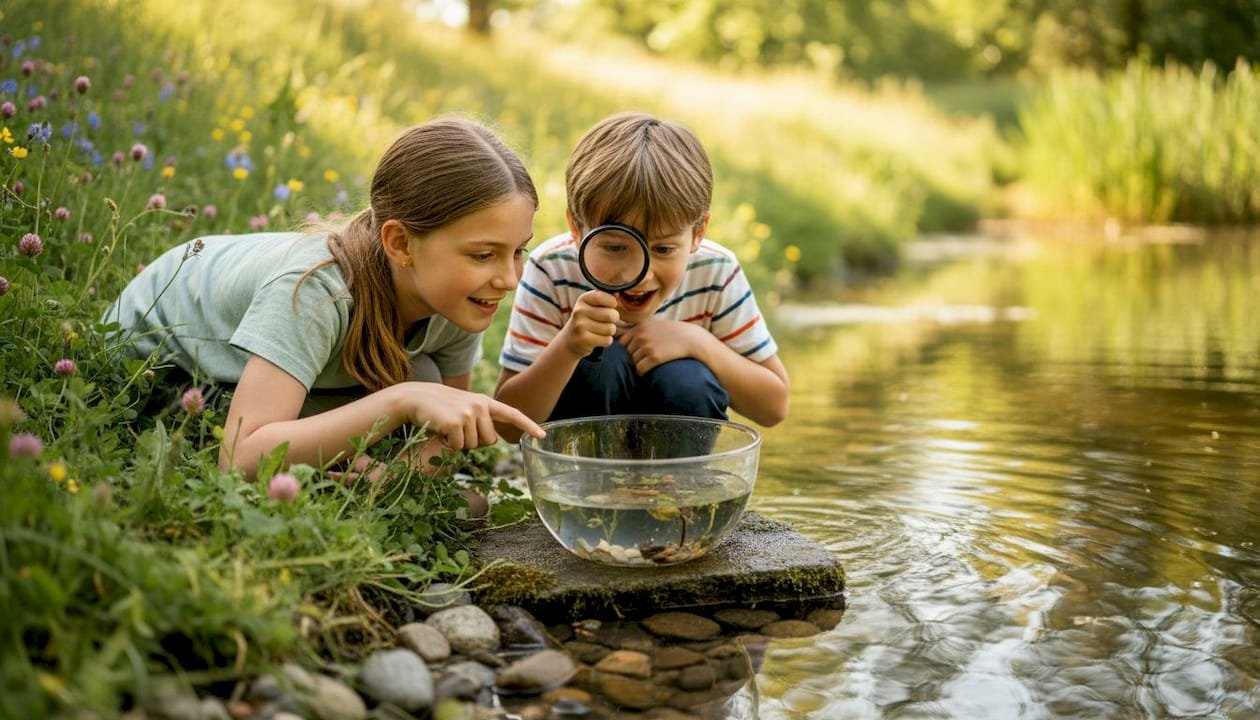
Kit: white plastic tray, magnifying glass, a simple ID guide (the Field Studies Council produces free downloadable keys for UK species), and a small paintbrush for moving creatures gently.
Session length: 30–45 minutes. Ages 4+ for minibeast hunts; ages 6+ for pond dipping with adult supervision.
Birdwatching
Birdwatching teaches patience and close observation — two skills that transfer directly into scientific thinking. Start with a garden or school window, a bird feeder, and a basic RSPB identification chart. The Natural History Museum’s summer nature activities include bird spotting as one of its recommended starting points for families.
Ages 5–7: identify three common garden birds by colour. Ages 8+: keep a tally chart and note behaviour (feeding, singing, nesting). Ages 10+: submit records to the RSPB’s Big Garden Birdwatch or the British Trust for Ornithology’s BirdTrack.
Kit: binoculars (optional), ID chart, notebook. Time: 20–40 minutes.
Citizen science and recording
Children move from passive observers to active contributors when they submit records to platforms such as iNaturalist or iRecord (the National Biodiversity Network’s recording portal). Both accept UK wildlife sightings and are free to use. Structured recording tools — stick journals, seasonal weather logs, biodiversity surveys — help children move from passive observation to genuine scientific investigation when repeated over time.
Ages 7+ with adult oversight for account creation and photo uploads. Privacy note: use a parent or teacher account; do not upload location data for sensitive species.
Nature games and sensory walks
Quick, low-prep games that need almost nothing. A colour walk (match a paint-chip card to something in nature), a texture hunt, nature bingo, or a listening walk (eyes closed, count the sounds) can fill a 10-minute break or a 30-minute lesson. These are the activities to reach for when the plan falls apart and you have five minutes before the bell.
Indoor adaptations for bad weather
A sensory tray filled with soil, bark, pine cones, and leaves brings the outdoors in. Window birdwatching, cloud journalling from a classroom window, and sorting collections already gathered outside all count as nature discovery excursions of a kind. The Scottish Wildlife Trust publishes free indoor activity sheets for exactly these moments.
2. Creative and sensory nature activities: art, crafts, and photography
Creative activities build observational skills without requiring children to name or classify anything. The act of looking closely enough to draw a leaf or match a bark texture to paper is itself a scientific skill.
Three activities with step-by-step guidance
1. Leaf rubbings
- Collect fallen leaves only (never pull from a living plant).
- Place a leaf vein-side up under thin paper.
- Rub a wax crayon or soft pencil sideways across the paper until the pattern appears.
- Label with tree name if known, date, and location.
- Compare rubbings from different seasons to track leaf shape changes.
Materials: fallen leaves, thin paper, wax crayons or soft pencils. Time: 20–30 minutes. Ages: 3+.
2. Bark printing
- Press a piece of soft clay or an ink pad gently against a tree trunk (never carve or damage bark).
- Press paper onto the clay or inked surface and peel away carefully.
- Label the tree species if known.
Materials: air-dry clay or a washable ink pad, paper. Time: 15–20 minutes. Ages: 5+.
3. Outdoor photography for children
- Give each child a tablet or camera and one theme: “find something tiny”, “find something that casts a shadow”, or “find something that surprises you”.
- Review images together and discuss what each child noticed.
- Print favourites and add to a nature journal.
Materials: a shared tablet or disposable camera. Time: 20–30 minutes. Ages: 6+.
Pro Tip: Collect only fallen or shed material — leaves on the ground, feathers, shed bark, empty seed pods. For everything else, photograph it and leave it exactly where it is. This single rule, applied consistently, teaches conservation ethics more effectively than any worksheet.
Inclusive adjustment: for visually impaired children, replace visual rubbings with tactile texture boards made from bark, moss, and seed pods mounted on card. Pair with verbal description prompts (“how many different textures can you feel?”).
3. How to build wildlife habitats with children
Habitat projects give children a long-term stake in their outdoor space. Building something and then watching animals use it is a powerful motivator for repeat observation.
Three projects with build checklists
Bird feeder (simple hanging type)
- Materials: a clean plastic bottle or a wooden offcut, string, bird seed mix, a wooden dowel for a perch.
- Time to build: 30–45 minutes.
- Best months to install: September to February in the UK, when natural food sources are scarce.
- Place at least 2 metres from a window (to prevent bird strikes) and away from dense shrubs where cats can hide.
- Clean weekly with hot water; never use bleach near a feeder.
Bee hotel
- Materials: a bundle of bamboo canes or hollow stems cut to 15–20 cm, a waterproof container (a tin can or wooden box), wire to hang it.
- Time to build: 30–40 minutes.
- Best months to install: March to April, before solitary bees begin nesting.
- Fix south- or south-east-facing, 1–1.5 metres above ground, away from direct rain.
- Check annually in autumn; replace damp or mouldy canes.
Hedgehog shelter
- Materials: a wooden box or upturned plastic storage crate (minimum 30 cm × 30 cm), dry leaves, a length of pipe or tunnel for the entrance.
- Time to build: 45–60 minutes.
- Best months to install: October, before hedgehogs begin hibernation.
- Place in a quiet corner under a hedge or shrub; never near a road.
- Do not disturb between November and March.
Safety and ethics notes:
- Always wash hands after handling materials that have been outside.
- Avoid placing habitats near busy roads or areas with known fox or domestic cat activity.
- Teach children that once an animal moves in, the habitat belongs to the animal — no peeking inside nests or disturbing hibernating hedgehogs.
- Check with your local council if installing habitats on school grounds, as some sites have wildlife management plans in place.
4. Exploration and observation: minibeasts, pond dipping, rockpooling, and birdwatching
These four activities form the backbone of most environmental education programmes in UK schools and wildlife trusts. Each one teaches a slightly different scientific skill.
Observation checklist template
Copy and adapt this for any session:
| Field | What to record |
|---|---|
| Date and time | Day, month, year; time of day |
| Location | Garden, park, pond, coast |
| Weather | Sunny, cloudy, temperature estimate |
| What I saw | Species name or description |
| Behaviour | Moving, feeding, resting, calling |
| Sketch or photo | Quick drawing or camera reference |
| Question | One thing I want to find out next time |
Safety and ethical handling rules
- Minibeasts: use a paintbrush to move creatures into a white tray; observe for no more than a few minutes, then return to exactly where they were found. Wash hands immediately after.
- Pond dipping: never lean over water unsupervised; use a long-handled net; return all animals to the same pond within 15 minutes. Dry equipment between sites to prevent spreading invasive species.
- Rockpooling: check tide times before visiting; wear non-slip footwear; replace any stones you lift exactly as you found them, animals facing downward.
- Birdwatching: keep a minimum distance from nests; never touch eggs or chicks; use binoculars rather than approaching birds closely.
Free species ID resources: the Field Studies Council’s fold-out identification charts cover UK minibeasts, pond life, and seashore species and are available to download free. The RSPB’s online bird identifier is suitable for ages 7+.
5. Nature games, sensory walks, and indoor adaptations for bad weather
These activities need almost nothing and can be dropped into any gap in the day.
- Colour walk (10–15 minutes, all ages): give each child a paint-chip card or a colour wheel printed on card. Walk slowly and match each colour to something in the environment. Ages 9+ can record the exact location and material of each match.
- Texture hunt (15–20 minutes, ages 4+): texture hunts teach material properties and observation skills and can be adapted for older children by asking them to categorise and compare findings. Provide a simple grid: smooth, rough, soft, hard, wet, dry.
- Nature bingo (20–30 minutes, ages 5+): pre-print a 3×3 bingo card with drawings or words (a feather, a stone, something yellow, an insect, a cloud). First to complete a row wins. A four-seasons version becomes a reusable record across the year.
- Nature bowling (20–30 minutes, ages 4+): collect pine cones or smooth stones and set them up as skittles on a flat surface. Roll a larger stone to knock them down. Simple, physical, and surprisingly competitive.
- Listening walk (5–10 minutes, all ages): walk in silence for two minutes, then stop. Eyes closed. Count every distinct sound. Compare lists. This works in a city park as well as a forest.
Indoor adaptations: fill a shallow tray with soil, bark chips, pine cones, acorns, and dried leaves. Children sort, classify, sketch, and describe. Window birdwatching with a printed ID chart works from any classroom. Cloud journalling — drawing cloud shapes and noting weather — needs only a window and a notebook.
Templates: the NYSDEC (New York State Department of Environmental Conservation) publishes free colour hike and leaf hunt recording sheets that teachers can display on a tablet or print. Twinkl’s UK nature activity packs include bingo cards, scavenger hunt lists, and observation journals ready to photocopy.
6. Citizen science, recording methods, and simple journal templates
Recording transforms a one-off activity into a learning habit. Children who return to the same spot, the same tree, or the same pond over weeks begin to notice patterns that a single visit never reveals.
Four recording methods
- Stick journal: a small notebook kept outdoors, used only outside. Date every entry. Sketch first, label second. The rule is: write or draw something on every visit, even if it is just “nothing moving today, cold and grey.”
- Seasonal weather log: a simple table with columns for date, temperature (estimate or thermometer), cloud cover, wind, and one wildlife sighting. Run it for a full school term and the data becomes genuinely interesting.
- Square-foot study: mark a 30 cm × 30 cm plot with four sticks and string. Visit it weekly. Record every living thing visible. Over a school term, children typically find 10–20 species in a single square foot of grass or soil.
- Biodiversity survey: count the number of different species (not individuals) in a defined area over 30 minutes. Compare results between seasons or between sites.
Copy-ready journal template
Citizen science platforms for children
- iNaturalist: free, works on any smartphone or tablet. Children photograph a species and the app suggests an identification. Use a parent or teacher account; set observations to “obscured” for sensitive species locations.
- iRecord (NBN Atlas): the UK’s national biodiversity recording portal. Accepts records from all ages with adult oversight. Particularly useful for school biodiversity surveys submitted to local records centres.
Privacy guidance: create a shared class or family account rather than individual child accounts. Never upload precise location data for rare or protected species. Review the platform’s child safety policy before use in a school setting.
7. Practical tips for educators and carers: adapting by age, site, and accessibility
Session planning checklist
Before taking children outside, run through these five points:
- Permission: parental consent for off-site visits; school risk assessment signed off for on-site sessions.
- Risk assessment basics: identify trip hazards, water sources, allergies (especially insect stings and plant contact), and nearest first-aid point.
- Kit list: pencils, clipboards, printed sheets, magnifying glasses, hand sanitiser, spare bags for any collected items.
- Learning intention: one clear sentence — “today we are going to find three different minibeasts and record where each one lives.”
- Timebox: set a clear start and end time; build in five minutes for handwashing and regrouping.
Inclusive and accessible adjustments
Children with physical disabilities or mobility challenges can participate fully in most activities with minor adjustments: bring the activity to a ground-level tray rather than requiring children to crouch; use raised planters for garden activities; provide tactile materials (bark, soil, seed pods) in a sensory tray for children with visual impairments.
For children with autism or sensory processing differences, a social story explaining what the session will involve — what they will hear, smell, and touch — reduces anxiety significantly. Clear verbal prompts (“now we are going to look at the tray for three minutes”) work better than open-ended instructions.
Children with hearing impairments can participate in all visual observation activities; pair them with a partner for listening-based games and provide a written or visual version of any verbal instructions.
Low-cost kit suggestions
Most activities need nothing beyond a pencil and a printed sheet. A class set of magnifying glasses costs under £15 from most educational suppliers. White plastic trays (for minibeast and pond work) can be sourced from pound shops. Clipboards made from cardboard and a bulldog clip work perfectly well outdoors.
Safeguarding note: in the UK, any off-site visit with children requires a completed risk assessment and, for school groups, adherence to the employer’s outdoor learning policy. The Outdoor Education Advisers’ Panel (OEAP) publishes free guidance for schools. Parents should be informed of any activity involving water, even shallow pond dipping.
Key takeaways
The most effective nature discovery activities combine short, repeatable observation with a single clear conservation rule: photograph rather than collect living material.
| Point | Details |
|---|---|
| Start with a scavenger hunt | Adaptable for ages 3+, completable in 15–20 minutes, needs only a pencil and a printed list. |
| Repeat observation builds skills | Returning to the same spot weekly, using a stick journal or square-foot study, turns one-off curiosity into scientific thinking. |
| One conservation rule covers everything | Collect only fallen or shed material; photograph everything else and leave it in place. |
| Inclusive adjustments are simple | Tactile trays, social stories, and ground-level setups make every activity accessible without specialist equipment. |
| Skyehighlandstours for guided discovery | Families wanting a guided nature experience in the Scottish Highlands can book private, child-paced excursions tailored to any age group. |
Why child-led curiosity matters more than correct answers
The most common mistake adults make in nature sessions is answering too quickly. A child who spots an unusual beetle and asks “what is it?” learns far more when the adult says “I don’t know — how could we find out?” than when they receive an immediate identification. Modelling inquiry — saying “let’s find out together” — increases children’s engagement and scientific thinking more reliably than providing answers, because it shows children that not-knowing is the starting point of science, not a failure.
There is also a strong case for resisting the urge to structure every minute. Practitioners warn against over-structuring: a child who spends an entire session watching a single ant hill has not wasted the time. They have practised sustained attention, which is one of the hardest skills to teach in a classroom. The activities in this article are frameworks, not scripts. Hand a child a scavenger hunt list and then step back. The best discoveries happen in the gaps between the instructions.
Guided family nature discovery in the Scottish Highlands with Skyehighlandstours
The activities above work brilliantly in a back garden or school playground. But there is a particular kind of engagement that only happens when children encounter genuinely wild landscapes — a red deer on a hillside, an osprey over a loch, or the sheer scale of a Highland glen seen for the first time.

Skyehighlandstours offers private, family-friendly Highland excursions across the Isle of Skye, Loch Ness, and the wider Highlands, led by expert local guides who know where to find wildlife, how to pace a walk for younger children, and how to turn a roadside stop into a genuine discovery moment. Every itinerary is built around your family’s ages, interests, and pace.
What families can expect on a guided nature discovery excursion:
- A local guide with deep knowledge of Highland species, habitats, and safe access routes
- Child-friendly pacing with built-in stops for observation, sketching, and photography
- Accessible sites chosen to suit different mobility levels and age groups
- Activities tailored to the season — from spring wildflower spotting to autumn deer rut watching
- Flexible durations from half-day to full-day, with no fixed group size
To plan a custom family itinerary for the Highlands, get in touch with Skyehighlandstours directly. Every booking is private, so the pace and focus are entirely yours.
Useful sources and trusted UK resources
These are the most reliable starting points for printables, teacher guides, and species identification tools:
- Natural History Museum — nature activities for summer: free activity ideas from one of the UK’s leading natural history institutions; suitable for families and classroom use.
- Twinkl: — a UK-based educational resource platform with a large library of nature activity printables, bingo cards, observation journals, and scavenger hunt lists; most resources are free with a basic account.
- iNaturalist: free species identification app and citizen science platform; suitable for family and classroom use with adult oversight.
- iRecord / NBN Atlas: the UK’s national wildlife recording portal; accepts records from all ages and feeds data to local biodiversity records centres.
- Natural Inquirer — Outdoor Activity Compendium: a structured activity library organised by topic (birds, insects, soil, water); useful for educators planning curriculum-linked sessions.
FAQ
What are the main types of nature discovery activities for children?
The main types are scavenger hunts, creative nature art, habitat-building projects, minibeast and pond exploration, birdwatching, observation studies, citizen science recording, sensory games, and indoor adaptations. Most can be run in a garden or school playground with minimal kit.
What are some fun nature activities that take less than 30 minutes?
A colour walk, texture hunt, listening walk, or nature bingo card can all be completed in 5–30 minutes and need nothing more than a printed sheet and a pencil. Scavenger hunts can be completed in as little as 15–20 minutes with basic household supplies.
What are some examples of nature-based learning activities for schools?
Minibeast hunts, pond dipping, square-foot observation studies, seasonal weather logs, and biodiversity surveys all align with UK primary science curricula. Platforms such as iRecord allow classes to submit real wildlife data to the National Biodiversity Network.
How can families experience nature discovery in the Scottish Highlands?
Skyehighlandstours offers private, family-friendly guided excursions across the Isle of Skye and the wider Highlands, with child-paced itineraries, local expert guides, and activities tailored to the season and age group.
How do you make nature activities accessible for children with additional needs?
Use tactile sensory trays, social stories explaining what the session involves, clear verbal prompts, and ground-level setups. Most outdoor observation activities can be adapted for children with mobility, sensory, or communication differences without specialist equipment.