
Your cart is empty Continue Shopping
Sea eagle habitats on Skye: 9 key examples
White-tailed eagles on the Isle of Skye occupy four principal habitat types: sheltered sea lochs, coastal cliffs and headlands, large trees or treelines near the shore, and inland lochs with marshy edges. Forestry and Land Scotland and the RSPB both confirm these as the core environments supporting Scotland’s recovering population.
The best vantage types are shore viewpoints overlooking sea lochs, exposed headlands, and boat tours departing from small harbours such as Portree. All three give you distance from the birds, which matters as much as proximity.
- Sheltered sea lochs along Skye’s west coast and around Portree
- Coastal cliffs and headlands, particularly the Duirinish peninsula
- Large trees and treelines near the shore, used for nesting when available
- Inland lochs, marshes and wetland edges as secondary feeding grounds
Pro Tip: Never attempt to locate a nest independently. Conservation monitoring groups keep precise nest coordinates confidential to prevent disturbance and egg theft. Use a licensed local guide or an established wildlife boat tour for the safest, most ethical viewing.
Table of Contents
- What habitat types do sea eagles use on Skye?
- Concrete Skye locations and vantage points worth knowing
- When are sea eagles most visible on Skye?
- How sea eagles nest on Skye and why nest locations stay secret
- Conservation and reintroduction: why sea eagles are back on Skye
- Responsible watching: what to do and what to avoid
- Why Skye works so well for sea eagles: the ecological picture
- Authoritative resources and how to use them
- Key takeaways
- The view from the ground
- Private guided tours: the responsible way to see sea eagles on Skye
- Useful sources
- FAQ
What habitat types do sea eagles use on Skye?
Forestry and Land Scotland advise that white-tailed eagles favour sheltered lochs over exposed shoreline, and will nest in large trees when they are available, reverting to cliff ledges where trees are absent or unsuitable. Understanding each habitat type helps you identify likely sighting zones before you arrive.
Sheltered sea lochs
These are the most productive hunting grounds on Skye. Calm, enclosed water makes fish more predictable to spot from above, and the surrounding hillsides provide thermal lift for soaring. In the field, look for long, narrow inlets flanked by steep slopes, often with a mix of woodland and open ground at the water’s edge. Skye’s west coast is dense with examples: Loch Bracadale, Loch Harport, and the sea lochs feeding into the Sound of Raasay all fit this profile.
Coastal cliffs and headlands
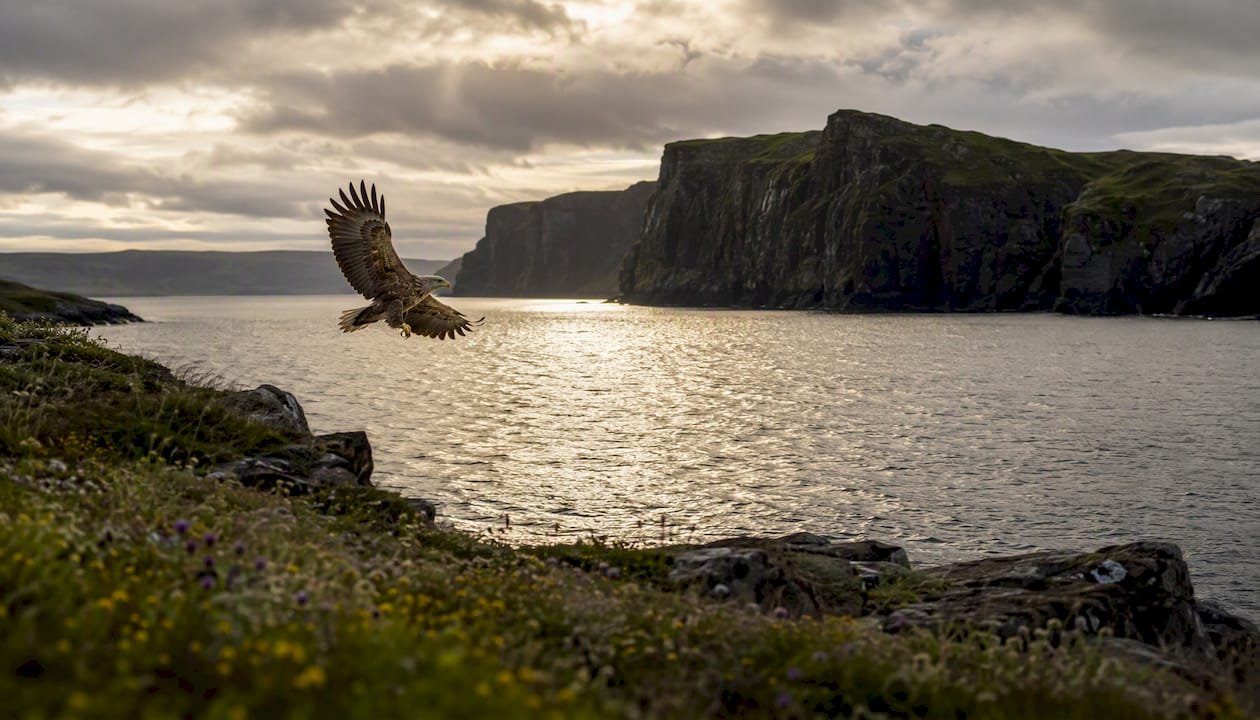
Cliffs serve as both vantage points and, where trees are scarce, nest sites. Unlike golden eagles, which tend to favour high inland crags, white-tailed eagles are drawn to coastal cliff systems close to water. The Duirinish peninsula in the west of Skye offers some of the most dramatic cliff scenery on the island, and the combination of height, proximity to the sea, and relatively low human disturbance makes it a reliable area. Headlands around Portree also fall into this category.
Large trees and treelines
When large trees are present, sea eagles strongly prefer them for nesting over cliffs. Nest trees are typically 10–30 metres tall, broadleaved or coniferous, and positioned within or at the edge of woodland. Isolated large trees are used occasionally. On Skye, patches of mature woodland near the coast, particularly around sheltered bays and estate grounds, provide exactly this structure.
Inland lochs, marshes and wetland edges
These are secondary habitats, used mainly for feeding and scavenging rather than nesting. White-tailed eagles are opportunistic feeders: fish, rabbits, small birds, and carrion all feature in their diet, so freshwater margins with good visibility attract them regularly. On Skye, the broader wetland areas in the north and east of the island see occasional visits, particularly outside the breeding season.
| Habitat type | What it provides | Where to look on Skye |
|---|---|---|
| Sheltered sea lochs | Hunting, shelter, thermal lift | West coast, Loch Bracadale, Loch Harport, Sound of Raasay |
| Coastal cliffs and headlands | Vantage, occasional nesting | Duirinish peninsula, headlands near Portree |
| Large trees and treelines | Preferred nesting sites | Mature woodland near sheltered bays and estate grounds |
| Inland lochs and marshes | Secondary feeding and scavenging | Northern and eastern Skye wetlands |
Concrete Skye locations and vantage points worth knowing
The areas below are general zones, not nest coordinates. They are cited in local wildlife resources and by guides as reliable sighting areas precisely because the habitat is right and disturbance levels are manageable.
Portree coast and surrounding sea lochs
The cliffs and sea lochs around Portree are among the most consistently cited sighting zones on the island. The sheltered waters of Portree Harbour and the sea loch to the south provide good hunting habitat, and the surrounding hillsides offer thermal columns that eagles use for effortless soaring. Wildlife boat tours departing from Portree regularly report sightings, and some crews use fish to attract birds closer to the vessel under controlled conditions.
Duirinish peninsula
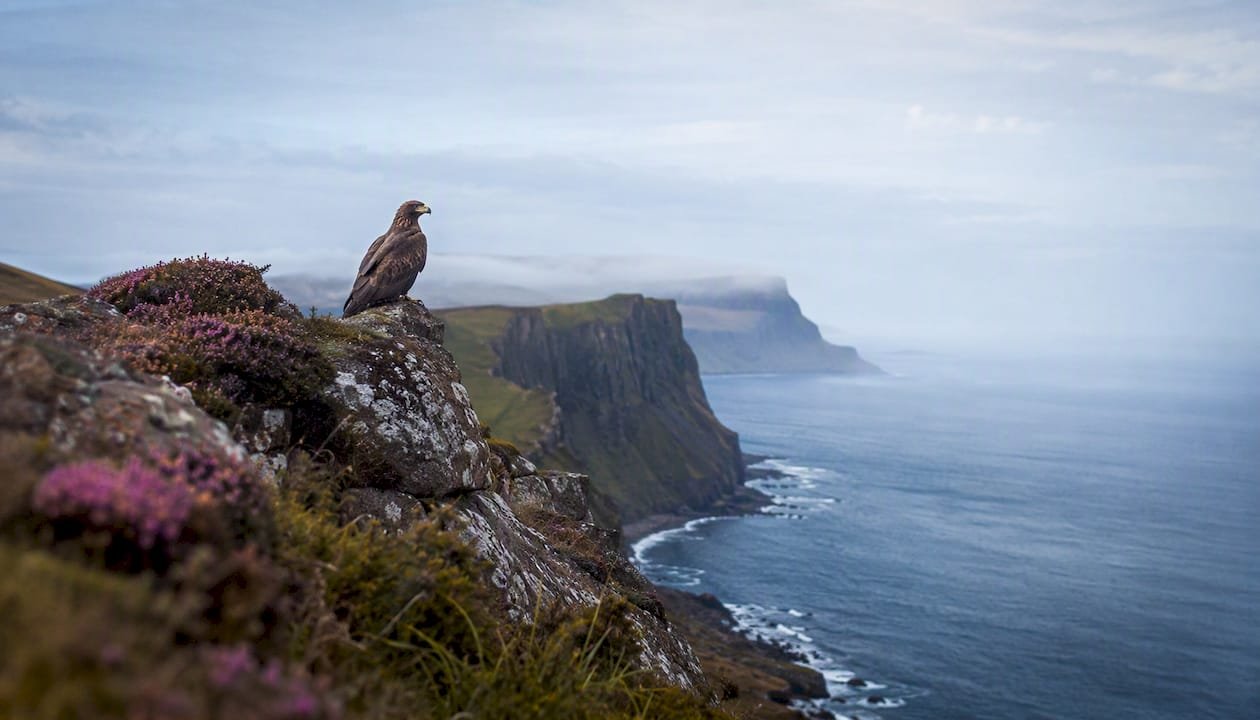
The western cliffs of Duirinish, including the area around Neist Point, combine dramatic coastal scenery with the kind of low-disturbance environment sea eagles prefer. The mix of cliff faces and sheltered inlets on either side of the peninsula covers two habitat types simultaneously. Scan the cliff tops and the air above the headland rather than the cliff faces themselves.
West-coast sea lochs
Loch Bracadale and Loch Harport are the standout examples. Both are large, sheltered, and flanked by a mix of rough grazing and scattered woodland. The islets within Loch Bracadale are particularly worth watching: sea eagles will perch on low rocky outcrops near the water when not actively hunting.
Trotternish ridge and northern coast
The northern peninsula is less frequently cited than the west coast but offers inland loch habitats and coastal sections that attract birds outside the breeding season. The ridge itself is too exposed for nesting, but the lower ground to either side, particularly near the coast, can produce sightings.
Vantage type summary:
- Shore viewpoints overlooking sea lochs: best for watching hunting behaviour and low-level flight over water
- Headlands: best for observing soaring and scanning behaviour at distance
- Small harbours and boat tours: highest probability of close sightings; boat-based viewing with an experienced crew reduces disturbance compared with land-based nest searching
Pro Tip: Early morning and late afternoon are the most productive times at any vantage. At headlands, arrive before 8 AM in summer when thermals are just beginning to build. On boat tours, the skipper’s local knowledge matters more than the time of day.
When are sea eagles most visible on Skye?
Timing a visit around the breeding cycle makes a significant difference to sighting probability.
- February to April (pre-breeding and incubation): Pairs are active around nest sites, displaying and bringing material. Visible flight near treelines and cliff areas increases.
- May to July (chick-rearing): Adults make frequent foraging flights between nest and feeding waters. This is the period of highest activity and the easiest time to observe hunting behaviour over sea lochs.
- August to October (fledging and post-fledging): Juveniles begin to explore, often moving along the coast. Young birds are less wary and more likely to be seen at lower altitudes.
- November to January (winter): Some birds maintain defined home ranges; others move more widely. Inland loch and marsh habitats become more important as coastal weather deteriorates.
Behaviours that signal an eagle rather than a buzzard or other large bird:
- Flat, plank-like wing profile in soaring flight (no dihedral)
- Very slow, deliberate wingbeats
- Low gliding passes over water before a strike
- Perching on low rocks, fence posts, or shoreline boulders
- Loud, barking calls, particularly near nest areas in spring
Weather matters too. Overcast days with light winds often produce better soaring conditions than bright, still mornings. High winds push eagles into sheltered loch systems where they are easier to observe from shore.
Scotland hosts 123 breeding pairs of white-tailed eagles nationally, with Skye, Mull, and the Small Isles forming the core of the west-coast population.
How sea eagles nest on Skye and why nest locations stay secret
Sea eagle eyries are among the largest bird nests in Britain. A pair will return to the same structure year after year, adding branches, heather, and seaweed each season until the nest can exceed 1.5 metres in diameter and grow considerably deeper over decades. Some eyries in Europe are thought to be centuries old.
According to raptor monitoring guidance, nests are typically sited below 300 metres above sea level, and most are below 150 metres, keeping the birds within efficient commuting distance of their feeding waters. On Skye, that means nest sites cluster in the lower coastal and loch-side zones rather than on the high moorland.
Nesting preferences in practice:
- Large trees (10–30 m tall, broadleaved or coniferous) are the first choice when available
- Cliff ledges are used where suitable trees are absent
- A pair may maintain several alternative nest sites within their territory, switching between them in different years
- Nests are almost always sheltered from above by part of the tree or cliff overhang
The confidentiality around nest locations is not arbitrary caution. NatureScot guidance confirms that nest sites are legally protected and that disturbance during incubation or early chick-rearing can cause nest abandonment. Egg theft, though less common than in previous decades, remains a real threat. Pairs also show strong site fidelity: displacing a pair from a nest tree does not simply move them elsewhere; it can remove them from a territory entirely.
This is why responsible guides do not share GPS coordinates, and why you should be sceptical of any operator who offers to take you directly to a nest.
Conservation and reintroduction: why sea eagles are back on Skye
By 1916, white-tailed eagles had been persecuted to local extinction across Britain. The last confirmed individual on Skye was a single female, eventually killed. The reintroduction programme began on the Isle of Rum in 1975, when Norwegian chicks were brought to the Inner Hebrides, held in pens, and released with supplementary feeding. It took a further ten years before the first chick was successfully raised to fledging.
Key milestones:
- 1975: First Norwegian chicks released on Rum
- 1985: First successful fledging in Scotland
- 1990s: Gradual spread to Mull, Skye, and other west-coast islands
- 2018: First successful breeding on Hoy, Orkney
- Present: 123 breeding pairs recorded nationally; Skye, Mull, and the Small Isles remain the core zones
Skye’s success is not the result of a single campaign. It reflects decades of habitat protection, reduced persecution, and careful monitoring by Forestry and Land Scotland, the RSPB, and NatureScot. The west coast and Inner Hebrides remain the stronghold of the Scottish population, and Skye sits at the centre of that range.
The species is currently amber-listed in the UK, reflecting its recovering but still vulnerable status. Continued habitat protection, particularly of mature woodland near the coast, is the single most important factor in sustaining the population.
Responsible watching: what to do and what to avoid
Ethical watching is not complicated, but it does require deliberate choices before and during a visit.
Do:
- Keep a minimum of 300 metres from any suspected nest site
- Use binoculars or a telephoto lens; never approach to get a better view
- Follow all landowner and nature reserve signage without exception
- Choose a guide or tour operator with a clear conservation policy and small-group practice
- Report sightings to local recording groups (not on public social media with location data)
Do not:
- Attempt to locate nests using online coordinates or social media posts
- Play recorded eagle calls to attract birds
- Fly drones near coastal cliffs or woodland during the breeding season (February to August)
- Leave food to attract eagles outside of a licensed, supervised context
When choosing a tour operator, ask directly: how do they handle sightings near nest areas? Do they operate with a maximum group size? Are they familiar with the raptor monitoring guidance on disturbance avoidance? A guide who can answer those questions without hesitation is one worth booking.
Pro Tip: Ask your guide whether they contribute sighting data to local monitoring schemes. Those who do are embedded in the conservation community and are far less likely to cut corners on disturbance protocols.
Why Skye works so well for sea eagles: the ecological picture
Skye’s suitability for white-tailed eagles comes down to a combination of factors that are difficult to replicate elsewhere in Britain. The sheltered sea lochs combine hunting opportunity with calmer water that makes fish more predictable to spot and strike. The mix of mature coastal woodland and cliff systems means pairs can choose between tree and cliff nesting depending on local conditions. And the relatively low human population density across much of the island reduces disturbance pressure during the critical breeding months.
Territorial behaviour reinforces why habitat protection matters so much. Pairs hold the same territory for many years, and on Mull, the most densely populated area, the average distance between neighbouring nest sites is 8.6 kilometres. Disrupting a single nest tree or cliff site does not just affect one season; it can unsettle a pair’s attachment to a territory that may have been occupied for decades.
Ecological drivers of Skye’s sea eagle population:
- Extensive sheltered sea loch system providing reliable fish stocks
- Mix of mature woodland and coastal cliffs for flexible nest siting
- Prey diversity: fish, rabbits, seabirds, and carrion all available year-round
- Long-term conservation effort by Forestry and Land Scotland, RSPB, and NatureScot
- Relatively low persecution pressure compared with historical levels
Scotland’s population of 123 breeding pairs represents one of the most significant raptor recoveries in European conservation history. Skye’s contribution to that figure is substantial, and the island’s habitat diversity is the primary reason.
For visitors wanting to observe this without contributing to disturbance, a small-group private tour with a guide who knows the local Skye landscape is the most reliable and responsible option.
Authoritative resources and how to use them
Knowing which source to consult for which type of information saves time and avoids the misinformation that circulates on social media.
- RSPB / Wildlife Trusts: Species biology, diet, conservation status, and national population data. The first stop for factual background.
- Forestry and Land Scotland: Official habitat guidance, management recommendations, and information on protected sites. Use this to understand land management context.
- NatureScot: Legal protection framework, nest site guidance, and licensing information. Essential if you are planning any activity near known nest areas.
- Raptor Monitoring guidance: Practitioner-level detail on monitoring methodology, territorial behaviour, and disturbance protocols. More technical than the above, but valuable for understanding why confidentiality rules exist.
- BBC Scotland Outdoors / BBC News: Accessible coverage of distribution and reintroduction history. Good for general context and for understanding the species’ range across the west coast.
- Isle of Skye wildlife guide: Local sighting notes and practical visitor information. Useful for trip planning, though always cross-check specific location claims against conservation guidance.
For tour operator verification, check that the operator is familiar with NatureScot’s disturbance guidance, operates in small groups, and does not advertise access to nest sites as a selling point. Local visitor centres on Skye can often recommend operators they know personally.
Key takeaways
The Isle of Skye’s sheltered sea lochs, coastal cliffs, mature treelines, and inland wetlands together make it one of Scotland’s most important white-tailed eagle strongholds, and responsible visiting means keeping distance, using licensed guides, and never sharing nest locations.
| Point | Details |
|---|---|
| Four core habitat types | Sheltered sea lochs, coastal cliffs, large trees/treelines, and inland lochs and marshes support sea eagles on Skye. |
| Best local areas | Portree coast, Duirinish cliffs, Loch Bracadale, and Loch Harport are the most consistently cited sighting zones. |
| Nest confidentiality | Nest sites are legally protected; disturbance is a criminal offence under the Wildlife and Countryside Act 1981. |
| 123 breeding pairs | Scotland’s national population includes 123 breeding pairs, with Skye central to the west-coast stronghold. |
| Skyehighlandstours | Private guided tours with Skyehighlandstours offer small-group, conservation-aware access to Skye’s sea eagle habitats. |
The view from the ground
There is a moment that stays with you: a white-tailed eagle dropping low over a sea loch, barely a metre above the surface, then pulling up empty-handed and banking back towards the treeline without any apparent urgency. No drama, no fanfare. Just an enormous bird going about its morning.
What surprises most people on a guided trip is how much of the experience depends on knowing where not to go. The instinct is to get closer, to find the nest, to push for a better angle. Every experienced guide on Skye will tell you the opposite: the best sightings come from patience at the right distance, not from pressing in. Clients who arrive expecting a zoo encounter leave understanding something more interesting: that these birds are genuinely wild, operating on their own terms, and that the habitat itself, the loch, the cliff, the treeline, is as much the subject as the eagle.
The conservation story matters here too. Skye’s sea eagles exist because of decades of deliberate, unglamorous work by Forestry and Land Scotland, the RSPB, and NatureScot. Visitors who choose responsible operators are part of that story, not separate from it.
Private guided tours: the responsible way to see sea eagles on Skye
The difference between a memorable sea eagle sighting and a wasted morning usually comes down to one thing: local knowledge applied at the right moment. Skyehighlandstours offers private guided tours on the Isle of Skye built around exactly that: small groups, expert guides who know the coastal habitats and seasonal patterns, and a conservation-first approach that keeps you at the right distance from sensitive areas.

Unlike large coach tours that pass through without stopping, a private tour means your guide can position you at the best vantage for the time of day and season, explain what you are seeing in real time, and adjust the itinerary if conditions change. The Isle of Skye adventure tour combines wildlife habitats with the island’s broader landscapes and heritage, making it a practical choice for wildlife enthusiasts who want more than a single-species tick.
To check availability and discuss a wildlife-focused itinerary, visit the private tours page and ask specifically about sea eagle vantage points and conservation practice when you enquire.
Useful sources
- RSPB / Wildlife Trusts — white-tailed eagle species page: Species biology, diet, national population figures, and conservation status. Best for factual background and understanding the species’ recovery.
- Forestry and Land Scotland — white-tailed eagle habitat page: Official habitat guidance and management recommendations. Use for understanding preferred environments and land management context on Skye.
- NatureScot: Legal protection framework, nest site guidance, and licensing. Essential for understanding what is and is not permitted near active nest sites.
- Raptor Monitoring guidance: Practitioner-level monitoring methodology, territorial behaviour, and disturbance protocols. Supplies the technical basis for nest confidentiality and disturbance-avoidance rules.
- BBC News — sea eagle reintroduction coverage: Accessible reporting on the reintroduction milestones and Skye’s role in the national population. Good for historical context.
- BBC Scotland Outdoors — sea eagles distribution: Distribution summary covering Mull, Skye, and the Small Isles. Useful for understanding the species’ west-coast range.
- Isle of Skye wildlife guide: Local sighting notes and practical visitor information. Cross-check specific location claims against official conservation guidance before acting on them.
- Hawk and Owl Trust — white-tailed eagle profile: Population figures, reintroduction history, and habitat summary. Supplies the 123 breeding pairs figure and useful historical context on persecution and recovery.
FAQ
Are there sea eagles on Skye?
Yes. Skye is one of the core areas for white-tailed eagles in Scotland, alongside Mull and the Small Isles, and the island hosts a significant share of the national breeding population.
What habitat does a sea eagle need?
White-tailed eagles require open water for hunting (coastal or freshwater), large trees or cliff ledges for nesting, and low human disturbance near nest sites. Sheltered sea lochs are particularly favoured because calmer water makes fish easier to spot and catch.
Where is the best place to see sea eagles in Scotland?
Skye and Mull are the most reliable locations. On Skye, the coastal areas around Portree, the Duirinish peninsula, and the west-coast sea lochs such as Loch Bracadale are the most consistently productive zones for sightings.
Do sea eagles nest in trees or on cliffs?
Both, depending on what is available. Large trees (10–30 metres tall, broadleaved or coniferous) are the preferred option when present; cliff ledges are used where suitable trees are absent. Nests are reused and expanded over many years and are legally protected.
How do I see sea eagles without disturbing them?
Use a licensed local guide or a wildlife boat tour with an experienced crew, keep at least 300 metres from any suspected nest site, and avoid sharing location data on social media. Responsible operators familiar with NatureScot and RSPB guidance are the safest choice.
Recommended
- Scotland’s unique scenic spots list: 10 hidden gems – Skye Highlands Tours
- Discover What Makes Skye Unique: Landscapes, Heritage, and Folklore – Skye Highlands Tours
- Top 15 Unforgettable Things to Do on the Isle of Skye – Skye Highlands Tours
- Examples of highland glens: Scotland’s finest valleys – Skye Highlands Tours