Your cart is empty Continue Shopping
The role of customisation in travel: a Highland guide
Customisation is the single most influential factor in turning a Highland trip from a list of sights into something you actually remember. For private guided tours in the Scottish Highlands, it determines perceived value, emotional satisfaction, and whether your guide can accommodate the things that matter most to you — a mobility requirement, a passion for whisky, or simply a preference for slow mornings and long stops.
The practical outcomes are concrete:
- Higher traveller satisfaction, because the experience matches stated motivations rather than a generic template
- Stronger trust in the provider, built through transparency and responsiveness
- Deeper cultural immersion through micro-experiences (a private ceilidh, a crofter visit, a dawn photography shoot)
- Practical accommodation of accessibility needs, dietary requirements, and group pace
Personalisation transforms tourism from transactional to emotionally resonant. Travellers now judge trips by meaning, not by the number of sights ticked off — and the itinerary should follow the motivation, not the reverse.
Skyehighlandstours builds every private tour around this principle: your motivations come first, and the route follows.
Table of Contents
- Why does customisation matter so much in 2026?
- What customisation actually looks like on a Highland tour
- How to plan a fully customised private Highland tour
- How customisation changes price, lead time, and booking practicalities
- What should you ask providers — and what are the red flags?
- Real examples of customised Highland trips
- Key takeaways
- What the research gets right — and what providers still miss
- Private Highland tours, built around you
- Useful sources
- FAQ
Why does customisation matter so much in 2026?
Research published in the MDPI Smart Tourism series confirms that AI-driven personalisation increases traveller satisfaction through a sequential chain: personalisation builds trust, trust raises perceived value, and perceived value drives satisfaction. The study, based on 347 tourists using PLS-SEM analysis, found that technology readiness moderates this relationship — meaning travellers who feel in control of the process benefit most.
The research chain is clear: personalisation → trust → perceived value → satisfaction. Providers who surface transparency and user control convert personalisation into measurable outcomes, not just a marketing claim.
That finding aligns with a separate experimental study of 398 travellers which found measurable resistance to purely AI-designed itineraries. When travellers perceived AI as unable to meet their unique personal needs, satisfaction dropped. Positioning AI as a support tool — with human sign-off at key decision points — reduced that resistance significantly.
The broader market shift reinforces this. Personalised travel is growing because travellers now prioritise emotional resonance and micro-moments over standard sightseeing checklists. The rise of hyper-curated travel reframes destinations as backdrops for personal stories rather than boxes to tick.
The practical implication for Highland travellers: choose providers who combine AI efficiency with a local guide’s cultural judgement, and who give you explicit control points throughout the planning process.
What customisation actually looks like on a Highland tour
The Scottish Highlands offer an unusually wide canvas. Ways to customise your tour range from activity type to pace to the specific sensory experiences you want to prioritise.
Activity customisation
Private whisky tours can include exclusive distillery access, guided nosing sessions with a specialist, and pairing with local food producers — none of which appear on a standard group tour. Wildlife photography safaris work differently: they require early starts, specific seasonal windows, and a guide who knows where red deer congregate at dawn. Castle history deep dives suit a different traveller entirely, one who wants context and narrative rather than a photo stop.
Pace and format
Half-day excursions suit cruise passengers or travellers with limited mobility. Full-day private tours allow extended stops, unhurried lunches, and the kind of detour that only happens when you are not sharing a coach with 40 strangers. Hillwalkers often want the opposite — a fast-paced action day with maximum elevation gain. The route, transport, and logistics all shift depending on which version you choose.
Accessibility and special needs
Accessible vehicle options, mobility-friendly routes, and dietary accommodation with local producers are all achievable with sufficient notice. Family-friendly Highland tours require child-centred pacing, shorter walking distances, and activities that hold a ten-year-old’s attention as well as an adult’s.
Cultural micro-experiences
Arranging a private ceilidh, a guided Gaelic storytelling session, or a visit to a working croft takes planning but delivers something no standard itinerary can replicate. These moments are where the emotional value of a bespoke trip concentrates.
Pro Tip: Ask your guide for a short cultural briefing document before departure. It should cover local sensitivities, seasonal constraints (lambing season affects access to certain areas, for instance), and any permit requirements for specialist activities.
How to plan a fully customised private Highland tour
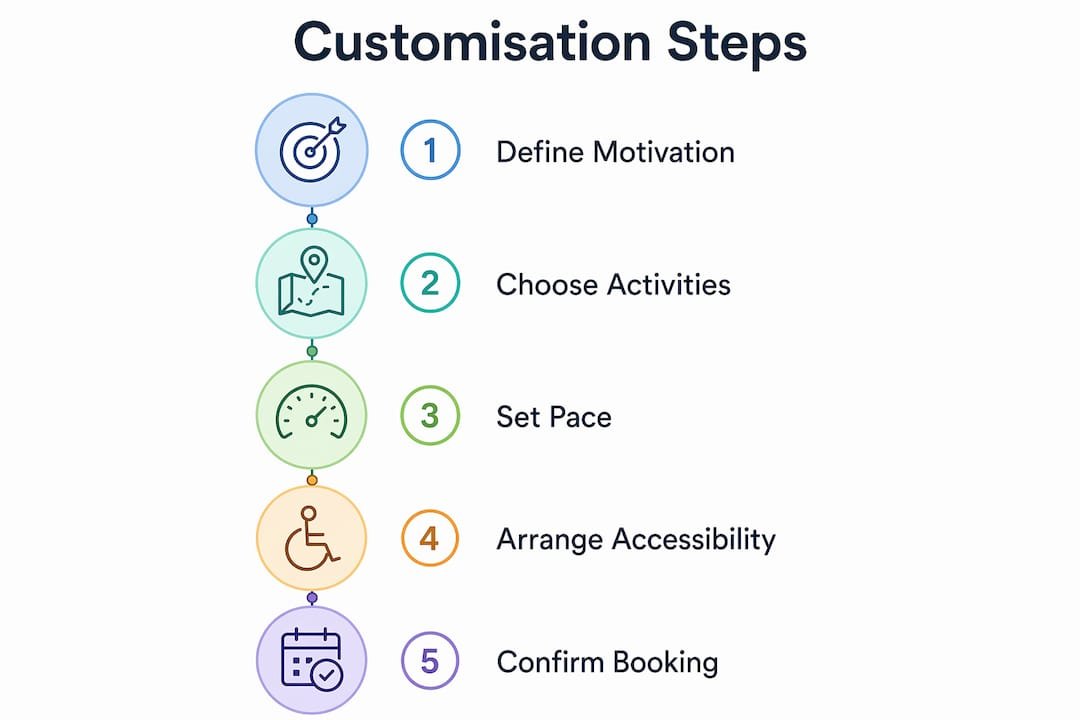
A well-run customisation process follows five clear steps. Expect this from any reputable provider.
Initial consultation. Your provider captures motivations, interests, mobility and dietary requirements, trip tone, and any significant dates. These become the primary constraints that shape everything else. A provider who skips this step and jumps straight to a draft itinerary is not truly customising.
Draft itinerary. The provider proposes a structured draft with time estimates, alternative activities at key decision points, and transparent cost drivers. You should be able to see why each choice was made.
Refinement and user control. You select options, flag sensitivities, and agree cancellation and flexibility terms. Human sign-off at this stage is non-negotiable — AI tools can speed up options generation, but a local guide’s judgement on weather contingencies and cultural nuances cannot be automated. See how to customise Highland itineraries for a worked example.
Pre-departure confirmation. Timings, meeting points, transport arrangements, and contingency plans are confirmed in writing. A one-page itinerary summary makes the day itself far less stressful.
On-tour adjustments. Weather changes, a slower-than-expected pace, or a spontaneous detour should all be possible within an agreed process. Confirm in advance how substitutions are handled and whether any cost implications apply.
Lead time guidance: private distillery bookings typically need 4–8 weeks’ notice; seasonal wildlife permits and specialist photographers may require 2–3 months. Lock priority activities first.
How customisation changes price, lead time, and booking practicalities
Customisation adds cost in predictable ways. Understanding the drivers helps you balance ambitions against budget.
| Customisation type | Cost impact | Typical lead time needed |
|---|---|---|
| Private transport (full day) | Moderate | a few weeks |
| Exclusive distillery access | Substantial | several weeks to months |
| Specialist guide (photography, wildlife) | Moderate to substantial | several weeks to months |
| Accessible vehicle upgrade | Modest | a few weeks |
| Bespoke local food experience | Modest to moderate | a few weeks |
| Off-hour or dawn bookings | Modest | a few weeks |
| Private ceilidh or cultural arrangement | Substantial | several weeks to months |
The most common mistake travellers make is treating all customisation elements as equally flexible. Private distillery visits and specialist photographers have hard capacity limits; book them first and build the rest of the day around them.
Ask for price bands rather than fixed totals when options are still tentative. A good provider will give you a range tied to specific choices, not a vague estimate. Confirm cancellation and flexibility terms for bespoke elements in writing before paying any deposit — standard tour cancellation policies often do not cover third-party specialist bookings.
What should you ask providers — and what are the red flags?
Before committing to a bespoke booking, ask these questions directly:
- How do you capture my preferences, and who reviews them before the draft itinerary?
- Who will guide us, and what are their local credentials and specialist knowledge?
- Which parts of the itinerary are fixed and which remain genuinely flexible?
- How do you handle accessibility requirements and dietary needs with local suppliers?
Request sample customised itineraries, written testimonials, guide qualifications, a transparent pricing breakdown, and a written change and cancellation policy. These are not unreasonable asks — they are the minimum standard for a provider who takes personalisation seriously.
A provider who cannot show you a sample customised itinerary or explain their guide’s local credentials in specific terms is not offering genuine customisation. They are offering a standard tour with a flexible label.
Red flags to watch for: vague answers about local suppliers; unwillingness to document accessibility arrangements in writing; flat itineraries relabelled as “custom”; pressure to pay the full amount upfront without written terms. If you have doubts, ask for a single-day customisation trial before committing to a multi-day bespoke package.
Real examples of customised Highland trips
The following examples illustrate how stated traveller motivations translate into specific bespoke choices.
Family with young children, Loch Ness day. The family requested wildlife spotting, a relaxed pace, and an afternoon activity that would engage children aged 6 and 9. The guide scheduled a morning Loch Ness circuit with extended stops for wildlife observation, then arranged a private session with a local baker in the afternoon. Shorter walking distances and a mid-morning snack stop kept the pace manageable. The parents noted that the guide’s knowledge of child-friendly viewpoints made the difference between a stressful day and a genuinely enjoyable one.
Photography couple, Isle of Skye dawn shoot. The couple wanted golden-hour light on the Quiraing and access to a remote viewpoint unreachable by road. The guide arranged a 4:30 AM departure, a specialist landscape photography guide, and a private boat launch to reach the location. The itinerary was built entirely around light conditions and tidal windows — details a standard tour cannot accommodate.
Whisky enthusiast, private Speyside circuit. A solo traveller with deep knowledge of Scotch requested access beyond the standard visitor centre experience. The guide arranged a private Speyside Whisky Tour with a distillery manager walkthrough and a tasting led by a production specialist rather than a retail guide.
Across all three examples, the connection between stated motivation and bespoke choice is direct and traceable. That traceability is what separates genuine customisation from a repackaged standard tour.
Key takeaways
Customisation is the primary driver of perceived value and emotional satisfaction on private Highland tours, and providers who combine local guide expertise with transparent planning workflows consistently deliver stronger outcomes.
| Point | Details |
|---|---|
| Lead times matter | Book specialist guides, distillery access, and permits 2–8 weeks ahead; priority activities first. |
| State emotional goals, not just activities | Providers design better itineraries when they know why you want an experience, not only what it is. |
| Insist on written flexibility terms | Cancellation and substitution policies for bespoke elements must be confirmed in writing before deposit. |
| Human oversight is non-negotiable | AI tools speed up options; a local guide’s cultural judgement and adaptive decisions cannot be replaced. |
| Skyehighlandstours | Offers fully customisable private Highland tours with local guide expertise and transparent booking terms. |
What the research gets right — and what providers still miss
The MDPI findings on trust and perceived value are solid. The chain from personalisation to satisfaction is real, and providers who ignore it are leaving measurable value on the table. What the research does not fully capture is the asymmetry between traveller expectations and provider capacity.
Most travellers arrive at a consultation knowing what they want to feel but not how to articulate it as a brief. A skilled local guide bridges that gap instinctively. The problem is that many providers treat the consultation as a formality rather than the most important part of the process. They collect preferences, then produce an itinerary that reflects their existing routes with minor adjustments. That is not customisation. It is personalisation theatre.
The providers who get it right treat traveller motivations as the organising principle. The itinerary follows the motivation, not the other way around. For a Highland tour, that means a guide who knows that a traveller who mentions “my grandfather was from Skye” needs a different kind of day than one who says “I want the best photography light.” Both requests are valid; neither is served by the same route.
The human-AI co-creation model works precisely because it separates what technology does well (generating options quickly, flagging logistics conflicts, surfacing alternatives) from what it does poorly (reading emotional subtext, adapting to a traveller’s mood on the day, knowing which crofter will welcome a visit and which will not). The providers who understand that distinction are the ones worth booking.
Private Highland tours, built around you
Skyehighlandstours offers private guided tours across the Scottish Highlands — Isle of Skye, Loch Ness, Glenfinnan Viaduct, the Black Isle, and beyond — with fully customisable itineraries, specialist local guides, and flexible booking terms. Every tour starts with a consultation, not a catalogue.
Whether you want a private whisky circuit, a family-friendly Loch Ness day, a dawn photography shoot, or a special occasion tour built around a specific date, the team will draft an itinerary around your motivations and refine it until it fits. Small groups, accessible options, and dietary accommodation are all handled directly. Cancellation and flexibility terms are confirmed in writing before any deposit is taken.
Request a bespoke quote or browse custom tour planning tips to see what a tailored Highland day can look like.
Useful sources
The following sources underpin the claims and research references in this article.
| Source | Type | Relevance |
|---|---|---|
| AI-Driven Personalization and Traveler Satisfaction (MDPI) | Primary academic research (347-tourist PLS-SEM study) | Trust → perceived value → satisfaction chain |
| Resistance to AI-designed travel (Emerald) | Experimental study (398 questionnaires) | Human sign-off and user control in customisation |
| Human–AI co-creation in smart tourism (Taylor & Francis) | Academic chapter | Co-creation quality, responsiveness and user control |
| Why personalised travel is growing (AZ Big Media) | Industry commentary | Micro-experience demand and emotional travel trends |
| The rise of hyper-curated travel (News18) | Journalism | Hyper-curated journeys and interest-led activities |
| Tailored or turnkey travel (Valtech) | Industry research (Global Travel & Hospitality Outlook) | Divergence between granular control and turnkey relief |
| Skyehighlandstours — customise Highland itineraries | Internal — provider workflow | Step-by-step planning and sample itineraries |
| Skyehighlandstours — ways to customise your tour | Internal — options catalogue | Activity, pace and special-interest customisation |
| Skyehighlandstours — whisky tours | Internal — product category | Specialist whisky experience options |
FAQ
What is the role of customisation in travel?
Customisation determines whether a trip matches a traveller’s actual motivations and needs. Research confirms it drives trust, perceived value, and satisfaction — particularly on private guided tours where the itinerary can be built around individual goals rather than a standard route.
How far in advance should I book a customised Highland tour?
Most bespoke elements need 2–8 weeks’ notice; specialist guides, private distillery access, and seasonal wildlife permits can require 2–3 months. Book priority activities first, then build the rest of the itinerary around them.
Does customisation always cost significantly more?
Not always. Modest upgrades — accessible vehicles, dietary accommodation, adjusted pacing — add little to the base cost. Substantial cost increases typically come from exclusive access (private distillery sessions, specialist photographers) or off-hour bookings.
How does Skyehighlandstours handle accessibility requirements?
Skyehighlandstours accommodates mobility requirements through accessible vehicle options and mobility-friendly route planning, confirmed in writing during the pre-departure stage. Dietary needs are coordinated directly with local suppliers.
What separates genuine customisation from a relabelled standard tour?
A genuine customised itinerary traces directly back to your stated motivations — every choice has a reason tied to your brief. If a provider cannot explain why each element was included, or cannot show you a sample bespoke itinerary, the customisation is superficial.
Recommended
- Ways to customize your tour of the Scottish Highlands – Skye Highlands Tours
- How to customise Highland itineraries for your trip – Skye Highlands Tours
- How to customise whisky tours: your practical guide – Skye Highlands Tours
- Why personalized Highland tours create lasting memories – Skye Highlands Tours