
Your cart is empty Continue Shopping
Highland myth legend locations: the essential visitor guide
The Scottish Highlands hold more named myth and legend locations than almost any comparable area in Europe. The sites worth prioritising are: Loch Ness (monster tradition), Urquhart Castle (ghost sightings and Jacobite history), Clava Cairns (Bronze Age ancestor cult), Culloden Battlefield (haunted moorland), Sligachan Bridge and the Fairy Pools on Skye (fairy and giant lore), Eilean Donan Castle (clan legend and spectral tales), Glencoe (massacre ghosts and kelpie stories), Loch Morar (Scotland’s second lake monster, Morag), Loch Maree and Isle Maree (sacred well and ritual history), and Cawdor Castle (Macbeth legend). Each site pairs a specific oral tradition with genuine visitor access, making them practical targets for a folklore itinerary rather than abstract curiosities.
Who each site suits at a glance:
- Photographers and artists: Sligachan Bridge, Glencoe, Fairy Pools, Loch Maree
- Families with children: Eilean Donan, Urquhart Castle, Loch Ness Visitor Centre, Cawdor Castle
- Folklore and history students: Clava Cairns, Culloden, Isle Maree, Loch Morar
- Hikers and wild-land visitors: Glencoe, Cuillin ridgeline, Loch Morar shore, Loch Maree circuit
Table of Contents
- The best Highland myth legend locations: site by site
- How to plan your Highland folklore itinerary
- Why Highland places carry myths: the oral tradition explained
- What local guides and photographers notice that most visitors miss
- Key takeaways
- What a guide sees that a map cannot show you
- Useful sources and further reading
- FAQ
The best Highland myth legend locations: site by site
The ten sites below are arranged in a travel-friendly order, moving roughly from the Inverness area westward and south to Skye, then back up the north-west coast. That sequence lets you combine clusters without excessive backtracking.
Inverness area and Badenoch
1. Loch Ness
The Nessie tradition is the most globally recognised of all Scottish folklore sites, but the loch itself earns a visit on its own terms: 37 km long, over 200 m deep, and dark enough to hide almost anything. The monster legend in its modern form dates to a 1933 newspaper report, though older Gaelic accounts of a water-beast in the loch predate that by centuries. The Loch Ness Centre in Drumnadrochit is the best starting point; it holds sonar records, historical accounts, and exhibition material that contextualises the tradition honestly. Nearest town: Drumnadrochit (A82 from Inverness, 23 km). Allow 2–3 hours for the centre plus a loch-side walk. Best photography: early morning mist on the south shore near Foyers.
2. Urquhart Castle
Perched on a promontory above Loch Ness, Urquhart is managed by Historic Environment Scotland and is one of Scotland’s most visited castle ruins. The ghost tradition centres on a Green Lady, and several Nessie sightings have been reported from the Grant Tower. Historically, the castle changed hands repeatedly during the Wars of Independence and was blown up in 1692 to prevent Jacobite use. Opening times vary by season (check Historic Environment Scotland’s website before visiting). Nearest town: Drumnadrochit, 3 km north on the A82. Allow 1.5–2 hours. The tower gives the best elevated view of the loch for photography.
3. Clava Cairns
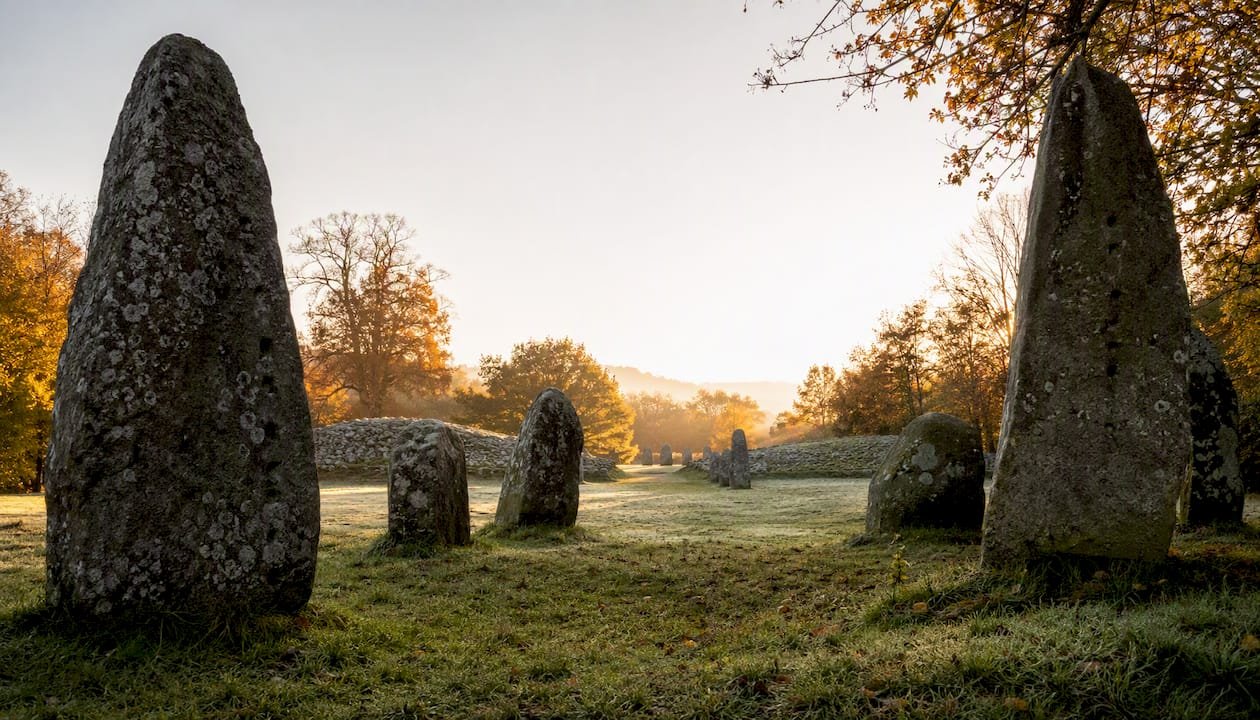
A Bronze Age cairn cemetery near Culloden, Clava is managed by Historic Environment Scotland and is free to enter. Three passage cairns and a ring cairn, all aligned with the midwinter sunset, point to a sophisticated ancestor cult active around 2000 BCE. The site is small but dense with meaning: the standing stones surrounding each cairn are graded in height, and the cup-mark carvings on several stones remain visible. Nearest town: Inverness (B9006, roughly 8 km east). Allow 1 hour. Visit at dusk in late autumn for the alignment effect; the site is open year-round.
4. Culloden Battlefield
The 1746 battle is Highland history’s most haunting event, and the moor has carried a reputation for its supernatural atmosphere since the 18th century. The National Trust for Scotland visitor centre is excellent, with immersive audio and archaeological finds. Clan graves are marked across the heather, and the Well of the Dead is a focal point for quiet reflection. Nearest town: Inverness (B9006, 8 km east, adjacent to Clava Cairns). Allow 2–3 hours. Combine with Clava Cairns in a single half-day. Photography is best in low winter light when the moor is empty of crowds.
Lochaber and Glencoe
5. Glencoe
The 1692 massacre of the MacDonalds by Campbell soldiers gives Glencoe its darkest story, but the glen’s folklore runs deeper: kelpies in the River Coe, the ghost of the murdered chief, and a landscape so geologically dramatic that it has generated myth simply by existing. Artists and photographers consistently describe Glencoe as uniquely atmospheric, noting that its changing light and damp mountain air require patience and flexibility to capture well. The National Trust for Scotland manages the glen; the visitor centre at Glencoe village is a good orientation point. Nearest town: Glencoe village (A82, 17 km south of Ballachulish). Allow a full day if walking; 2–3 hours if driving through. Misty dawn and late afternoon light are the most rewarding for photography.
Pro Tip: Arrive at the Three Sisters viewpoint before 8 AM in autumn. The valley mist sits below the ridgeline for roughly an hour after sunrise, and on clear days the light turns the rock face amber. By 10 AM the coach parties arrive and the atmosphere shifts entirely.
6. Loch Morar
Morar holds Scotland’s deepest freshwater (310 m) and its own lake-monster tradition: Morag, described in accounts going back to the 17th century as a large, humped creature. The loch is less visited than Loch Ness, which makes it genuinely atmospheric. Access is via the single-track road from Morar village (A830 from Fort William, then south). No formal visitor centre; the experience is the loch itself. Allow 2–3 hours for the shore walk. Nearest town: Mallaig (8 km west). Best visited in combination with the Glenfinnan Viaduct on the same day.
Isle of Skye
7. Sligachan Bridge and the Cuillin
Sligachan sits at the foot of the Black Cuillin, and the old bridge over the River Sligachan is one of the most painted and photographed structures in the Highlands. Landscape historians describe it as an “artistic stage” where the human structure frames the wild plateau behind it, drawing artists and writers for over a century. The local legend holds that washing your face in the river water grants eternal beauty. The Cuillin ridge itself is associated with the Norse giant Cú Chulainn and with fairy encounters in Gaelic tradition. Nearest town: Portree (12 km north on the A87). The bridge is roadside; allow 30 minutes minimum, longer if walking toward Loch Coruisk. Best light: golden hour facing south-west.
8. Fairy Pools, Glen Brittle
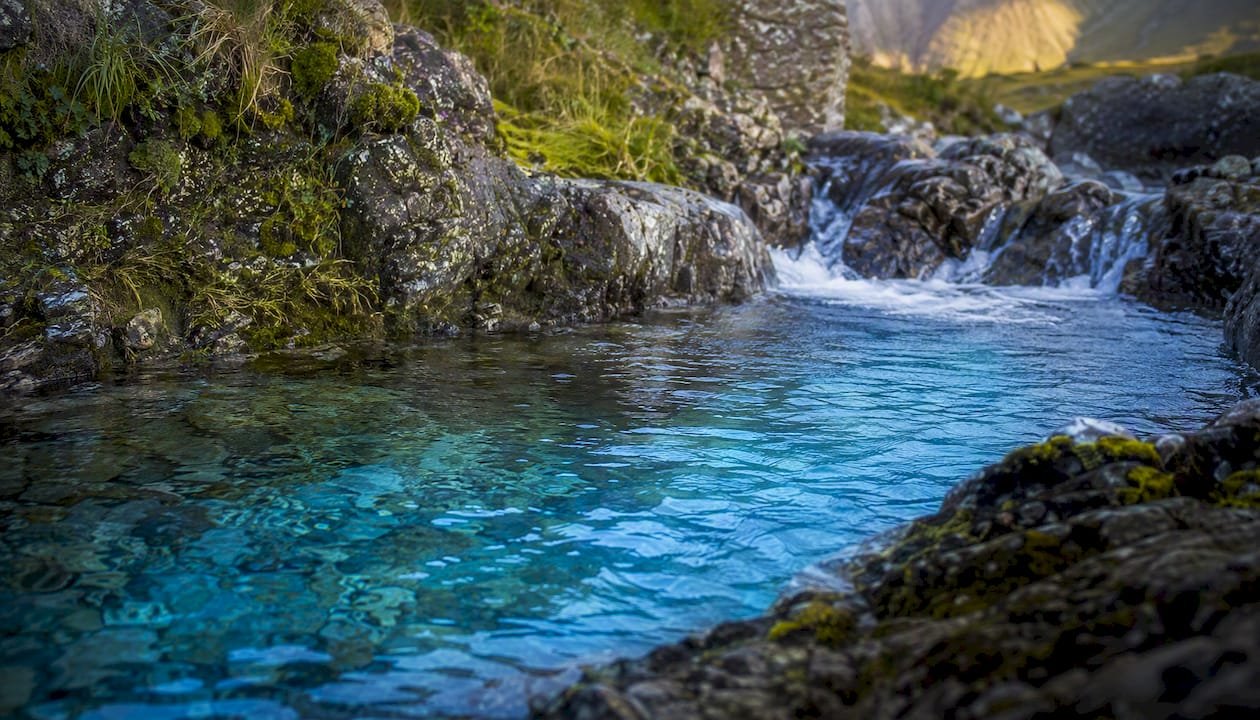
The Fairy Pools are a series of crystal-clear plunge pools fed by waterfalls on the River Brittle, named for the sìthean (fairy mounds) tradition documented across the Highlands. According to Victorian ethnographic collections, fairy dwellings were understood as real, inhabited places, and the pools’ otherworldly colour reinforces that reading. The walk from the car park is 2.5 km each way on a maintained path. Nearest town: Carbost (6 km). Arrive before 9 AM in summer to avoid crowds; the pools are busiest July–August. No entry fee; parking charges apply.
North-west coast
9. Eilean Donan Castle
One of Scotland’s most photographed castles, Eilean Donan sits on a tidal island at the junction of three sea lochs near Dornie. The castle’s legend includes a Spanish soldier whose ghost still walks the battlements, and a curse placed on the MacRae clan. Historically, the castle was garrisoned by Spanish Jacobite troops in 1719 and blown up by Royal Navy frigates. The current structure is a 20th-century reconstruction. Open to visitors most of the year (check the castle’s own website for seasonal hours). Nearest town: Kyle of Lochalsh (13 km west on the A87). Allow 1–1.5 hours. Photography is best from the causeway at dawn or dusk when the loch is calm.
10. Loch Maree and Isle Maree
Loch Maree in Wester Ross is one of the most historically significant ritual sites in the Scottish Highlands. Isle Maree, a small wooded island in the loch, holds a holy well associated with St Maelrubha and a ritual history documented into the 19th century, when people still visited seeking cures for mental illness. The folk cure traditions at Loch Maree are among the best-documented examples of Highland sacred practice surviving into the modern era. Access to the island requires a boat (no regular ferry; arrange locally at Kinlochewe or Gairloch). The loch shore is accessible via the A832. Nearest town: Kinlochewe (10 km east). Allow a half-day. The Supernatural Wester Ross trail curates geotagged folklore for the wider area, making it an excellent companion resource.
11. Cawdor Castle
Cawdor is the castle Shakespeare linked to Macbeth’s thane title, though the real castle postdates the historical Macbeth by several centuries. The legend is the draw: the castle’s own founding myth involves a donkey led by a dream, and the 14th-century tower was supposedly built around a holly tree that still stands inside. The castle is privately owned by the Cawdor family and opens to visitors from May to October. Nearest town: Nairn (8 km south-west on the B9090). Allow 1.5–2 hours for the castle and gardens. Photography inside is restricted; the exterior and walled garden are the best subjects.
12. Urquhart and Loch Ness area: local resources
The Discover Highlands and Islands story trails and the North West Highlands Geopark both maintain catalogues of geotagged folklore for their respective areas, covering sites that do not appear on standard tourist maps. For Scottish heritage sites beyond the headline names, these resources are the most reliable way to find lesser-known ritual places, holy wells, and story-linked landscape features.
How to plan your Highland folklore itinerary
Transport connections
| Cluster | Nearest rail/road | Typical drive from Inverness | Ferry/coach note |
|---|---|---|---|
| Inverness area (Culloden, Clava, Urquhart) | Inverness station (A9/A82/B9006) | 15–30 min | Citylink coaches serve Drumnadrochit |
| Glencoe | A82 south | 1.5 hrs | No direct rail; Fort William is nearest station |
| Isle of Skye | A87 west + Skye Bridge | 2 hrs | Caledonian MacBrayne ferry from Mallaig to Armadale (alternative) |
| Loch Morar | A830 from Fort William | 2 hrs 30 min | Mallaig accessible by Jacobite steam train (seasonal) |
| Loch Maree / Wester Ross | A832 from Inverness | 1 hr 30 min | No public transport to Isle Maree; boat hire locally |
| Cawdor Castle | B9090 from Nairn | 30 min | No direct public transport; taxi from Nairn |
Safety and etiquette
- Some sites (Clava Cairns, Isle Maree) are archaeologically fragile. Stay on marked paths, do not move stones, and do not leave offerings that could damage surfaces.
- Loch Morar’s shore road is single-track with limited passing places; allow extra time and drive slowly.
- Cawdor Castle and Eilean Donan are privately managed; check opening dates before travelling, especially outside May–October.
- For responsible visiting at active ritual sites, ask permission before photographing any objects left as offerings, and treat any site that appears to be in active use with the same respect you would give a working church.
Pro Tip: A custom itinerary built around folklore sites lets you adjust pace on the day. The sites that reward the most time are rarely the ones you planned to linger at.
Guided vs self-drive
A self-drive itinerary works well for the headline sites (Loch Ness, Eilean Donan, Glencoe, Fairy Pools) because signage and visitor infrastructure are solid. A local guide adds genuine value at Clava Cairns, Isle Maree, and any holy well site, where specialist interpretation is often needed to identify and contextualise what you are looking at. Estate permissions for off-path access to lesser-known ritual sites are also easier to arrange through a guide with local contacts.
Why Highland places carry myths: the oral tradition explained
Highland folklore is not a fixed body of stories. It is a living, place-centred oral tradition shaped by environment, agricultural cycles, and social history. The same loch or hillside might carry three different stories depending on which community you ask, and the stories shift over generations to absorb new events and anxieties.
The main myth types you will encounter at the sites above:
- Fairy and sìthean traditions: Fairy mounds (sìthean) were understood as inhabited places where the sìth (fairy folk) lived parallel to human communities. Victorian ethnographers documented a consistent belief that certain hills and water features were dangerous to approach at night or during liminal seasons.
- Water-spirits and kelpies: The kelpie, a shape-shifting water-horse, appears in traditions attached to almost every significant loch and river. Loch Ness, Loch Morar, and the River Coe all carry variants.
- Monster traditions: Distinct from kelpies, the large-creature tradition (Nessie, Morag) tends to be associated with the deepest lochs and may encode genuine ecological memory of unusual sightings.
- Saint-associated wells and islands: Sites like Isle Maree and St Fillan’s Well represent a layer of Christianised folklore overlaid on older ritual practice. The folk cure traditions documented at Loch Maree show how sacred sites retained practical social functions well into the 19th century.
- Ancestor and burial cults: Clava Cairns and similar Bronze Age monuments generated their own folklore as later communities encountered structures they could not explain. The archaeological record of holy wells and ritual sites shows remarkable continuity of use across millennia.
- Living shrines: Tigh nam Bodach (also called Tigh na Cailleach) in Glen Lyon is the only surviving shrine to the Celtic goddess Cailleach in the UK. A family of water-worn sandstones is ceremonially moved between Beltane and Samhain each year by local keepers, making it a genuinely functioning ritual site rather than a historical curiosity. Contemporary field reporting confirms that the seasonal practice continues today.
Understanding these categories before you visit transforms the experience. A cairn is not just old stones; it is evidence of a community’s relationship with its dead, its land, and its sense of time.
What local guides and photographers notice that most visitors miss
That shift from scenery to story is what separates a memorable visit from a forgettable one. A few practical points that experienced guides and working photographers consistently raise:
- Timing matters more than weather. Overcast days at Glencoe and Loch Maree often produce better atmosphere than bright sunshine. Flat light removes harsh shadows and lets the colour of the water and heather read clearly.
- Arrive early or stay late. The Fairy Pools, Sligachan Bridge, and Eilean Donan all attract large crowds by mid-morning in summer. The artistic and photographic quality of Sligachan depends heavily on having the bridge and mountain to yourself.
- Ask locally. Pub landlords, estate staff, and local shopkeepers often know story variants that do not appear in any guidebook. This is especially true in Wester Ross, where the Supernatural Wester Ross trail has catalogued community stories that are not on mainstream tourist routes.
- Carry an OS map or offline equivalent. Many ritual sites and holy wells are not signposted. A 1:25,000 Ordnance Survey map for the relevant area is the most reliable navigation tool.
Site preparation checklist:
- Waterproof boots (mandatory for Fairy Pools, Loch Morar shore, and any off-path site)
- Waterproof jacket and a spare layer (Highland weather changes within the hour)
- Offline maps downloaded before you leave mobile coverage
- Camera battery fully charged; carry a spare for long days
- Permission confirmed for any private land access
Pro Tip: For cultural experiences in Scotland that go beyond the standard visitor trail, ask your guide specifically about the Gaelic place-name meaning of each site. The name usually encodes the oldest layer of the story.
Key takeaways
The single most important principle for visiting Highland myth and legend locations is this: the stories are inseparable from the landscape, and understanding the oral tradition before you arrive will make every site more rewarding than any guidebook description alone.
| Point | Details |
|---|---|
| Prioritise site clusters | Combine Clava Cairns and Culloden in one half-day; pair Sligachan and the Fairy Pools on Skye in another. |
| Arrive early at popular sites | Sligachan, Eilean Donan, and the Fairy Pools are best before 9 AM in summer to avoid crowds and capture atmosphere. |
| Use geotagged story trails | The Supernatural Wester Ross trail and North West Highlands Geopark catalogue folklore sites not on standard tourist maps. |
| Respect active ritual sites | Tigh na Cailleach and Isle Maree are functioning sacred places; do not move stones or leave disruptive offerings. |
| Skyehighlandstours for guided access | Private guided tours from Skyehighlandstours cover folklore sites with custom itineraries and local guide expertise. |
What a guide sees that a map cannot show you
The conventional wisdom about visiting Highland folklore sites is that you need a good guidebook and a reliable car. That gets you to the car park. What it does not get you is the story behind the story: why a particular loch was feared at Samhain and not at midsummer, or which version of the Glencoe massacre account the local community actually holds, as distinct from the one printed in tourist literature.
Oral traditions are not stable texts. They shift with the community that carries them, and the version a local guide knows is often richer, stranger, and more specific than anything written down. The Cailleach shrine at Glen Lyon is a good example: the written record describes the ritual, but the reason the practice has survived is a small group of local keepers who understand it as a living obligation, not a heritage attraction. That distinction matters to how you behave at the site.
Responsible visiting at active sites means treating them as you would any working sacred space: quietly, without rearranging anything, and with the assumption that your presence is a privilege rather than a right. The Scottish heritage sites that carry the deepest folklore are often the ones that look least impressive on arrival. A small stone enclosure in a wet field can be the most significant place you visit all week.
Useful sources and further reading
- The shrine of the Cailleach at Glen Lyon
- 10.6.3 Holy wells and ritual sites | The Scottish Archaeological Research Framework
- The Eternal Call of Sligachan: The Bridge in Highland Art and Literature — Andrea Martin
- Why Glencoe inspires Scottish artists | Carol McEwan
- Supernatural Wester Ross | Discover the Highlands and Islands of Scotland
- Superstitions of the Highlands and Islands of Scotland, by John Gregorson Campbell (Project Gutenberg)
- Tigh na Cailleach: Long, hot search for shrine to Celtic goddess Cailleach — The Scotsman
FAQ
What is the most mystical place in Scotland?
Loch Ness and the Isle of Skye are the most widely cited, but Clava Cairns near Inverness carries the deepest archaeological and folkloric weight: a Bronze Age cairn cemetery aligned with the midwinter sunset, in continuous use for ritual purposes across millennia.
Are there real places in Scottish Highland folklore?
Yes. Every major Highland myth is attached to a specific, named location. Sites like Isle Maree, Sligachan, and Tigh nam Bodach in Glen Lyon are documented in both historical records and ongoing ethnographic research as genuine places of ritual significance.
What is the most famous myth in Scotland?
The Loch Ness Monster is the most internationally recognised, but the Cailleach tradition (the divine hag who shapes the landscape) is arguably the most deeply rooted in Highland culture, with the Glen Lyon shrine as its only surviving physical expression.
Where might you find a legendary monster in Scotland?
Loch Ness (Nessie) and Loch Morar (Morag) are the two lochs with the strongest and best-documented monster traditions. Both are accessible by road, and Loch Morar in particular is far less crowded for visitors who want a quieter experience.
Can Skyehighlandstours include folklore sites in a private tour?
Yes. Skyehighlandstours builds private guided itineraries that can include any combination of the sites in this article, with local guide narrative and custom pacing to suit your group.
Recommended
- Must-visit spots in the Highlands: your 2026 guide – Skye Highlands Tours
- Discover Loch Ness: Myths, Heritage & Guided Tours – Skye Highlands Tours
- Discover Highland Heritage: Culture, Clans, and Scenic Scotland – Skye Highlands Tours
- Examples of highland glens: Scotland’s finest valleys – Skye Highlands Tours
1 Comment