
Your cart is empty Continue Shopping
Top 10 examples of standing stones in Scotland
Scotland holds some of the most remarkable examples of standing stones anywhere in the world. The nine most celebrated sites, all listed or cared for by Historic Environment Scotland or recognised under the UNESCO Heart of Neolithic Orkney designation, are:
- Calanais (Callanish) Standing Stones — Isle of Lewis, Outer Hebrides
- Ring of Brodgar — Mainland Orkney
- Standing Stones of Stenness — Mainland Orkney
- Clava Cairns — near Inverness, Highland
- Machrie Moor Standing Stones — Isle of Arran
- Kilmartin Glen stone settings — Argyll
- Sueno’s Stone — Forres, Moray
- Clach an Trushal — Ballantrushal, Isle of Lewis
- Achavanich — Caithness
Radiocarbon dating places the oldest of these monuments at around 3100 BCE, and VisitScotland’s standing-stones guide confirms that mainstream archaeology interprets most as components of ritual or ceremonial landscapes, sometimes aligned with astronomical events. Whether you are planning a dedicated megalith tour or folding a site visit into a broader Highland trip, this guide covers what each place looks like, why it matters, and how to get there.
Key takeaways
Scotland’s standing stones span roughly 5,000 years of human activity, from Neolithic ritual landscapes to Pictish carved monuments, and the best examples are spread across the Highlands, islands, and Argyll.
| Point | Details |
|---|---|
| Top sites to prioritise | Calanais, Ring of Brodgar, Stenness, Clava Cairns, and Kilmartin Glen offer the best combination of scale, access, and context. |
| Oldest dated activity | Stenness shows radiocarbon evidence of activity from at least 3100 BCE, among the earliest henge monuments in Britain. |
| Visitor centre caveat | Calanais visitor centre is closed until 2026; check HES and VisitScotland before travelling to any site. |
| Respect scheduled status | Climbing on or disturbing scheduled monuments is a criminal offence; follow Historic Environment Scotland guidance. |
| Guided tours add value | Skyehighlandstours offers private guided Highland tours that can incorporate standing-stone sites with local archaeological context. |
Table of Contents
- Notable examples of standing stones in Scotland: a site-by-site guide
- What archaeologists say about Scotland’s standing stones
- Practical tips and etiquette for visiting Scotland’s standing stones
- Suggested day trips and routes combining several sites
- Why these sites reward slow, curious visitors
- Private guided tours that bring Scotland’s megaliths to life
- Sources
- FAQ
Notable examples of standing stones in Scotland: a site-by-site guide
The entries below move from the most visited to the more remote, giving you location, period, what sets each site apart, and the practical details you need before you go.
1. Calanais (Callanish) Standing Stones, Isle of Lewis
Location: Near Stornoway, Isle of Lewis, Outer Hebrides. Period: Neolithic, c. 2900 BCE.
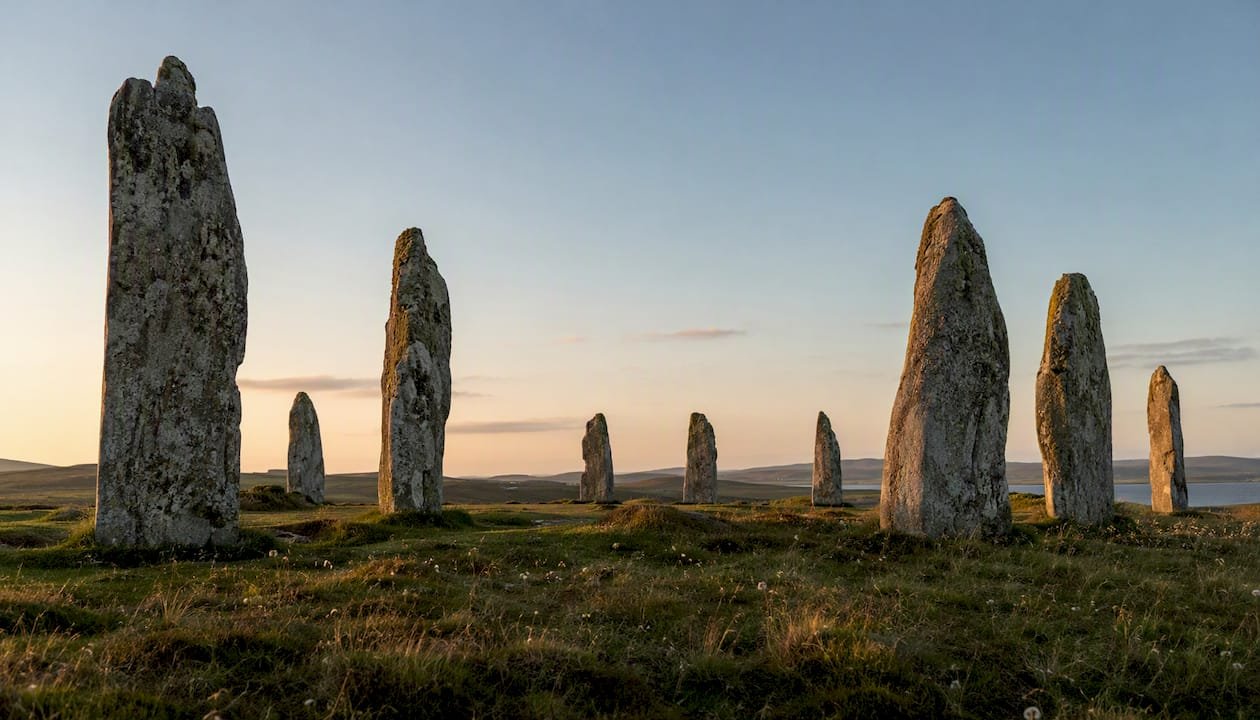
Calanais is the one site that consistently stops people in their tracks. The main circle comprises 13 stones arranged around a central monolith standing roughly 4.8 m tall, with a double-row avenue of 19 surviving stones extending northward. The whole complex forms a rough cross shape, set deliberately on a ridge so the stones are silhouetted against the sky. The rock itself is Lewisian Gneiss, geologically among the oldest exposed rock on Earth, though the monument dates to around 2900 BCE. The stones are ancient, but the landscape they stand in is older still.
Historic Environment Scotland notes that Calanais predates Stonehenge and that the visitor centre is closed for redevelopment until 2026, so facilities are currently limited. The stones themselves are free to visit at any time.
- Access: 15 miles west of Stornoway via the A858; roadside parking available
- Facilities: Visitor centre closed until 2026; no café or toilets on site during redevelopment
- Scheduled status: Cared for by Historic Environment Scotland
2. Ring of Brodgar, Mainland Orkney
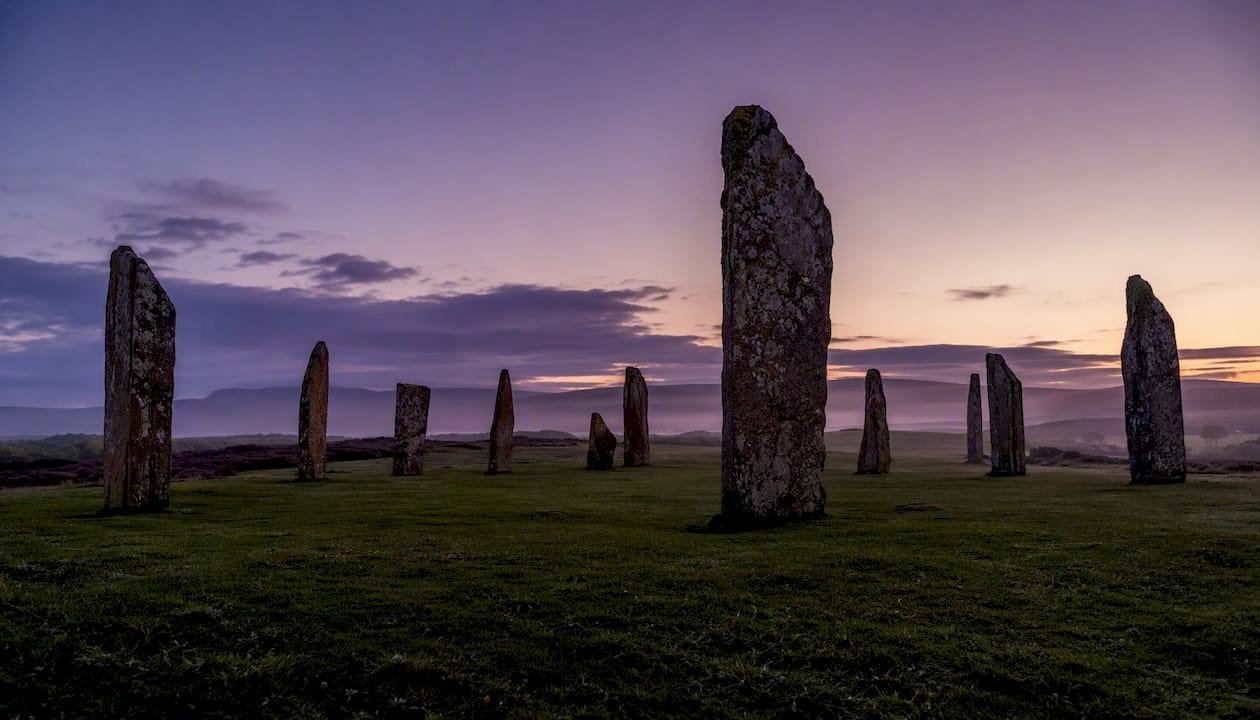
Location: Between Loch Harray and Loch Stenness, Mainland Orkney. Period: Neolithic, c. 2500–2000 BCE.
With a large diameter, the Ring of Brodgar is among the most expansive stone circles in Britain. Of an original 60 stones, 36 remain standing, rising from a rock-cut ditch that required enormous communal effort to excavate. The site forms part of the Heart of Neolithic Orkney UNESCO World Heritage Site, alongside Stenness, Skara Brae, and Maeshowe. On a clear day, with the lochs on either side catching the light, the ring feels genuinely otherworldly.
- Access: Off the B9055, 5 miles north-east of Stromness; free car park on site
- Facilities: No visitor centre; open access at all times
- Scheduled status: Managed by Historic Environment Scotland
3. Standing Stones of Stenness, Mainland Orkney
Location: 4 miles north-east of Stromness, Mainland Orkney. Period: Neolithic, activity from at least 3100 BCE.
Stenness may be the earliest henge monument in the British Isles. Only a few of the original stones survive, but they are tall and dramatically thin, rising from a platform 44 m in diameter with a ditch cut up to 2 m into bedrock. The nearby Watch Stone stands notably tall. Radiocarbon evidence ties Stenness to the same cultural moment as Skara Brae and Maeshowe, making it a cornerstone of the Heart of Neolithic Orkney World Heritage designation.
- Access: Off the B9055; small layby parking nearby
- Facilities: Open access; no visitor centre
- Scheduled status: Historic Environment Scotland care
4. Clava Cairns, near Inverness
Location: Near Culloden, 6 miles east of Inverness, Highland. Period: Bronze Age, c. 2000 BCE.
Clava Cairns is a group of three Bronze Age passage cairns surrounded by stone circles, set among mature beech trees that give the site an unusually atmospheric quality. The cairns are aligned so that at midwinter sunset, light enters the passage of the south-west cairn. VisitScotland highlights that Clava Cairns gained wider popular recognition as the inspiration for Craigh na Dun in the Outlander television series, which has noticeably increased visitor numbers. The archaeology, however, stands entirely on its own merits.
- Access: Signed from the B9006 near Culloden; free car park on site
- Facilities: Open access; Historic Environment Scotland managed
- Scheduled status: Scheduled monument, HES care
5. Machrie Moor Standing Stones, Isle of Arran
Location: West coast of Arran, 3 miles north of Blackwaterfoot. Period: Neolithic to Bronze Age, c. 3500–1500 BCE.
Machrie Moor holds several distinct stone circles spread across open moorland, each with a different character: some are tall red sandstone pillars, others low granite boulders. The variety in a single landscape is unusual even by Scottish standards. The walk across the moor (roughly 1.5 miles from the car park) is part of the experience; the circles emerge gradually from the heather.
- Access: Car park off the A841; 1.5-mile walk across moorland to the circles
- Facilities: No visitor centre; open access
- Scheduled status: Historic Environment Scotland scheduled monument
6. Kilmartin Glen, Argyll
Location: 9 miles north of Lochgilphead, Argyll. Period: Neolithic to Bronze Age, from c. 3500 BCE.
Kilmartin Glen contains over 350 ancient monuments within a compact valley, making it one of the densest concentrations of prehistoric remains in Scotland. Standing stones, carved rock art, cairns, and a linear cemetery of burial mounds all sit within walking distance of each other. Kilmartin Museum provides essential context before you set out. The sheer variety here rewards a full day rather than a quick stop.
- Access: Village of Kilmartin off the A816; parking at Kilmartin Museum
- Facilities: Kilmartin Museum on site (check opening hours before visiting)
- Scheduled status: Multiple scheduled monuments; Kilmartin Museum manages interpretation
7. Sueno’s Stone, Forres, Moray
Location: East end of Forres town, Moray. Period: Pictish, c. 9th–10th century CE.
Sueno’s Stone is among the tallest Pictish carved stones in Scotland and one of the most complex. One face carries an elaborate battle scene with hundreds of carved figures; the other shows a cross with interlace decoration. It is now enclosed in a glass case to protect the carvings from weathering. The stone is a scheduled monument cared for by Historic Environment Scotland and is free to visit at any time.
- Access: Finderne Road, Forres; roadside parking nearby
- Facilities: Glass enclosure; open access; no visitor centre
- Scheduled status: Historic Environment Scotland scheduled monument
8. Clach an Trushal, Ballantrushal, Isle of Lewis
Location: Ballantrushal village, north-west Lewis, Outer Hebrides. Period: Neolithic, c. 3000 BCE.
Clach an Trushal is the tallest standing stone in Scotland and one of the tallest single menhirs in Britain, standing over 5 meters tall. It sits in a field just off the road, with no visitor infrastructure at all, which gives it a raw, unmediated quality that the more managed sites cannot replicate. The stone leans slightly, which somehow adds to its presence rather than diminishing it.
- Access: Off the A857, north of Stornoway; limited roadside parking
- Facilities: None; open access on foot
- Scheduled status: Scheduled monument
9. Achavanich, Caithness
Location: Near Lybster, Caithness. Period: Bronze Age, c. 2000 BCE.
Achavanich is unusual among Scottish megalithic sites because its many surviving stones form a distinctive horseshoe or U-shape, open to the south-east. The setting on open moorland, with views across Loch Stemster, is bleak in the best possible way. It receives far fewer visitors than the Orkney sites despite being archaeologically fascinating.
- Access: Minor road off the A9 near Lybster; limited roadside parking
- Facilities: None; open moorland access
- Scheduled status: Scheduled monument
10. Hill o’ Many Stanes, Caithness
Location: Near Mid Clyth, Caithness. Period: Bronze Age, c. 2000 BCE.
Around 200 small stones arranged in 22 parallel rows fanning across a hillside make this one of the most visually striking megalithic monuments in Scotland. No one has convincingly explained the rows’ purpose, though astronomical interpretations have been proposed. Historic Environment Scotland manages the site, and it is free to visit. The Scotland’s Stories guide to standing stones includes it among the top ten sites worth seeking out.
- Access: Off the A9 near Mid Clyth; small layby parking
- Facilities: Open access; Historic Environment Scotland managed
- Scheduled status: Scheduled monument
What archaeologists say about Scotland’s standing stones
The core consensus is that most standing stones and stone circles formed part of deliberate ritual landscapes, often positioned to mark or frame astronomical events. At Calanais, the avenue aligns with the rising of the major southern moon, and the ridge siting means the stones are visible from a distance. At Clava Cairns, midwinter sunset light enters the passage cairn’s opening. These are not coincidences; the builders clearly understood their local horizon.
c. 3100 BCE — the earliest radiocarbon-dated activity at the Standing Stones of Stenness, making it one of the oldest henge monuments in the British Isles.
Dating methods have refined our picture considerably. Radiocarbon dating of organic material from ditch fills and buried soils beneath monuments places the main Neolithic building phase roughly between 3500 and 2500 BCE, with Bronze Age activity continuing to around 1500 BCE. The Heart of Neolithic Orkney UNESCO World Heritage Site designation reflects the exceptional density and preservation of monuments from this period in Orkney specifically.
Siting patterns are consistent: ridges, moorland, and loch margins appear repeatedly. Calanais sits on a ridge specifically to silhouette the stones against the sky. Many sites have water nearby, which may have held ritual significance. Exact functions remain debated, and community folklore has layered additional meanings onto the archaeology over millennia.
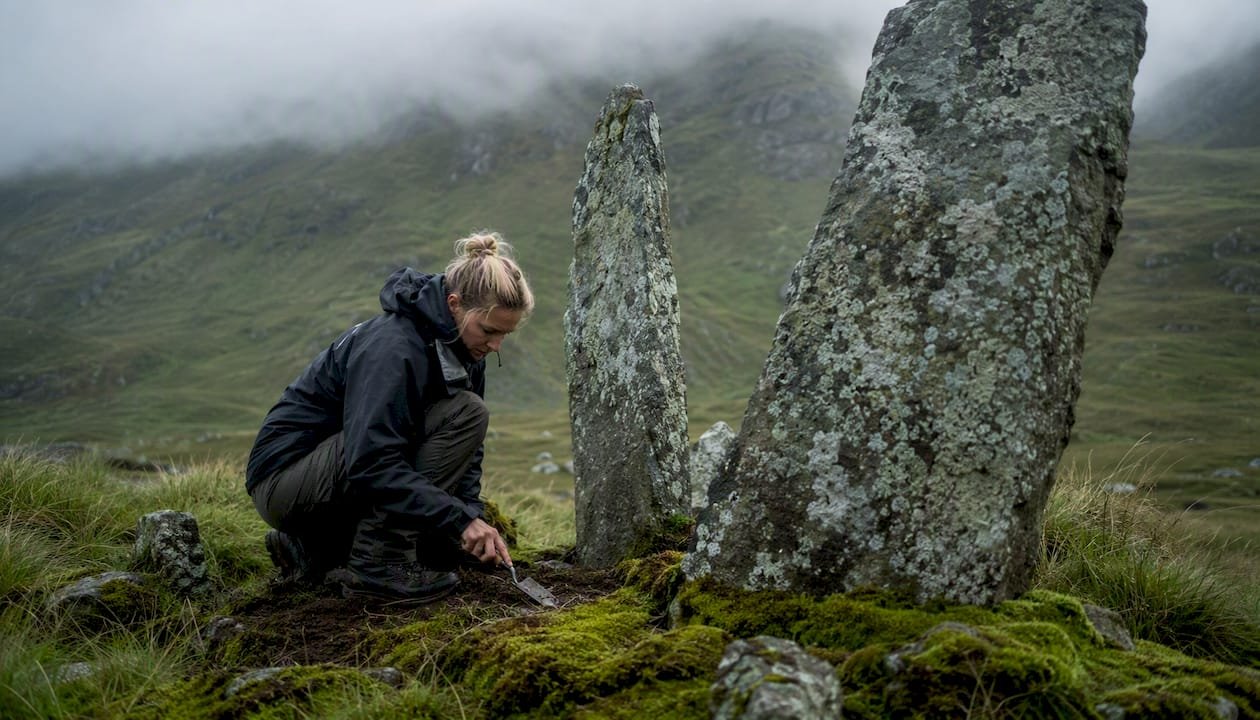
Pro Tip: To appreciate astronomical alignments, visit at sunrise or sunset rather than midday. At Calanais, the major southern moon alignment is most visible in the 18.6-year lunar cycle, but even a standard sunset visit in autumn or winter shows how the stones frame the horizon in ways that feel entirely intentional.
Practical tips and etiquette for visiting Scotland’s standing stones
The single most important rule: these are scheduled monuments. Climbing on stones, removing anything from the site, or disturbing the ground is a criminal offence under the Ancient Monuments and Archaeological Areas Act 1979. Follow Historic Environment Scotland’s guidance on site behaviour before you go.
Before you travel:
- Check the HES website and VisitScotland for current access status; facilities change (Calanais visitor centre is closed until 2026)
- Confirm ferry schedules if visiting Lewis or Arran; CalMac timetables shift seasonally
- Check the Canmore database (RCAHMS records) for detailed site information on lesser-known stones
On site:
- Wear waterproof boots; most sites involve boggy moorland or rough grass
- Close all gates on farmland access routes; some stones sit on private land
- Drone flying requires Civil Aviation Authority permission and, for scheduled monuments, Historic Environment Scotland consent; do not assume it is permitted
- Photography is generally unrestricted for personal use, but commercial shoots may require site permission
- Take all litter away; there are no bins at most open-access sites
Pro Tip: Visit in the golden hour before sunset for the best photography and the fewest other visitors. Midweek visits to Orkney sites in April or September hit a sweet spot between reasonable weather and low crowds.
Suggested day trips and routes combining several sites
Orkney loop (2 days)
Orkney’s main megalithic sites cluster within a few miles of each other on Mainland, making them easy to combine.
- Day 1: Arrive Kirkwall by ferry from Scrabster or Aberdeen. Drive to Stenness (20 minutes from Kirkwall). Walk to the Ring of Brodgar (10 minutes from Stenness). Visit Maeshowe chambered cairn nearby.
- Day 2: Skara Brae in the morning, then drive south to the Barnhouse Neolithic village site adjacent to Stenness. Allow 4–5 hours across both days for the UNESCO Heart of Neolithic Orkney core sites.
- Transport note: Hire car from Kirkwall is the most practical option; no direct bus links all sites.
Lewis day trip (1 day from Stornoway)
- Start at Calanais (15 miles west of Stornoway, 25 minutes by car).
- Drive north to Clach an Trushal at Ballantrushal (30 minutes from Calanais).
- Return via the Calanais II and III satellite circles, which are within a mile of the main site.
- Allow 3–4 hours total, more if you want to walk the satellite circles properly.
Argyll and Kilmartin circuit (1–2 days from Oban)
Kilmartin Glen is 35 miles north of Oban on the A816. A full day covers the museum, the linear cairn cemetery, and the standing stone settings at Temple Wood and Nether Largie, as detailed in these adventure travel stories that capture the rich heritage and traveller experiences around historic monuments. Pair with a visit to Dunadd hillfort for a broader Scottish heritage experience. Guided tours add real value here: the density of monuments means context matters, and a knowledgeable guide can connect the cairns, stones, and rock art into a coherent narrative.
Arran short visit (half-day)
Machrie Moor is accessible by ferry from Ardrossan to Brodick (55 minutes), then a 20-mile drive to the west coast car park. The moorland walk to the circles takes around 30–40 minutes each way. Combine with a visit to Brodick Castle for a full day on the island.
Caithness north route (1 day from Inverness)
Drive north on the A9 to Achavanich near Lybster (2.5 hours), then continue to Hill o’ Many Stanes at Mid Clyth (10 minutes further north). Both sites are roadside and require no more than 30–40 minutes each. The drive itself through the Flow Country is part of the appeal. For travellers interested in pairing this with Highland glen scenery, the route north from Inverness passes through some of the most open landscape in Britain.
Why these sites reward slow, curious visitors
Visiting Scotland’s standing stones well means slowing down. The temptation is to tick them off a list, but the sites that stay with you are the ones where you spent time looking at the horizon the builders were looking at.
A few things most visitors miss. First, the scale of effort involved. The ditch at Stenness was cut up to 2 m into solid bedrock with antler picks. The Calanais avenue required transporting and erecting 19 stones in a double row across a ridge. These were not casual undertakings by small communities. Second, the weather is part of the experience, not an obstacle. Low cloud, Atlantic light, and wind change these places entirely. A grey morning at Calanais is more affecting than a bright midday visit. Third, the stones rarely make sense from a single viewpoint. Walking the full circuit of the Ring of Brodgar, watching the geometry shift as you move, is the only way to understand why the builders chose a circle.
Local guides earn their keep at the more complex sites. At Kilmartin Glen, where over 350 monuments sit within a few miles, the difference between a guided visit and an unguided one is the difference between understanding a conversation and hearing noise. The same applies to astronomical alignments: knowing which notch on the horizon to watch, and when, is not obvious from a site plan.
Private guided tours that bring Scotland’s megaliths to life
Scotland’s standing stones are scattered across islands, moorland, and remote glens. Knowing which ferry to catch, where to park, and which satellite circles at Calanais are worth the detour takes planning that eats into the time you actually want to spend at the stones.

Skyehighlandstours offers private guided tours of the Scottish Highlands that can be built around megalithic sites, with local guides who understand both the logistics and the archaeology. Rather than spending half a day working out access routes, you arrive knowing what you are looking at and why it matters. Tours are fully customisable, so whether you want a dedicated stone-circle day on Lewis or a broader cultural heritage itinerary that combines Kilmartin Glen with Dunadd and the Argyll coast, the itinerary fits your interests. To start planning, visit the Scottish Highlands tours page and get in touch with your preferred dates.
Sources
The sources below are the most reliable starting points for visitor information and archaeological detail on Scotland’s standing stones.
- 7 Standing Stones in Scotland | VisitScotland
- Calanais Standing Stones | Historic Environment Scotland | HES
- Calanais Stones / Tursachan Chalanais – Calanais Standing Stones & Visitor Centre on Isle of Lewis Scotland
- 10 Of The Best Standing Stones In Scotland – Scotland’s Stories
- Kilmartin
FAQ
Are there standing stones in Scotland?
Yes. Scotland has hundreds of standing stones and stone circles, ranging from the Neolithic circles of Orkney and Lewis to Bronze Age settings on Arran and Pictish carved stones in Moray. The most visited are managed by Historic Environment Scotland.
What are the most famous standing stones in Scotland?
Calanais on the Isle of Lewis and the Ring of Brodgar and Standing Stones of Stenness in Orkney are the most celebrated. All three are free to visit and are among the best-preserved Neolithic monuments in Europe.
What is the mystery behind Scotland’s standing stones?
Exact functions remain debated, but mainstream archaeology interprets most sites as components of ritual landscapes, sometimes aligned with solar or lunar events. The precise social or ceremonial purpose is unknown and may have varied between communities and periods.
Where are the Outlander standing stones in Scotland?
Clava Cairns, near Culloden outside Inverness, served as the visual inspiration for Craigh na Dun in the Outlander series. The real site is a group of Bronze Age passage cairns with surrounding stone circles, cared for by Historic Environment Scotland and free to visit.