
Your cart is empty Continue Shopping
Leave no trace Scotland: the rules every visitor must follow
In Scotland, leaving no trace means following the Scottish Outdoor Access Code: camp lightly for no more than a few nights in one spot, pack out every scrap of waste, skip the open fire, and keep well back from lochs and rivers when nature calls. Get those four things right and you have covered most of what actually matters.
The Code is not a suggestion. It sits alongside Scotland’s statutory right of responsible access, and it is the practical rulebook that turns “leave no trace” from a vague slogan into something you can actually check yourself against before you set off.
Before you go, do three things:
- Pack every item of waste back out, including food scraps and toilet paper
- Skip open fires entirely on peat, moorland or anywhere a stove will do the job
- Check the relevant national park page (Cairngorms or Loch Lomond & The Trossachs) and the Met Office mountain forecast before heading into any upland area
Key Takeaways
Practising leave no trace in Scotland means following the Scottish Outdoor Access Code’s camping limits, burying waste well clear of water, skipping fires on peat, and choosing slower, rail-first travel.
| Point | Details |
|---|---|
| Camp within SOAC limits | Stay lightweight and move on after two to three nights in any one spot. |
| Bury waste properly | Dig catholes at least 30 metres from water and carry out toilet paper on peat ground. |
| Skip fires on peat and moorland | Use a stove instead, since smouldering peat can reignite as wildfire days later. |
| Check park pages before travelling | Cairngorms and Loch Lomond & The Trossachs both publish current byelaws and seasonal restrictions. |
| Travel slower and by rail where possible | Longer stays in fewer places ease pressure on popular routes and support local economies. |
Table of Contents
- The seven leave no trace principles, translated for Scotland
- Camping rules and lawful access in Scotland: what SOAC actually allows
- Toilet and water protection: why 30 metres is the minimum, not the target
- Fires, stoves and fuel: the peatland problem most visitors miss
- Respecting wildlife, farm animals and local communities
- Trip planning and travel choices that cut your impact before you arrive
- Kit, packing and daily habits that make leave no trace automatic
- Weather, safety and what to do if plans change
- How local guides reduce impact: Skye Highlands Tours’ approach
- Why most leave no trace advice misses the point in Scotland
- Sources
- FAQ
The seven leave no trace principles, translated for Scotland
The Leave No Trace Centre for Outdoor Ethics sets out seven principles used worldwide. In Scotland, they work differently to how they work in, say, the Rocky Mountains, because access here is a legal right rather than a permit system, and that changes what “responsible” looks like on the ground.
Pro Tip: Think of the seven principles as a checklist you run through the night before, not something you improvise on the trail. Five minutes of planning saves most of the mistakes covered below.
Plan ahead and prepare. Know your route, check the forecast, and confirm whether any byelaws apply where you are headed.
- Check Cairngorms or Loch Lomond & The Trossachs park pages for seasonal restrictions
- Carry a map and know your exit points before conditions turn
Travel and camp on durable ground. Scotland’s access rights let you roam widely, but the Scottish Outdoor Access Code still expects you to camp lightly and move on.
- Choose short grass or bare ground over fragile moss and heather
- Stick to established paths on popular routes to avoid widening erosion scars
Dispose of waste properly. This is where most avoidable damage happens, particularly around popular wild camping spots.
- Pack out all litter, including food waste and micro-litter like sweet wrappers
- Bury human waste correctly, covered fully in the next section
Leave what you find. Scotland’s archaeology, flora and geology are part of what makes a place worth visiting.
- Leave stone circles, cairns and historic ruins exactly as found
- Resist picking rare upland flowers, especially in protected areas
Minimise campfire impact. Deadwood and peat are part of a living ecosystem, not free fuel.
- Use a stove instead of a fire wherever possible
- Check local byelaws, since open fires are banned outright in parts of Loch Lomond & The Trossachs
Respect wildlife. Ground-nesting birds, deer and otters are all present across the Highlands and Skye.
- Keep dogs on a short lead or under close control near livestock and nesting birds
- Watch from a distance rather than approaching for a photograph
Be considerate of other visitors. Crofting communities and other walkers share the same ground you’re passing through.
- Keep noise down near settlements, especially in the evening
- Give way on narrow paths and keep groups small on popular routes
Camping rules and lawful access in Scotland: what SOAC actually allows
The Scottish Outdoor Access Code gives you the right to camp wild across most of Scotland, but that right comes with conditions, and misunderstanding them is the single most common cause of friction between visitors and land managers. Treating Leave No Trace as a nice-to-have rather than a condition attached to your legal access is where most conflicts start.
The Code permits lightweight wild camping for small groups and generally advises staying only a short time in any one spot before moving on. That guidance exists because repeated use of the same patch of ground, even by considerate campers, wears down vegetation and soil faster than it can recover.
Some places are off-limits regardless of how lightly you camp. The Code specifically advises against pitching in enclosed fields containing crops or farm animals, close to houses, or in car parks and other spots where camping simply is not appropriate. Land managers can reasonably ask you to move on if you have set up somewhere sensitive, and the polite response is to comply rather than argue the point.
National parks add their own layer on top of SOAC. Loch Lomond & The Trossachs National Park operates camping management byelaws in specific zones during peak season, restricting where and how you can pitch. Cairngorms National Park does not run the same byelaw system but publishes clear seasonal guidance on its own site. Check the relevant park page before you travel rather than assuming blanket wild camping rights apply everywhere.
- Stick to two to three nights maximum in any one location
- Avoid enclosed fields, gardens and anywhere near buildings
- Check for seasonal camping byelaws if you are heading into Loch Lomond & The Trossachs
- Move promptly if a land manager asks, even if you believe you’re within your rights
Toilet and water protection: why 30 metres is the minimum, not the target
Human waste is the part of Leave No Trace visitors get wrong most often, and it is also the easiest to fix with a bit of forward planning. Official guidance from Cairngorms National Park requires waste to be buried in a cathole at least 30 metres from any water source, with toilet paper carried out rather than buried wherever that is practical.
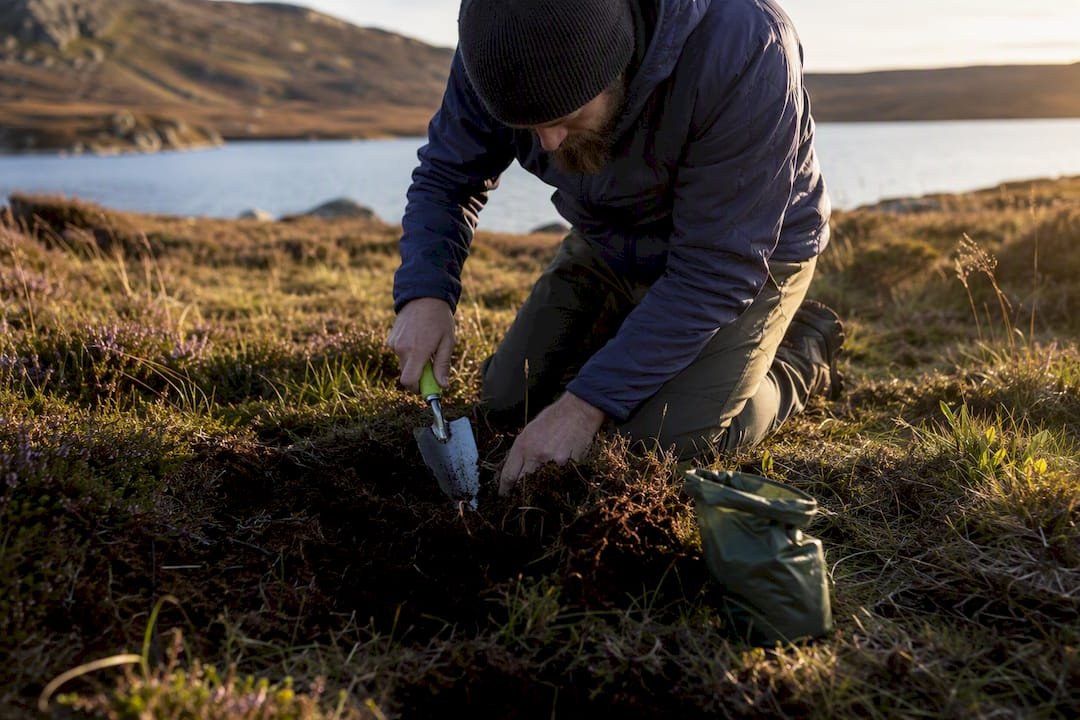
The 30-metre figure is a minimum, not a target. On Scotland’s peat soils, that distance often isn’t enough. Peat decomposes organic matter extremely slowly, which means anything buried there can persist for years rather than breaking down in a normal season. The safer habit, especially in the Cairngorms or on Skye’s boggier ground, is to go further than 30 metres and choose dry, absorbent soil well clear of any drainage line, rather than treating the metre count as a box to tick.
The technique itself is simple:
- Dig a cathole 15 to 20 centimetres deep in soil, not peat, if you have a choice
- Choose ground at least 30 metres from any stream, loch or drainage line, and further where the ground is boggy
- Cover the hole fully once finished
- Carry out toilet paper and all hygiene products in a sealed bag rather than burying them
- Consider a WAG bag (Waste Alleviation and Gelling bag) for popular routes where digging isn’t realistic, and dispose of it in general waste afterwards
Food waste follows the same logic. Cairngorms National Park guidance is explicit that leftover food attracts vermin and spreads disease, so it counts as litter and comes out with you, not into a hedge or under a rock.
Fires, stoves and fuel: the peatland problem most visitors miss
Scotland’s uplands are built on peat, and peat does not behave like ordinary soil when it comes to fire. A fire that looks fully out on the surface can keep smouldering underground in dry peat for days, occasionally resurfacing as a wildfire well after the campers who lit it have gone home.
That’s the reason deadwood and fallen branches should stay exactly where they are rather than being gathered for a campfire. Deadwood is part of the nutrient cycle for the local ecosystem, and pulling it out for fuel slows that process down for the plants and insects that depend on it.
Pro Tip: Bring a stove and treat it as non-negotiable kit, not a backup option. A canister stove boils water in minutes with zero risk of a smouldering peat fire, and it works in wind and rain when a campfire simply won’t light.
- Use a stove rather than an open fire wherever practical, particularly above the treeline
- Check park byelaws before assuming fires are allowed; Loch Lomond & The Trossachs bans them outright in managed camping zones
- Check wildfire risk warnings during dry spells, since Scottish moorland burns faster than most visitors expect
- Never leave a fire unattended, even briefly, and douse thoroughly if you do light one where it’s permitted
Respecting wildlife, farm animals and local communities
Leave No Trace in Scotland is as much about people and livestock as it is about landscape. Ground-nesting birds such as curlew and skylark are especially vulnerable during the breeding season, roughly March to July, when a dog running loose can wipe out a nest in seconds.
Keep dogs on a short lead around livestock and nesting birds, and remember that a crofter’s sheep or cattle are somebody’s livelihood, not scenery. Close gates behind you, stick to field edges rather than cutting across growing crops, and never assume a track through working farmland is there for casual wandering.
- Keep dogs under close control, or on a lead, near livestock and during bird breeding season
- Close gates and avoid crossing fields with crops or animals where a path skirts the edge instead
- Park considerately, well clear of passing places and farm access points
- Keep noise down near small settlements, particularly in the evening
Trip planning and travel choices that cut your impact before you arrive
The lowest-impact decision you make on any Scottish trip often happens before you’ve packed a bag: how you get there and when. VisitScotland’s responsible tourism guidance recommends favouring rail and slower itineraries specifically because they ease pressure on fragile places and put more money into local economies than a fast, car-based dash between honeypots.
ScotRail services and the Caledonian Sleeper reach much of the Highlands directly, cutting the need for a car on routes into Fort William, Inverness or Aviemore. Staying longer in fewer places, rather than ticking off five glens in three days, spreads your spending across local businesses and takes pressure off the same viewpoints everyone photographs on a tight schedule.
Timing matters just as much as transport. Visiting the Cairngorms or Skye outside peak summer weekends means less strain on parking, paths and toilets, and a noticeably calmer experience for you too. If you’re planning where to stay rather than camp, a good holiday accommodation guide can help you pick a base that supports slower, longer stays rather than constant relocation.
- Choose rail where routes allow, particularly into Fort William, Inverness or the Cairngorms
- Stay longer in one base rather than moving nightly between locations
- Travel outside peak weekends when you have flexibility
- Check byelaws, parking availability and the forecast a day or two before you leave, not the morning of
Kit, packing and daily habits that make leave no trace automatic
Good habits beat good intentions. A short kit list and a five-minute departure routine do more for minimal impact camping in Scotland than any amount of enthusiasm on day one.
- Pack reusable foodware instead of single-use plates and cutlery, which reduces what you’re carrying out at the end
- Carry sealed waste bags for litter and a WAG bag if you’re heading somewhere without easy access to a cathole site
- Bring a stove and enough fuel for the whole trip, so you’re never tempted to improvise a fire
- Choose a tent with a smaller footprint on multi-night trips, since less ground pressure means faster recovery for the vegetation underneath
- Do a final sweep before leaving, checking for guy-line pegs, micro-litter and anything dropped in long grass
- Scale kit to trip length, packing lighter for a single overnight and adding waste capacity for anything longer than two nights
A detailed Highlands packing checklist is worth working through before a longer trip, since it’s easy to forget the small items, like extra waste bags, that make the biggest practical difference.
Weather, safety and what to do if plans change
Scottish mountain weather turns fast, and that has a direct bearing on your low-impact choices as well as your safety. Check the Met Office mountain forecast before any upland trip, since it covers wind, visibility and temperature at altitude in a way general forecasts don’t, and it affects whether a stove will even light in exposed conditions.
If a wildfire warning is issued for a national park, treat it as absolute: stoves and fires both become off-limits until the warning lifts, regardless of what you’d planned. Tell someone your route and expected return time before you head out, particularly for overnight camps in remote glens, and build a margin into your plans rather than pushing on when weather closes in. A pre-trip preparation guide covers the wider safety basics worth reading alongside the forecast itself.
- Check the Met Office mountain forecast, not just a general app, before altitude trips
- Treat wildfire warnings as a hard stop on stoves and fires
- Leave your route and return time with someone before setting off
- Build in a weather margin rather than committing to a fixed schedule
How local guides reduce impact: Skye Highlands Tours’ approach
A knowledgeable local guide changes the impact equation in ways a solo visitor with good intentions often can’t replicate. At Skyehighlandstours, guides route groups toward less-pressured paths rather than the handful of spots that appear on every Instagram feed, and they shift timing to quieter windows that avoid peak congestion at places like the Fairy Pools or the Old Man of Storr.
- Guides choose parking and assembly points already agreed with land managers, rather than improvising
- Group behaviour, noise and pace get managed in real time, something a printed guidebook can’t do
- Local knowledge means fewer accidental byelaw breaches, since guides already know which glens restrict fires or camping
Hiring a guide makes the most sense when you’re short on local knowledge, travelling with a mixed-ability group, or simply want a day that runs smoothly without the planning overhead. Skyehighlandstours’ private tours are built around exactly this kind of responsible, low-impact routing, tailored to group size and interests rather than a fixed coach itinerary.
Why most leave no trace advice misses the point in Scotland
Most Leave No Trace advice gets written for permit-based wilderness in North America and then pasted onto Scotland without adjustment. That’s the wrong frame. Scotland’s access rights make Leave No Trace a condition attached to your legal freedom to roam, not an optional ethic layered on top of it, and that distinction changes how seriously visitors should take the detail.
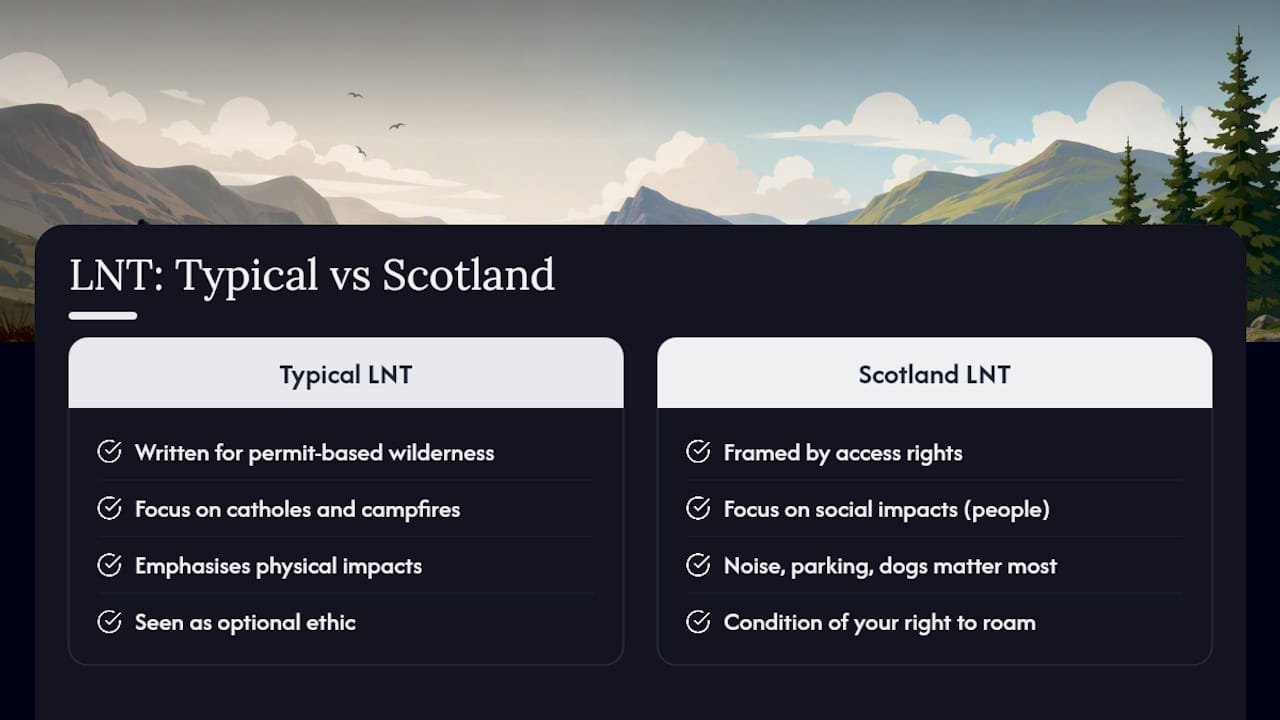
The conventional advice fixates on catholes and campfire bans, which matter, but underweights the social side: noise near crofting communities, parking that blocks a farm gate, dogs off-lead during nesting season. Physical damage heals faster than trust between visitors and the people who live on this land year-round.
If you take one thing from this article, prioritise the two to three night camping guidance over everything else. It’s the rule most visitors ignore first, and it’s the one doing the most quiet work to keep wild camping viable for everyone who comes after you.
— Alin
Sources
- Camping | Scottish Outdoor Access Code
- Cairngorms National Park | Leave no trace
- Sustainable & responsible tourism in Scotland | VisitScotland
- Met Office mountain weather forecasts
FAQ
What are the leave no trace rules in the UK?
There’s no single UK-wide legal code. In Scotland, the practical rules come from the Scottish Outdoor Access Code: camp lightly for two to three nights maximum, pack out all waste, avoid open fires, and bury human waste at least 30 metres from water.
Can you legally sleep in your car in Scotland?
Scotland’s right of responsible access under SOAC covers wild camping on foot, but sleeping in a vehicle falls outside that specific provision and depends on local parking rules and land ownership. Always check for signage and avoid blocking passing places or private access.
Can I live in a tent on my own land in Scotland?
Camping on land you own isn’t governed by the Scottish Outdoor Access Code’s wild camping guidance, which applies to access over other people’s land. Long-term living arrangements typically involve separate planning permission rules, so check with your local council.
Can you get prosecuted for wild camping?
Wild camping itself is lawful under the Scottish Outdoor Access Code when done responsibly, but camping in breach of specific byelaws, such as those in parts of Loch Lomond & The Trossachs during managed periods, can result in enforcement action.
Recommended
- Essential packing list for Scotland: your 2026 guide – Skye Highlands Tours
- Responsible travel in Scotland: your guide to authentic tours – Skye Highlands Tours
- Packing checklist for the Scottish Highlands: 2026 guide – Skye Highlands Tours
- Plan a perfect Scottish day trip from Edinburgh – Skye Highlands Tours
1 Comment