
Your cart is empty Continue Shopping
20–40 mph on Single-Track Roads in Scotland: Drive or Hire a Guide
Single-track roads are one-lane, two-way routes threaded with passing places, and they cover most of the Highlands and islands. Keep left at all times, pull into passing places on your left, and stop opposite a passing place on your right rather than crossing into it. Master those two habits and you’ll find these roads deliver some of the best driving in Scotland, not the most stressful.
TL;DR:
- Passing places on single-track roads must be used correctly; pull into left passing places and stop opposite rights, giving way to the nearest vehicle regardless of direction.
- Typical safe driving speed ranges from 20 to 40 mph, with adjustments for bends, weather, and visibility, due to unpredictable wildlife and road conditions.
- Long vehicles and campervans should arrive early at passing places and avoid routes like Bealach na Bà, which are unsuitable for larger or inexperienced drivers.
- Always check fuel, tyre pressure, weather, and road conditions before setting out, and build in extra time to accommodate the slower pace of sightseeing routes.
- Hiring a local guide can be a safer, more comfortable option for unfamiliar drivers or those with limited time, with tours covering Skye, Loch Ness, and other scenic Highlands destinations.
Table of Contents
- What are single track roads in Scotland and where will you find them?
- How do passing places actually work?
- What speed and driving style suits these roads?
- Preparing for a day on single-track roads
- What to do if you get stuck or need help
- Skye Highlands Tours’ take: when driving isn’t the answer
- Prefer someone else to handle the driving?
- Sources
- FAQ
What are single track roads in Scotland and where will you find them?
You’ll meet single-track roads the moment you leave the A-roads behind, particularly on the islands and along the west coast. There are over 2,500 miles of single-track routes across the Highlands, so if your trip takes you off the main trunk roads, expect to spend real time on them.
A few stretches come up again and again in trip reports and for good reason: the roads to the Quiraing and Neist Point on Skye squeeze between dramatic scenery and drop-offs, while Bealach na Bà on the Applecross peninsula climbs through hairpins that catch out drivers expecting a normal mountain pass. Add to that:
- Most of the Outer Hebrides and Mull’s minor roads
- Long single-track approaches to island ferry terminals
- Remote Highland routes such as the road to Lower Diabaig
- Numerous detours off the main NC500 loop
If you’re building an itinerary around scenic routes in Scotland, factor in that single-track sections eat into your schedule far more than the map suggests. A 40-mile route can often take significantly longer than the same distance on a dual carriageway due to road conditions and passing requirements.
How do passing places actually work?
Passing places aren’t optional courtesy stops. They’re a structural part of how single-track roads function, and getting the etiquette wrong is the fastest way to create a stand-off with a local driver who has somewhere to be.
The rule is straightforward once you’ve done it a couple of times. Here’s the sequence:
- Keep left as a default. This maximises your sightline on bends and gives you the best chance of spotting an oncoming vehicle early.
- If a passing place appears on your left, pull into it and let the oncoming car pass.
- If the passing place is on your right, stop level with it and wait. The oncoming driver pulls into their own left-hand passing place. Never cross the road to sit in a passing place on the right, according to Road Safety Scotland.
- Give way to whoever is nearer a passing place, regardless of direction of travel.
- On hills, the convention favours the vehicle travelling uphill getting the clearer run, though nearest passing place still takes priority in practice.
- Give way to larger vehicles, cyclists, and horses, since they have far less room to manoeuvre than you do.
Passing places are marked with white diamond signs or black and white poles, and they’re often spaced further apart than you’d expect on remote stretches, according to guidance on driving in the Scottish Highlands. That means you sometimes need to plan two or three moves ahead, not just react to the car in front of you.
Reversing is part of the deal too. If you’ve passed a passing place and meet oncoming traffic before the next one, you’re the one who reverses back to it, not the other driver. Do it slowly, check your mirrors constantly, and don’t panic if it takes a few attempts.
Pro Tip: A quick flash of your headlights or a raised hand as you pass someone using a passing place for you goes a long way. It costs nothing and it’s how word gets round that visitors are being sensible on these roads.
What you should never do: park in a passing place for lunch or photos, stop on a blind summit or bend, or drift onto a verge to let someone through. Parking in passing places causes an obstruction for other road users, and soft verges swallow tyres faster than you’d think.
What speed and driving style suits these roads?
Drive to what you can actually see, not to the posted limit. The national speed limit may technically apply on many single-track roads, but sensible speeds sit between 20 and 40 mph depending on bends, weather, and visibility. Blind summits and tight corners mean you often can’t see more than a few car lengths ahead, so that’s your real speed ceiling, not the sign.
Wildlife and livestock show up without warning. Sheep wander onto the road on Skye and Mull constantly, and deer cross at dawn and dusk across the mainland Highlands. Slow right down when you see animals near the verge, give them space, and resist the urge to sound your horn. Sudden noise tends to make animals bolt in unpredictable directions.
- Keep both wheels on tarmac at all times; soft verges cause vehicles to sink and get stuck
- Slow to a crawl through fords, blind bends, and humpback bridges
- Assume every blind summit hides an oncoming vehicle
- Watch for cyclists and walkers, who often have nowhere to step aside
Large vehicles need extra thought. Campervans and long wheelbase vehicles should pull into passing places earlier than smaller cars, since stopping distances and manoeuvring space work against you. Bealach na Bà specifically isn’t suitable for long vehicles or learner drivers, and local signage says so for good reason.
If you’re driving an electric vehicle, plan your charging stops with care. Chargers exist in most Highland towns, but they thin out fast once you’re on the islands or west coast peninsulas, so top up whenever you pass a reliable charger rather than waiting until you need one.
Preparing for a day on single-track roads
A little preparation turns a potentially nerve-wracking drive into an easy one. Before you set off:
- Check fuel and tyre pressure. Petrol stations are sparse in remote areas, and a puncture on a verge-heavy road is a genuine inconvenience.
- Download offline maps. Mobile signal drops out constantly in glens and on the islands, and you don’t want your navigation to vanish halfway up a pass.
- Check the weather and road conditions before leaving, especially in autumn and winter when single-track routes are the first to be affected by wind or flooding.
- Build in extra time. If a route looks like it should take an hour, budget ninety minutes.
- Pack water, snacks, and warm layers, particularly if you’re heading to the west coast or the islands where help can be a long way off.
If you’re planning a longer trip, a Highlands packing checklist is worth running through before you leave, since weather here shifts faster than most visitors expect.
Pro Tip: If you’re a cruise passenger with a fixed return time, single-track roads are the one variable most likely to throw off your schedule. Build in far more buffer than you think you need, or consider a route that avoids the trickiest passes entirely.
What to do if you get stuck or need help
If your vehicle ends up on a soft verge or you can’t get traction, don’t spin the wheels harder. That usually digs you in deeper. Get out carefully, check for oncoming traffic, and see whether gentle rocking or placing a floor mat under the tyre gives you enough grip to ease back onto the road.
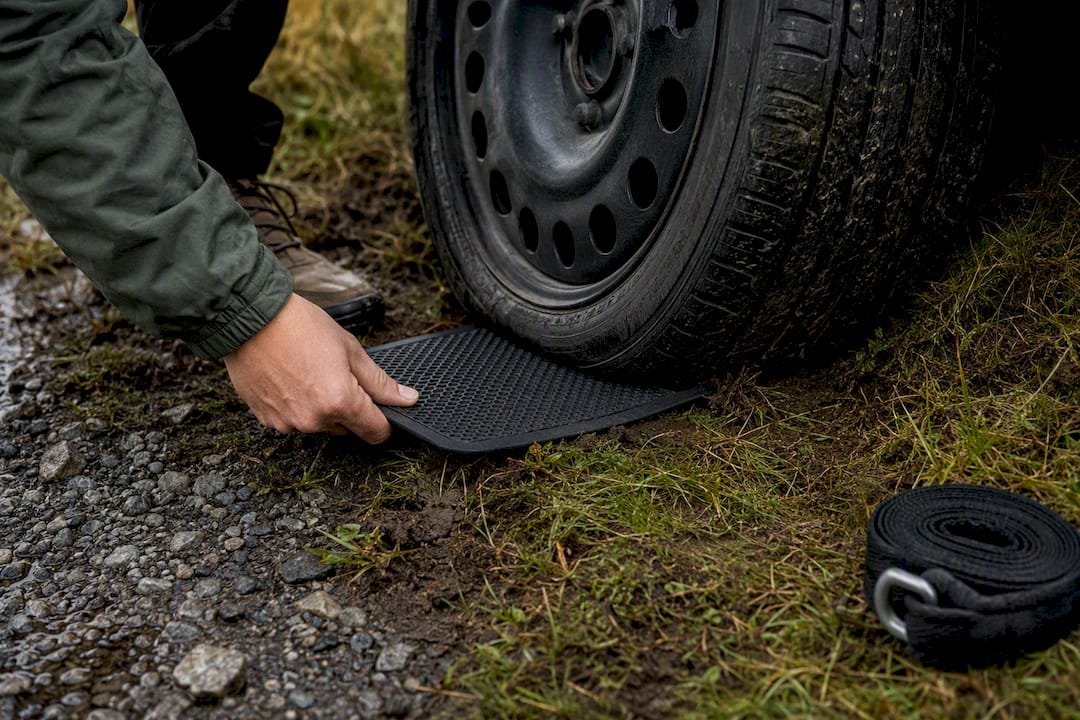
If the car doesn’t move at all, your first job is visibility. Put your hazard lights on and, if you have one, a warning triangle a safe distance behind the vehicle, especially near a bend where oncoming drivers won’t see you until the last moment. Mobile signal is unreliable on many single-track stretches, so don’t assume you can call for help the moment something goes wrong.
Know your recovery cover before you set off. Most UK breakdown providers cover remote Highland roads, but response times can run to a few hours on the islands or far peninsulas, simply because of distance and ferry schedules. If you’re renting a car, confirm what the hire company’s roadside assistance actually covers geographically.
For anything more serious, such as a collision or a medical issue, call 999 as you would anywhere else. If you have no signal, walking to the nearest passing place or junction sometimes picks up a weak signal, and flagging down a passing local is often faster than waiting for a tow. Locals on these roads are used to helping stranded visitors. It’s part of the culture out here.
Skye Highlands Tours’ take: when driving isn’t the answer
Plenty of visitors read all this and still feel uneasy about tackling Bealach na Bà in a hire car they’ve had for two days. That’s a fair instinct, and it’s exactly why Skye Highlands Tours exists as a private guided tour operator across the Highlands, covering Skye, Loch Ness, Glenfinnan Viaduct, and the Black Isle.
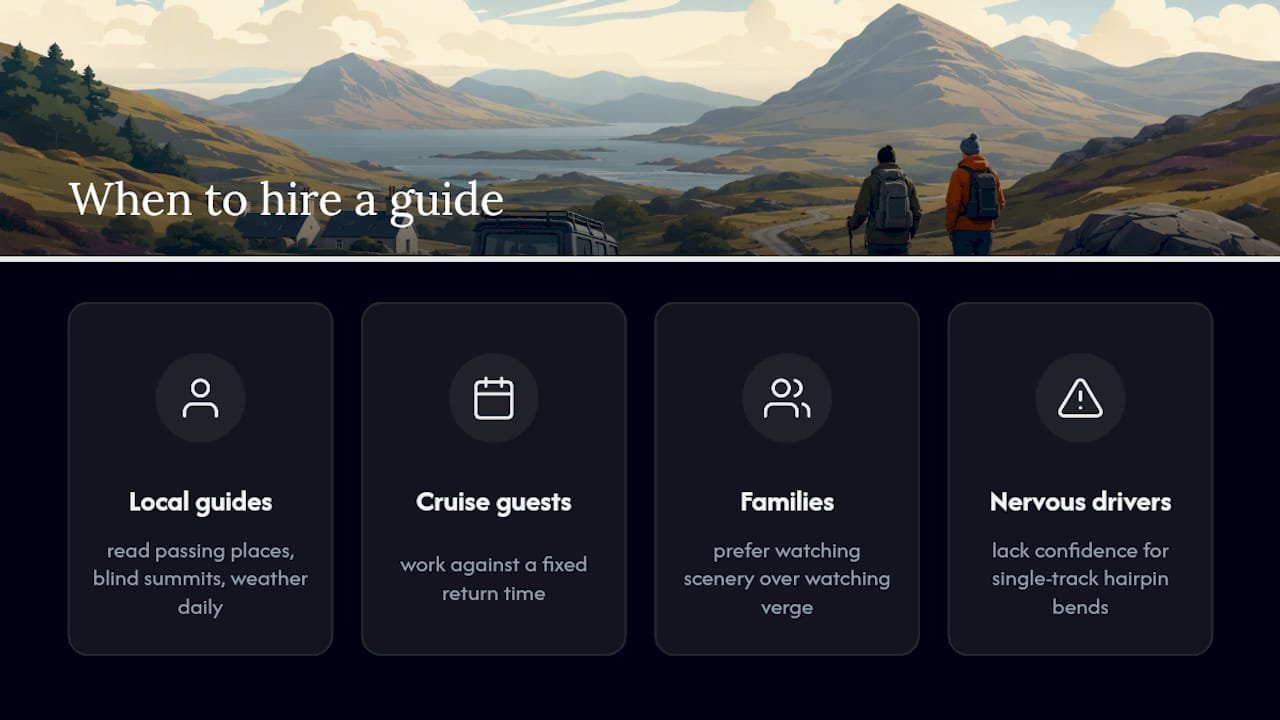
Local guides who drive these roads daily read the passing places, the blind summits, and the weather changes without a second thought. That local knowledge matters most for cruise passengers working against a fixed return time, families who’d rather watch the scenery than the verge, and anyone whose confidence doesn’t stretch to a single-track hairpin bend on a cliff edge. Guided routes can flex around interests, physical ability, and how long you actually want on the road.
If your holiday time is tight or your nerves aren’t built for hairpin bends above sea cliffs, a guide handles the driving so you get the view.
— Alin
Prefer someone else to handle the driving?
One alternative to hiring a car and driving challenging routes yourself is to use a local guide who knows every passing place, blind summit, and sheep-crossing on the route, so you can relax and enjoy the scenery instead of focusing on driving.

That option is especially helpful if you have limited time, travel with family, or prefer not to handle difficult driving, but still want to enjoy destinations like Skye, Loch Ness, or Glenfinnan Viaduct. Browse the full range of private guided tours to see what’s on offer, or look at the North Highland Tour if remote Highland scenery is what draws you. Cruise passengers docking at Invergordon can also check the transfer and shore excursion options built around port timings. If none of the set itineraries fit, get in touch about a custom route, whisky-focused day, or family trip that skips the roads you’d rather not drive yourself.
Sources
For official guidance, see Road Safety Scotland on driving on the left and Traffic Scotland’s country roads advice. For broader trip planning, Wild Foodz’s self-catering stay guide covers practical logistics worth reading alongside your route plan.
- Driving on the left – Road Safety Scotland
- How to drive on single-track roads in Scotland — Watch Me See
FAQ
What is the rule for passing places on single-track roads?
Pull into a passing place on your left when you meet oncoming traffic. If the passing place is on your right, stop opposite it and wait for the other driver to use their own left-hand passing place, as Road Safety Scotland sets out.
Can you park in a passing place in Scotland?
No. Passing places exist to keep traffic moving on single-track roads, and stopping in one for lunch or photos causes an obstruction for other road users, according to Traffic Scotland.
How fast should you drive on single-track roads?
Drive to what you can see ahead rather than the posted limit. Safe speeds typically run between 20 and 40 mph, depending on bends, weather, and visibility.
Are single-track roads suitable for campervans?
Many are, but some routes such as Bealach na Bà on Applecross aren’t recommended for long vehicles. Campervan drivers should pull into passing places earlier than car drivers and be ready to reverse if needed.
Is there a guided alternative to driving single-track roads myself?
Yes. Skye Highlands Tours offers private guided tours across the Highlands, including Skye, Loch Ness, and Glenfinnan Viaduct, with local guides handling the driving. Current tour prices are listed on the tours page.