


Your cart is empty Continue Shopping

How to prepare for a highlands adventure
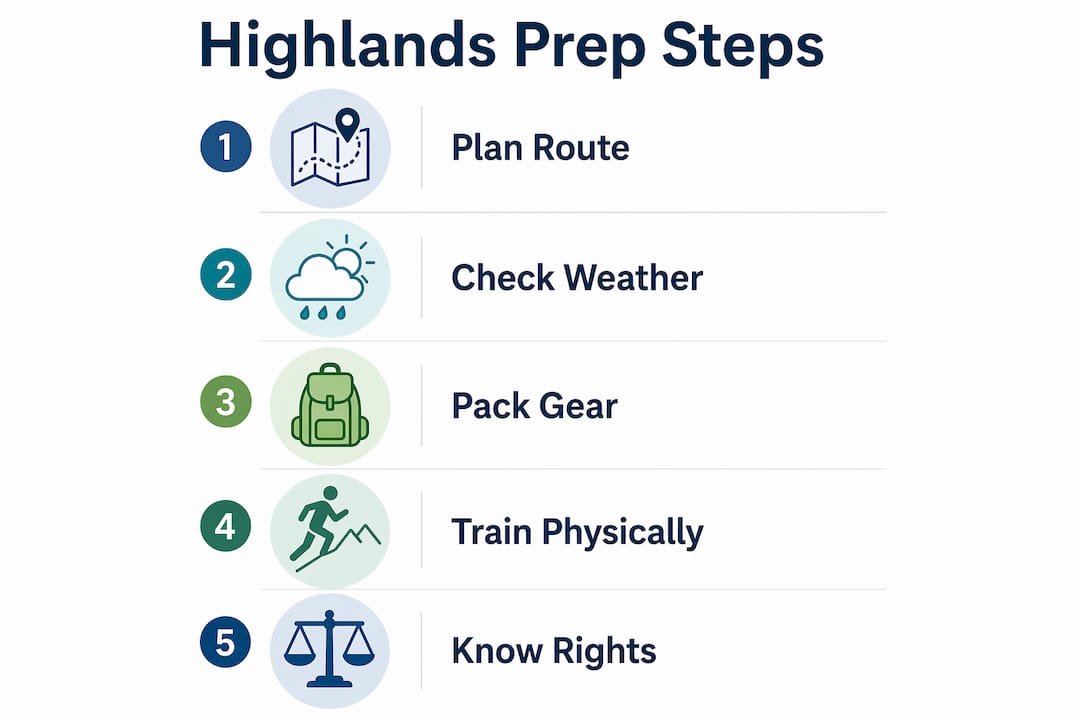
Preparing for a Highlands adventure means equipping yourself with the right skills, gear, and knowledge to handle remote, rugged terrain and unpredictable Scottish weather. The Scottish Highlands demand genuine respect: steep ascents, pathless moorland, river crossings, and weather that can shift from sunshine to driving sleet within the hour. Whether you are planning your first Munro or a multi-day wild camp in Torridon, the difference between a memorable experience and a dangerous one comes down to preparation. This guide covers terrain awareness, physical conditioning, essential kit, weather tools such as MWIS and the Met Office, and your legal rights under Scotland’s access laws.
How to prepare for a highlands adventure: understanding the terrain
The Highlands are defined by remote, steep, and often pathless terrain that punishes the underprepared. Unlike the Lake District or Snowdonia, many Highland routes have no maintained path at all. You will cross boggy ground, navigate featureless ridges in cloud, and ford burns that become dangerous after rain. Understanding this before you leave home shapes every other decision you make.
Remote areas mean limited escape options and delayed rescue. Mountain Rescue teams in Scotland cover vast distances, and a helicopter response can take over an hour in poor visibility. This reality makes self-sufficiency non-negotiable rather than optional.
Common hazards worth knowing before you go:
- Boggy ground and peat hags: Ankle-twisting terrain that slows progress and soaks footwear rapidly
- River crossings: Burns rise fast after rain; never cross a swollen river and always scout upstream for a safer point
- Midges: The Highland midge (Culicoides impunctatus) is most active from May to September, particularly at dawn and dusk near still water. Smidge repellent and a midge head net are not optional extras
- Ticks: Common in bracken and long grass from spring through autumn; check your skin and clothing after every outing and carry tick removal tweezers
- Cornices and snow: Even in May, north-facing gullies on Ben Nevis, the Cairngorms, and the Torridon hills hold dangerous snow
Pro Tip: Use Google Earth alongside OS Maps to plan your parking, assess river crossing points, and identify escape routes before you leave home. Combining both tools gives you a three-dimensional picture that a flat map cannot.
What to pack for a highlands adventure
A 30-litre weatherproof daypack is the ideal size for a Highland day walk. It carries everything you need without the weight penalty of a larger sack, and a built-in rain cover or waterproof liner keeps your gear dry during prolonged downpours.
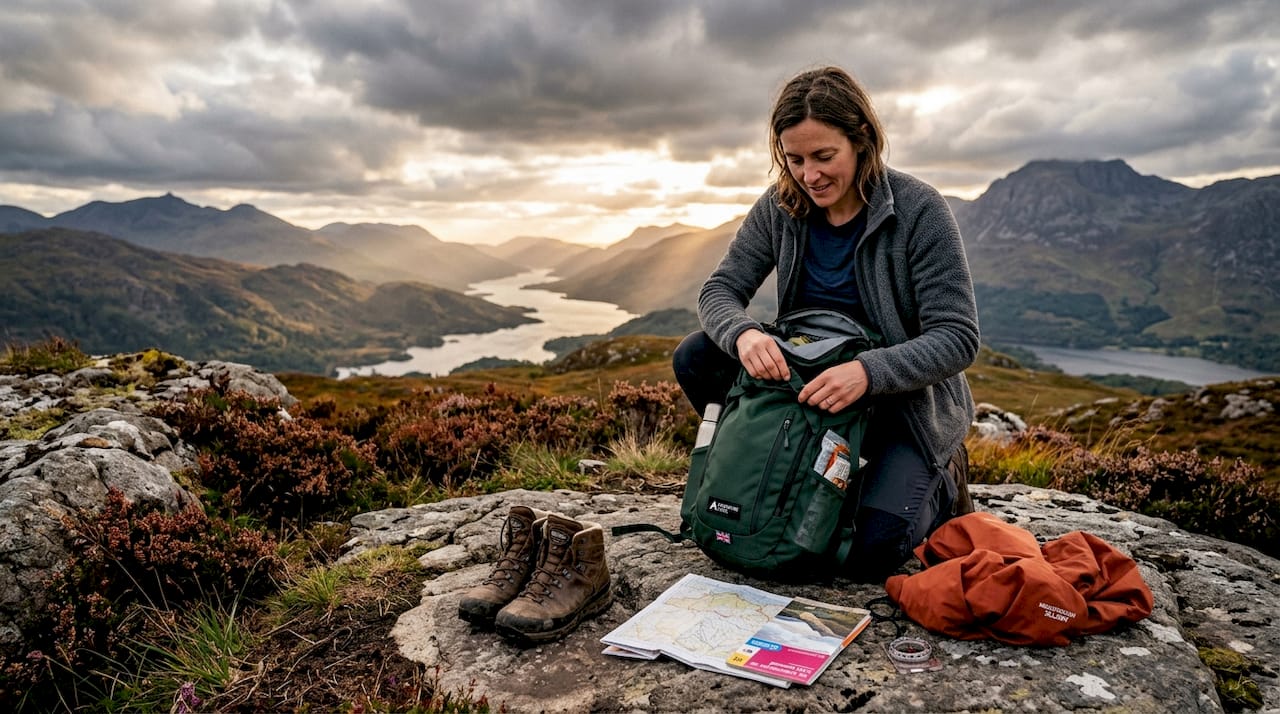
Clothing is your most critical system. The layering principle, base layer, mid layer, and outer shell, applies here more than anywhere in Britain. Your outer shell must be a fully seam-sealed waterproof jacket and over-trousers. Cotton kills in the hills because it holds moisture against your skin. Merino wool or synthetic fabrics dry fast and retain warmth when wet.
| Item | Why it matters |
|---|---|
| Waterproof jacket and over-trousers | Scottish weather changes rapidly; wet clothing accelerates heat loss |
| Sturdy waterproof boots (broken in) | Ankle support and grip on wet rock and bog are non-negotiable |
| OS Maps app or ViewRanger with downloaded maps | Digital backup to paper map and compass for route-finding |
| First aid kit with blister treatment | Remote terrain means you treat minor injuries yourself |
| Emergency bivvy bag and whistle | Lightweight insurance against an unplanned night out |
| Midge head net and Smidge repellent | Midges can make exposed camping genuinely miserable without protection |
Footwear deserves special attention. Sturdy waterproof boots with a Vibram-style sole must be broken in over several weeks before your trip. New boots on a 20-kilometre Highland day will produce blisters that end your adventure early. Walking poles and gaiters reduce fatigue significantly on rough ground and protect your lower legs from heather, bog, and wet grass.
Pro Tip: Pack your waterproofs in redundant layers by lining your pack with a dry bag and placing your sleeping kit or spare clothes inside a second dry bag within that. One wet day will teach you why this matters.
How to train for a highlands hike
Physical preparation is the most underestimated part of planning a Highland trip. Start training several months before your departure, building endurance and leg strength gradually rather than cramming fitness into the final weeks.
A structured approach works best:
- Build base endurance first: Walk three to four times per week, increasing distance by no more than 10% each week. Start on flat ground and progress to hilly terrain as your fitness improves.
- Add elevation: Seek out local hills or use a staircase at home. The Highlands involve sustained ascent, and flat walking does not prepare your cardiovascular system or your legs for it.
- Train with your loaded pack: Walking with a 10-kilogram pack changes your gait, your balance, and your fatigue profile. Do this from week four onwards so your body adapts before the trip.
- Strengthen your legs: Squats, lunges, step-ups, and single-leg deadlifts build the quad and glute strength you need for long descents on steep terrain. Descending is where most knee injuries occur.
- Practise navigation: Take your OS map and compass to a local park or woodland and practise taking bearings and following them. Navigation skills on remote Highland terrain are what separate a confident hiker from a lost one.
Mental preparation matters too. The Highlands can feel genuinely remote and isolating, particularly in poor weather. Knowing that you have the skills, kit, and fitness to handle adverse conditions transforms anxiety into confidence. Consider a navigation course with organisations like Glenmore Lodge or the Mountain Training Association before your first serious Highland outing.
Which weather tools should you use for Highland trip planning?
Valley weather forecasts do not reflect conditions on exposed ridges. A sunny forecast for Fort William tells you nothing about what is happening on the Aonach Eagach or the Grey Corries at 900 metres. Using mountain-specific forecasts is not a preference. It is a safety requirement.
The three tools that experienced Hill walkers use together:
- MWIS (Mountain Weather Information Service): Provides narrative forecasts specifically for Scottish mountain areas, including summit wind speed, cloud base, and visibility. Summit wind speed above 40mph makes exposed ridges dangerous and should trigger a route change to lower ground.
- Met Office Mountain Forecasts: Excellent for hourly timing decisions. If the forecast shows a weather window between 10am and 2pm, you plan your summit bid within that window.
- Yr.no: The Norwegian meteorological service produces reliable week-long trend forecasts for Scottish mountains. Use it to assess whether your planned trip dates look viable before you travel.
“The summit wind speed is the single most important number in any Highland weather forecast. A calm valley can mask a 60mph gale on the ridge above.” — OutdoorSCOT
Cross-referencing all three tools gives you a layered picture: the trend from Yr.no, the narrative from MWIS, and the hourly timing from the Met Office. No single forecast is infallible in Scottish mountain conditions.
What are your rights for wild camping in the Highlands?
Wild camping in Scotland is legal and protected. The Land Reform (Scotland) Act 2003 grants the right to camp on most open land, provided you exercise that right responsibly under the Scottish Outdoor Access Code.
Responsible wild camping in practice means:
- Leave No Trace: Carry out all waste, including food scraps and human waste where facilities are absent. Use a trowel and bury waste at least 30 metres from water sources.
- No open fires on bare ground: Use a lightweight stove instead. If you do light a fire, use a fire pan or existing fire rings and never cut living wood.
- Move on after two or three nights: Camping in one spot for extended periods causes ground damage and can conflict with land management.
- Respect sensitive areas: Stay away from enclosed farmland, private gardens, and areas with visible signs of land management such as deer stalking. The Scottish Outdoor Access Code provides full guidance on where access rights apply.
- Keep noise and light to a minimum: Other walkers and local communities share the same landscape.
For a broader understanding of how responsible travel principles apply to your Highland visit, Skyehighlandstours has published a guide on responsible travel in Scotland that covers access rights alongside wider environmental considerations.
Key takeaways
Successful preparation for a Highlands adventure requires terrain knowledge, mountain-specific weather tools, layered waterproof kit, structured physical training, and a clear understanding of Scotland’s access rights.
| Point | Details |
|---|---|
| Use mountain weather tools | Check MWIS, Met Office, and Yr.no together; never rely on valley forecasts alone. |
| Pack a layered waterproof system | A 30-litre weatherproof pack with redundant dry bags protects gear in persistent rain. |
| Train months in advance | Build endurance, leg strength, and navigation skills gradually before your trip. |
| Know your access rights | The Land Reform (Scotland) Act 2003 permits wild camping on most open land with responsible practice. |
| Carry emergency kit | An emergency bivvy bag, whistle, and first aid kit are non-negotiable on remote Highland terrain. |
What guiding in the Highlands has taught me about preparation
Most people who struggle on Highland trips do not fail because of fitness. They fail because of wet feet on day one, a dead phone with no paper map backup, or a summit attempt in 50mph wind because they trusted a valley forecast. I have seen all three.
The piece of advice I give every person heading into the hills for the first time is this: your waterproofing system needs to be redundant, not just adequate. One waterproof jacket is not enough if your pack soaks through and your spare base layer is wet before lunch. Hypothermia sets in when core temperature drops below 35°C, and in the Highlands, that can happen on a summer afternoon if you stop moving in wet clothing. The speed at which mild conditions become dangerous is the thing that surprises people most.
I also think the navigation conversation in most preparation guides is too cautious. People are told to practise with a map and compass, which is correct, but they are rarely told to practise in bad visibility. Take your compass out on a foggy morning locally and try to walk a bearing for 500 metres. That experience is worth more than any amount of clear-weather practice.
Hiking poles are the other underrated item. I resisted them for years. Now I would not cross a Highland bog without them. They reduce knee strain on descent, improve balance on wet rock, and give you a fighting chance at a river crossing without going in. If you are planning a personalised itinerary that includes serious hill days, add poles to your kit list before anything else.
— Alin
Let Skyehighlandstours handle the logistics for you
Preparation takes time, and not every Highland trip needs to be a solo exercise in self-sufficiency. Skyehighlandstours offers private guided Highland tours tailored to your fitness level, interests, and group size, covering destinations from the Isle of Skye and Loch Ness to the remote Northern Highlands.

Expert local guides handle route planning, weather monitoring, and logistics so you can focus entirely on the experience. Whether you want a full-day hill walk, a scenic drive through Glen Coe, or a whisky tour through Speyside, every itinerary is built around what you actually want from your trip. Explore the full range of Scottish Highlands tours and find the option that fits your adventure.
FAQ
What is the best time of year for a Highlands adventure?
May, June, and September offer the most reliable combination of long daylight hours, settled weather, and manageable midge activity. July and August are warmer but bring peak midge season and higher visitor numbers.
How fit do you need to be for a Highland hike?
You need a solid base of cardiovascular endurance and leg strength built over several months of progressive walking. West Highland Way daily distances average 11 miles, with some itineraries reaching 19 to 20 miles, which gives a useful benchmark for conditioning.
Do I need a guide for the Scottish Highlands?
A guide is not legally required, but navigation skills on remote terrain are critical on many Highland routes. First-time visitors benefit significantly from local expertise, particularly on pathless or technically demanding ground.
Is wild camping legal in Scotland?
Yes. The Land Reform (Scotland) Act 2003 grants the right to camp on most open land in Scotland, provided you follow the Scottish Outdoor Access Code and practise Leave No Trace principles.
What should I do if the weather turns bad on the hill?
Descend to lower ground immediately if summit wind speeds exceed 40mph or visibility drops to the point where navigation becomes unreliable. Carry an emergency bivvy bag and know your planned escape routes before you set out.
3 Comments